
« PREVIOUS ENTRY
The gender politics of being a cyborg
NEXT ENTRY »
Even better than the real thing
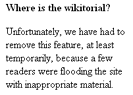
As you may have heard, the L.A. Times recently got enamored of wikis — those web sites where anyone can add, edit or delete text. So they launched a “wikitorial” section, which would publish op-ed pieces that readers could edit if they disagreed with the opinions. Tragedy struck: A mere two days after the section launched, the Times was forced to pull the entire section offline after users posted “inappropriate images” — including hardcore porn and the infamous image from goatse.cx (a massively prolapsed anus, which is precisely as revolting as it sounds).
What went wrong? After all, the inspiration here was Wikipedia, a user-generated wiki that has become the world’s largest, fastest-growing, and entirely free encyclopedia. Well, one obvious difference between Wikipedia and the wikitorials — as pundits like Jeff Jarvis have noted — is that wikis are designed to transmit hard, factual information, the content of which reasonable people can more or less agree upon. This isn’t the way opinion pieces work at all; the audience isn’t supposed to generally agree upon the content. It’s remarkable that the Times editors didn’t grok this basic fact, and put a halt to the entire ridiculous experiment before it even got started.
The irony is that the Times shouldn’t have been using wikis to gather opinions. It should have using them to gather facts. And this is where things get really interesting — because understood correctly, wikis ought to be an inspiration to American media and political culture.
Why? Because these days, many American journalists and politicians behave as though factual reality doesn’t exist. On the right, guys like Bill O’Reilly brazenly distort the news to support their arguments; on the left, pundits like Michael Moore play pretty fast and loose with reality themselves. The Bush administration reportedly regards itself as exempt from the “reality-based community” — that flourescently Orwellian phrase a senior Bush aide used to dismiss those who respect the idea of accurate facts. The biggest problem in political life right now is not differences of opinion — it’s that people believe entirely different versions of reality. The Bush government claims that no one has been tortured at Guantanamo Bay, that tax cuts have not caused much deficit damage, and that the Iraq insurgency is in its “last throes”. Critics say precisely the opposite is true.
This is what’s so singuarly refreshing about wikis: They prove that diverse people — many of whom hate each other’s guts — can actually agree on basic facts. Indeed, to post to Wikipedia, you must agree to behave in a way totally foreign to Washington and attack-dog media, and write in a “neutral point of view”. To make it clear precisely what neutrality means, Wikipedia founder Jim Wales has written a first-rate discussion of his philosophy:
Unbiased writing presents conflicting views without asserting them. Unbiased writing does not present only the most popular view; it does not assert the most popular view is correct after presenting all views; it does not assert that some sort of intermediate view among the different views is the correct one. [snip]
The prevailing Wikipedia understanding is that the neutral point of view is not a point of view at all; according to our understanding, when one writes neutrally, one is very careful not to state (or imply or insinuate or subtly massage the reader into believing) that any particular view at all is correct.
Another point bears elaboration as well. Writing unbiasedly can be conceived very well as representing disputes, characterizing them, rather than engaging in them. One can think of unbiased writing as the cold, fair, analytical description of debates. Of course, one might well doubt that this can be done at all without somehow subtly implying or insinuating that one position is correct. But experienced academics, polemical writers, and rhetoricians are well-attuned to bias, both their own and others’, so that they can usually spot a description of a debate that tends to favor one side. If they so choose, with some creativity, they can usually remove that bias.
Go read this essay in full; it’s a remarkable document. Wales’ commitment to neutrality is so smart and principled that it feels otherworldly — like some mathematically inverse image of our real-life Bizarro planet of square-tired pundit logic and Washingtonian mendacity.
Granted, Wikipedia’s pursuit of neutrality sometimes fails; during the last presidential election, Wales was forced to “freeze” the entries on George W. Bush and John Kerry, because they were being so regularly defaced. But in general, Wikipedia stands as a cultural beacon, proving not only that an impartial presentation of facts is possible — but that the public wants it, and is willing to help work on it.
I'm Clive Thompson, the author of Smarter Than You Think: How Technology is Changing Our Minds for the Better (Penguin Press). You can order the book now at Amazon, Barnes and Noble, Powells, Indiebound, or through your local bookstore! I'm also a contributing writer for the New York Times Magazine and a columnist for Wired magazine. Email is here or ping me via the antiquated form of AOL IM (pomeranian99).

ECHO
Erik Weissengruber
Vespaboy
Terri Senft
Tom Igoe
El Rey Del Art
Morgan Noel
Maura Johnston
Cori Eckert
Heather Gold
Andrew Hearst
Chris Allbritton
Bret Dawson
Michele Tepper
Sharyn November
Gail Jaitin
Barnaby Marshall
Frankly, I'd Rather Not
The Shifted Librarian
Ryan Bigge
Nick Denton
Howard Sherman's Nuggets
Serial Deviant
Ellen McDermott
Jeff Liu
Marc Kelsey
Chris Shieh
Iron Monkey
Diversions
Rob Toole
Donut Rock City
Ross Judson
Idle Words
J-Walk Blog
The Antic Muse
Tribblescape
Little Things
Jeff Heer
Abstract Dynamics
Snark Market
Plastic Bag
Sensory Impact
Incoming Signals
MemeFirst
MemoryCard
Majikthise
Ludonauts
Boing Boing
Slashdot
Atrios
Smart Mobs
Plastic
Ludology.org
The Feature
Gizmodo
game girl
Mindjack
Techdirt Wireless News
Corante Gaming blog
Corante Social Software blog
ECHO
SciTech Daily
Arts and Letters Daily
Textually.org
BlogPulse
Robots.net
Alan Reiter's Wireless Data Weblog
Brad DeLong
Viral Marketing Blog
Gameblogs
Slashdot Games

