
« PREVIOUS ENTRY
Shuttle produces a “Prandtl-Glauert” condensation cloud
NEXT ENTRY »
Them’s good eatin’
With all the talk of “intelligent agents”, mail “daemons”, software setup “wizards” and the like, the high-tech age is riddled with the language of magic. It’s no wonder that so many computer programmers spring from the same communities obsessed with Dungeons and Dragons or The Lord of the Rings, because software is, in essence, precisely like magic: Words that “do” things. Nor is this merely part of coder-geek life. Today’s average computer user spends an inordinate amount of time memorizing and reciting passwords — their own little magical “Open Sesame” phrases that unlock the eldritch realms of email, newspaper sites, and Ebay accounts. And when you accidentally forget a password, you can wind up feeling rather like Gandalf before the locked Doors of Durin, unable to remember which incantation opens them. In a world of software, we live surrounded by weird and invisible forces.
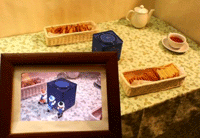
Now some Japanese artists have produced “Kobitos” — a hilarious little project that touches on precisely this dynamic. They wired up a kitchen table so that a tea caddy can be dragged around by an unseen magnet beneath the wood. Then they wrote software in which little gnomes — Kobitos — “push” the caddy around. The only way to see the gnomes is to look through a nearby LCD screen that shows a video of the table with the Kobitos digitally superimposed.
There’s a video here showing people playing with the system. It’s quite trippy: When you look at the table, you see the tea caddy scooting mysteriously across the surface; then when you look in the screen you can see that the Kobitos are pushing it. The system’s haptics work both ways, too: When the user pushes back on the caddy, it bonks the Kobitos out of the way like little tenpins. As the artists write:
Kobitos can be good playmates, because they are invisible sometimes and visible at other times. When they are invisible, and they move something in the real world, they generate a sense of wonder. Interaction with such a creature could be a new type of entertainment.
(Thanks to Cook Design for this one!)
I'm Clive Thompson, the author of Smarter Than You Think: How Technology is Changing Our Minds for the Better (Penguin Press). You can order the book now at Amazon, Barnes and Noble, Powells, Indiebound, or through your local bookstore! I'm also a contributing writer for the New York Times Magazine and a columnist for Wired magazine. Email is here or ping me via the antiquated form of AOL IM (pomeranian99).
ECHO
Erik Weissengruber
Vespaboy
Terri Senft
Tom Igoe
El Rey Del Art
Morgan Noel
Maura Johnston
Cori Eckert
Heather Gold
Andrew Hearst
Chris Allbritton
Bret Dawson
Michele Tepper
Sharyn November
Gail Jaitin
Barnaby Marshall
Frankly, I'd Rather Not
The Shifted Librarian
Ryan Bigge
Nick Denton
Howard Sherman's Nuggets
Serial Deviant
Ellen McDermott
Jeff Liu
Marc Kelsey
Chris Shieh
Iron Monkey
Diversions
Rob Toole
Donut Rock City
Ross Judson
Idle Words
J-Walk Blog
The Antic Muse
Tribblescape
Little Things
Jeff Heer
Abstract Dynamics
Snark Market
Plastic Bag
Sensory Impact
Incoming Signals
MemeFirst
MemoryCard
Majikthise
Ludonauts
Boing Boing
Slashdot
Atrios
Smart Mobs
Plastic
Ludology.org
The Feature
Gizmodo
game girl
Mindjack
Techdirt Wireless News
Corante Gaming blog
Corante Social Software blog
ECHO
SciTech Daily
Arts and Letters Daily
Textually.org
BlogPulse
Robots.net
Alan Reiter's Wireless Data Weblog
Brad DeLong
Viral Marketing Blog
Gameblogs
Slashdot Games

