
« PREVIOUS ENTRY
A cat’s-eye view of the world
NEXT ENTRY »
A straw that purifies
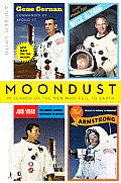
What do you do with the rest of your life after you’ve been to the moon? This is the intriguing central question in Moondust, a book that tracks the later lives of the Apollo spacemen — and which the The New York Times asked me to review. It was published today, and the review is online here; I’m also archived a permanent copy below!
Down to Earth
by Clive ThompsonAlan Bean rode the Apollo 12 mission all the way to the moon, and on the way back he made a promise to himself: “I’m going to live my life the way I want to.” So he resigned from NASA, holed up in a tiny condo and became an oil painter. In the decades since, the only thing he has ever painted has been scenes from his celestial journey: the hyperreal sheen of sunlight on a space helmet, the lunar orbiter slicing through the void. Physically, Bean was back on earth — but some part of him clearly never came home.
Can you blame him? Only 12 people in history have ever stood on the moon. They were treated like heroes upon departure, rock stars upon return; they’ve even been credited with helping end the cold war. NASA spent billions to give them the biggest rush any explorer has ever felt. So you can begin to appreciate the peculiarly cosmic dimensions of their eventual midlife crises: after you’ve been to the moon, whatever do you do with the rest of your life?
This is the question that Andrew Smith — a British journalist with a predilection for gonzo prose — tries to answer in “Moondust: In Search of the Men Who Fell to Earth.” He hunts down the nine surviving moonwalkers and finds them all still grappling with the experience, in oddly divergent ways. While Bean turned to art, some embraced spirituality. Indeed, when Apollo 14’s Edgar Mitchell touched the lunar soil, he experienced a “flash of understanding” that the universe was a huge matrix of information, and was promptly transformed into a new-age guru who to this day holds conferences where attendees discuss U.F.O.’s and biofeedback. In contrast, John Young of Apollo 16 became a NASA lifer, the pilot of the first Space Shuttle mission and an über-nerd so socially maladroit that he spends his entire interview with Smith speaking directly to a nearby wall. Some became beer-company executives; some became teachers; one, an alcoholic. And wherever they go, the astronauts face a public that still hungers, like Smith, for a profound explanation of What It’s Like Up There.
Smith never really gets a clear answer. The astronauts are witty, but not, by their own admission, terribly cogent philosophers. (“You feel inadequate that you can’t give people the answer they want,” Gene Cernan says.) Yet Smith’s book succeeds in spite of this, because he bungee-cords together so many intriguing digressions into Apollo minutiae, which are more poetically revealing than the loftiest of speeches. He discovers, for example, that the arch and reserved Neil Armstrong brought along a tape of eerie theremin music to play in the lunar capsule. Another astronaut notes that while the moon is gray, “until you’ve been there, you have no idea how many shades of gray there are.”
Even more gripping are Smith’s explorations of just how dangerous those voyages were. Virtually every one narrowly avoided catastrophe. During a Gemini spacewalk, Richard Gordon became so exhausted that his partner almost cut him loose to die. A Gemini capsule went into such a rapid spin it nearly “grayed out” the astronauts. And when Apollo 11 finally descended to the lunar surface, the onboard computer became so overloaded that the master alarm began shrieking, and Armstrong had to perform a hair-raising manual-stick landing that nearly crashed his lunar module into a crater.
Open up a paper these days, and you’ll find critics slamming NASA for having a “broken safety culture.” Sure, but as Smith documents, spaceflight is inherently dangerous, and the United States of yore — the one that actually sent people into deep space, instead of financing a go-nowhere shuttle that runs pointless laps around the Earth — was willing to tolerate levels of risk that today would be considered, pun intended, complete lunacy. Some of the astronauts initially gave the first moon landing a mere 50/50 chance of success. For space buffs like me, Smith’s book is a bit depressing, because it’s like reading about some long-lost mythical age of daring.
Indeed, it forces you to wonder anew: Why exactly was America so desperate to shoot the moon, anyway? Historians typically explain Apollo as a simple matter of beating the Soviets and proving American technological superiority. But Smith argues, with some persuasiveness, that the moon shot was not nearly so rational or calculated. It was less a feat of exploration than an awesome piece of public theater, a gesture “as primitive as song.” The astronaut Joseph Allen once claimed that the most important part of going to the moon wasn’t actually about the moon. It was the act of looking backward at the Earth — a $24 billion moment of self-reflection, when we finally realized just how tiny our world was. The moment “that nobody foresaw: a unique opportunity to look at ourselves,” Smith writes. “How madly, perfectly human.”
Clive Thompson is a contributing writer for The New York Times Magazine.
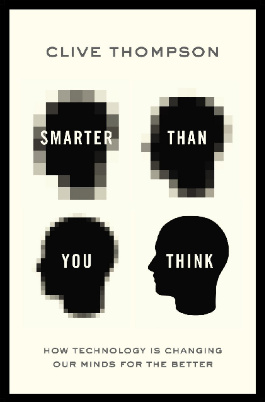
I'm Clive Thompson, the author of Smarter Than You Think: How Technology is Changing Our Minds for the Better (Penguin Press). You can order the book now at Amazon, Barnes and Noble, Powells, Indiebound, or through your local bookstore! I'm also a contributing writer for the New York Times Magazine and a columnist for Wired magazine. Email is here or ping me via the antiquated form of AOL IM (pomeranian99).
ECHO
Erik Weissengruber
Vespaboy
Terri Senft
Tom Igoe
El Rey Del Art
Morgan Noel
Maura Johnston
Cori Eckert
Heather Gold
Andrew Hearst
Chris Allbritton
Bret Dawson
Michele Tepper
Sharyn November
Gail Jaitin
Barnaby Marshall
Frankly, I'd Rather Not
The Shifted Librarian
Ryan Bigge
Nick Denton
Howard Sherman's Nuggets
Serial Deviant
Ellen McDermott
Jeff Liu
Marc Kelsey
Chris Shieh
Iron Monkey
Diversions
Rob Toole
Donut Rock City
Ross Judson
Idle Words
J-Walk Blog
The Antic Muse
Tribblescape
Little Things
Jeff Heer
Abstract Dynamics
Snark Market
Plastic Bag
Sensory Impact
Incoming Signals
MemeFirst
MemoryCard
Majikthise
Ludonauts
Boing Boing
Slashdot
Atrios
Smart Mobs
Plastic
Ludology.org
The Feature
Gizmodo
game girl
Mindjack
Techdirt Wireless News
Corante Gaming blog
Corante Social Software blog
ECHO
SciTech Daily
Arts and Letters Daily
Textually.org
BlogPulse
Robots.net
Alan Reiter's Wireless Data Weblog
Brad DeLong
Viral Marketing Blog
Gameblogs
Slashdot Games

