
NEXT ENTRY »
Left uppercut to black knight
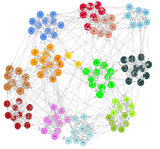
I don’t know crap about football. But I do recognize interesting algorithms when I see them, and this is some of the finest football-related math I’ve seen in some time: Two researchers at the University of Michigan have used network theory to design an alternative ranking system for college football.
Currently, inter-university football competition is a strangely balkanized affair. Unlike as with baseball or basketball, there is no single ranking for all teams; they’re broken into conferences, one of which is selected each year to be the “bowl” championship. But the problem here is that teams don’t get a chance to be evenly measured against one another. As the authors note in their paper (PDF here):
One often hears sports fans arguments of this form: “Although my team A didn’t play your team C this season, it did beat B who in turn beat C. Therefore A is better than C and would have won had they played a game.” (See Fig. 1.) In fact, this argument is usually articulated with less clarity than this and more beer, but nonetheless we feel that the general line of reasoning has merit.
So they essentially wrote a computer algorithm that would crunch game stats for the last couple of years and rank the teams according to precisely that idea: If A beats B and B beats C, A is thus superior to C, even if they never play. When they checked their results against the actual team results, they i) produced the funky graphic seen above, but more importantly, ii) found that their technique did a better job of predicting actual victors than the annual poll currently conducted by the Associated Press.
It’s Miller Time.
(Thanks to Samuel Arbesman for this one!)
I'm Clive Thompson, the author of Smarter Than You Think: How Technology is Changing Our Minds for the Better (Penguin Press). You can order the book now at Amazon, Barnes and Noble, Powells, Indiebound, or through your local bookstore! I'm also a contributing writer for the New York Times Magazine and a columnist for Wired magazine. Email is here or ping me via the antiquated form of AOL IM (pomeranian99).
ECHO
Erik Weissengruber
Vespaboy
Terri Senft
Tom Igoe
El Rey Del Art
Morgan Noel
Maura Johnston
Cori Eckert
Heather Gold
Andrew Hearst
Chris Allbritton
Bret Dawson
Michele Tepper
Sharyn November
Gail Jaitin
Barnaby Marshall
Frankly, I'd Rather Not
The Shifted Librarian
Ryan Bigge
Nick Denton
Howard Sherman's Nuggets
Serial Deviant
Ellen McDermott
Jeff Liu
Marc Kelsey
Chris Shieh
Iron Monkey
Diversions
Rob Toole
Donut Rock City
Ross Judson
Idle Words
J-Walk Blog
The Antic Muse
Tribblescape
Little Things
Jeff Heer
Abstract Dynamics
Snark Market
Plastic Bag
Sensory Impact
Incoming Signals
MemeFirst
MemoryCard
Majikthise
Ludonauts
Boing Boing
Slashdot
Atrios
Smart Mobs
Plastic
Ludology.org
The Feature
Gizmodo
game girl
Mindjack
Techdirt Wireless News
Corante Gaming blog
Corante Social Software blog
ECHO
SciTech Daily
Arts and Letters Daily
Textually.org
BlogPulse
Robots.net
Alan Reiter's Wireless Data Weblog
Brad DeLong
Viral Marketing Blog
Gameblogs
Slashdot Games

