
« PREVIOUS ENTRY
The mouse that roared
NEXT ENTRY »
Like, who can even pronounce “okadaic acid”?
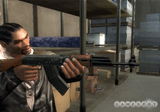
Wired News has published my latest video-game column — and this one is about why the most violent and brutal activities in games are usually committed by the forces of “order”: Police officers, soldiers, and marines. The column was inspired by my recent playing of True Crime: New York City — a screenshot is above — and the column is online here. A copy is archived permanently below!
The Bad Lieutenant
by Clive ThompsonWhen I opened my copy of True Crime: New York City, a white piece of paper fell out and fluttered to the ground. It was a disclaimer, hastily printed and stuffed into the case: “This game is not approved, endorsed or connected in any way to the New York City Police Department … The game is fictional and does not represent the views, policies or practices of the NYPD.”
It’s no wonder New York’s real-life cops were worried. In True Crime, you play as Marcus Reed, a reformed street thug who becomes a cop — and quickly discovers that the police force is a carnival of sleaze and corruption. As you wander the city on patrol, you’re allowed — hell, you’re encouraged — to break the law and enrich yourself.
When I busted a perp who was holding up citizens in Central Park, I discovered he was carrying illegal gun parts. I could have turned them in — but instead I nicked his goods, turned him loose, then sold the stuff at a pawn shop to buy an even more badass weapon.
Pretty soon I’d descended into a twisted evil-cop rampage. I jacked cars from innocent civilians, pistol-whipped perps within an inch of their lives and planted evidence on second-rate criminals so I could pretend to have made a big bust.
Then one day, as I was running over an innocent pedestrian during a car chase, I had an epiphany. Family-values types often deplore the brutality of today’s action titles. But have they ever closely examined who’s committing this carnage?
Nine times out of 10, when you’re blowing people’s chests open with hollow-point bullets, you aren’t playing as a terrorist or criminal. No, you’re playing as a cop, a soldier or a special-forces agent — a member of society’s forces of law and order.
Consider our gaming history. In Doom, the game that began it all, you were a Marine. Then came a ceaseless parade of patriotic, heart-in-hand World War II games, in which you merrily blow the skulls off Japanese and German soldiers under the explicit authority of the U.S. of A. Yet anti-gaming critics didn’t really explode with indignation until Grand Theft Auto 3 came along — the first massively popular modern game where the tables turned, and you finally played as a cop-killing thug.
Why weren’t these detractors equally up in arms about, say, the Rainbow Six series? Because games lay bare the conservative logic that governs brutal acts. Violence — even horrible, war-crimes-level stuff — is perfectly fine as long as you commit it under the aegis of the state. If you’re fighting creepy Arabs and urban criminals, go ahead — dual-wield those Uzis, equip your frag grenades and let fly. Nobody will get much upset.
Indeed, conservatives have long been fans of the Dirty Harry beat-down. Consider what Bill Clark — a former NYPD office who consulted on True Crime: New York City — said about the game in a recent news report: “Marcus is the type of cop we all wished we could be. He doesn’t need warrants to burst into buildings, search cars, or people. He doesn’t have to deal with politics or property damage or paperwork.”
These days, Dick Cheney is fiercely lobbying to grant the government virtually the same powers. And indeed, Congress is set to re-up the Patriot Act, preserving and extending the CIA’s special, magnified powers to detain and wiretap suspects — their “extra life” upgrades, as it were. If art imitates life, maybe it’s no wonder that we’ve seen a rise in games that blur the lines between criminals and state authority.
The irony is that, in reality, New York’s actual police have moved in the opposite direction. They’ve become more successful at keeping the peace by being less bloodthirsty. In the ’90s, they drastically reduced the city’s crime rate by “community policing” and beat walking, the sort of quiet, low-key work that makes a city genuinely secure.
Maybe our power fantasies are best kept where they belong — on the console.
(A tip of the hat to J.C. Herz’s Joystick Nation, which first introduced me to this line of thinking.)
I'm Clive Thompson, the author of Smarter Than You Think: How Technology is Changing Our Minds for the Better (Penguin Press). You can order the book now at Amazon, Barnes and Noble, Powells, Indiebound, or through your local bookstore! I'm also a contributing writer for the New York Times Magazine and a columnist for Wired magazine. Email is here or ping me via the antiquated form of AOL IM (pomeranian99).
ECHO
Erik Weissengruber
Vespaboy
Terri Senft
Tom Igoe
El Rey Del Art
Morgan Noel
Maura Johnston
Cori Eckert
Heather Gold
Andrew Hearst
Chris Allbritton
Bret Dawson
Michele Tepper
Sharyn November
Gail Jaitin
Barnaby Marshall
Frankly, I'd Rather Not
The Shifted Librarian
Ryan Bigge
Nick Denton
Howard Sherman's Nuggets
Serial Deviant
Ellen McDermott
Jeff Liu
Marc Kelsey
Chris Shieh
Iron Monkey
Diversions
Rob Toole
Donut Rock City
Ross Judson
Idle Words
J-Walk Blog
The Antic Muse
Tribblescape
Little Things
Jeff Heer
Abstract Dynamics
Snark Market
Plastic Bag
Sensory Impact
Incoming Signals
MemeFirst
MemoryCard
Majikthise
Ludonauts
Boing Boing
Slashdot
Atrios
Smart Mobs
Plastic
Ludology.org
The Feature
Gizmodo
game girl
Mindjack
Techdirt Wireless News
Corante Gaming blog
Corante Social Software blog
ECHO
SciTech Daily
Arts and Letters Daily
Textually.org
BlogPulse
Robots.net
Alan Reiter's Wireless Data Weblog
Brad DeLong
Viral Marketing Blog
Gameblogs
Slashdot Games

