
« PREVIOUS ENTRY
Virtual avatar, realpolitik
NEXT ENTRY »
Does Africa really need the $100 laptop?
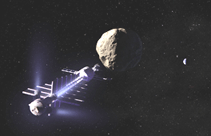
If an asteroid were on a collision course with the Earth, how in god’s name would we deflect it? Sci-fi mavens have meditated on this question for years, including in the hilariously awful 1998 movie Armageddon, in which NASA sent up the Shuttle to blast a deadly asteroid out of place. (This was presumably before we realized the Shuttles are so brittle that you can permanently cripple them with pieces of foam.) When I visited NASA a couple of years ago, some scientists showed me a demo of a laser system that would focus heat on an approaching asteroid to shift it into a new orbit.
But now comes an even cooler idea: A gravity tug. A new group of NASA wonks proposes sending a 20-ton craft out to meet with an oncoming asteroid, and have the craft’s gravity field gently nudge the threat out of harm’s way. The brilliant part of this concept is that it doesn’t require actually landing on or physically interacting with the asteroid — which is crucial, because those physics are hellishly complex, not least because, as we’re learning, many asteroids are actually loose clumpings of rocks that could fly apart if a probe tried to land on them. Then we’d have a huge flotilla of multi-ton celestial popcorn flying at the Earth’s atmosphere, and who wants that?
What’s the actual danger of a near Earth asteroid (NEA) hitting us? There are an estimated 200,000 to 400,000 objects that are about 100 meters in size, and about 1,000 objects about 1 km. in size. Scientists have analyzed about 65% of them and concluded that they will not hit the Earth within 100 years; the other 35%, though, are still up for grabs. Even scarier are comets, which move much faster. A new comet doesn’t become visible until it hits Jupiter’s orbit, and from there it’s only a few months before it arrives at Earth. How bad would an NEA strike be? Well, one of the little ones — 100 meters or so — would produce about 80 megatons of damage, a pretty nasty, but localized, blow. One of the 1 km beasts? As the scientists describe it on their site:
A 1 km. NEA striking the Earth would penetrate the atmosphere as if it were not there and burrow into the solid Earth exploding with the energy of 70,000 megatons of TNT. An explosion of this magnitude threatens life around the planet. If it lands in the ocean (four times as likely as an impact on land) it will generally penetrate to the bottom of the sea and, while following a slightly different scenario of destruction, will similarly threaten life globally. The frequency with which one of these giants collides with the Earth is approximately once every million years.
The consortium proposes testing a prototype gravity tug on a harmless asteroid by 2015, which to me seems like a hell of a good idea. So far, NASA seems relatively keen. If you want to read more articles on this — as well as read their correspondence with NASA heads — check out their excellent archive of documents here.
(Thanks to Plastic for this one!)
I'm Clive Thompson, the author of Smarter Than You Think: How Technology is Changing Our Minds for the Better (Penguin Press). You can order the book now at Amazon, Barnes and Noble, Powells, Indiebound, or through your local bookstore! I'm also a contributing writer for the New York Times Magazine and a columnist for Wired magazine. Email is here or ping me via the antiquated form of AOL IM (pomeranian99).

ECHO
Erik Weissengruber
Vespaboy
Terri Senft
Tom Igoe
El Rey Del Art
Morgan Noel
Maura Johnston
Cori Eckert
Heather Gold
Andrew Hearst
Chris Allbritton
Bret Dawson
Michele Tepper
Sharyn November
Gail Jaitin
Barnaby Marshall
Frankly, I'd Rather Not
The Shifted Librarian
Ryan Bigge
Nick Denton
Howard Sherman's Nuggets
Serial Deviant
Ellen McDermott
Jeff Liu
Marc Kelsey
Chris Shieh
Iron Monkey
Diversions
Rob Toole
Donut Rock City
Ross Judson
Idle Words
J-Walk Blog
The Antic Muse
Tribblescape
Little Things
Jeff Heer
Abstract Dynamics
Snark Market
Plastic Bag
Sensory Impact
Incoming Signals
MemeFirst
MemoryCard
Majikthise
Ludonauts
Boing Boing
Slashdot
Atrios
Smart Mobs
Plastic
Ludology.org
The Feature
Gizmodo
game girl
Mindjack
Techdirt Wireless News
Corante Gaming blog
Corante Social Software blog
ECHO
SciTech Daily
Arts and Letters Daily
Textually.org
BlogPulse
Robots.net
Alan Reiter's Wireless Data Weblog
Brad DeLong
Viral Marketing Blog
Gameblogs
Slashdot Games

