
« PREVIOUS ENTRY
I’ve got an Atom feed now
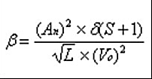
Most of us have, at some sodden point in our lives, learned the hazards of “beer goggles”. Indeed, research shows that 68% of men or women who hand out a phone number at a bar regret it the next day — after realizing the hottie they’d met was, in fact, not.
But now a neuroscientist has actually worked out a formula describing the precise interaction of booze, lighting, and distance that produces this dread syndrome. In Nathan Ephron’s equation, which is above, “Β” stands for the intensity of one’s beer goggle effect, and it is calculated by these variables:
An = number of units of alcohol consumed
S = smokiness of the room (graded from 0-10, where 0 clear air; 10 extremely smoky)
L = luminance of ‘person of interest’ (candelas per square metre; typically 1 pitch black; 150 as seen in normal room lighting)
Vo = Snellen visual acuity (6/6 normal; 6/12 just meets driving standard)
d = distance from ‘person of interest’ (metres; 0.5 to 3 metres)
The upshot is that the effect isn’t just about drinking: It’s about visual ability. A dance floor lit by black-lit bulbs would produce an epidemiological surge of beer goggles. As Ephron notes, “someone with normal vision, who has consumed five pints of beer and views a person 1.5 metres away in a fairly smoky and poorly lit room, will score 55, which means they would suffer from a moderate beer goggle effect.”
Presumably this stuff is a bit hard to calculate while you’re smashed beyond all recognition, but as Barbie said, math class is tough.
By the way, this stuff was funded by the contact lens firm Bausch & Lomb.
(Note: In a bit of hilarious mistyping, I inititally wrote this post as “beer googles”. And I didn’t mistype it that way once — I typed it wrong the whole way through! What would one call the digital age version of the Freudian slip? A Weinerian slip? Thanks to my brother-in-law Rob for pointing out the error!)
I'm Clive Thompson, the author of Smarter Than You Think: How Technology is Changing Our Minds for the Better (Penguin Press). You can order the book now at Amazon, Barnes and Noble, Powells, Indiebound, or through your local bookstore! I'm also a contributing writer for the New York Times Magazine and a columnist for Wired magazine. Email is here or ping me via the antiquated form of AOL IM (pomeranian99).
ECHO
Erik Weissengruber
Vespaboy
Terri Senft
Tom Igoe
El Rey Del Art
Morgan Noel
Maura Johnston
Cori Eckert
Heather Gold
Andrew Hearst
Chris Allbritton
Bret Dawson
Michele Tepper
Sharyn November
Gail Jaitin
Barnaby Marshall
Frankly, I'd Rather Not
The Shifted Librarian
Ryan Bigge
Nick Denton
Howard Sherman's Nuggets
Serial Deviant
Ellen McDermott
Jeff Liu
Marc Kelsey
Chris Shieh
Iron Monkey
Diversions
Rob Toole
Donut Rock City
Ross Judson
Idle Words
J-Walk Blog
The Antic Muse
Tribblescape
Little Things
Jeff Heer
Abstract Dynamics
Snark Market
Plastic Bag
Sensory Impact
Incoming Signals
MemeFirst
MemoryCard
Majikthise
Ludonauts
Boing Boing
Slashdot
Atrios
Smart Mobs
Plastic
Ludology.org
The Feature
Gizmodo
game girl
Mindjack
Techdirt Wireless News
Corante Gaming blog
Corante Social Software blog
ECHO
SciTech Daily
Arts and Letters Daily
Textually.org
BlogPulse
Robots.net
Alan Reiter's Wireless Data Weblog
Brad DeLong
Viral Marketing Blog
Gameblogs
Slashdot Games

