FREE counter and Web statistics from sitetracker.com
collision detection
content | discontent
send me yours
January 22, 2006
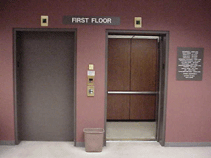
A new elevator algorithm


A few months ago, I blogged about a neat elevator hack that allows you to commandeer an elevator and go directly to your floor, without waiting for others. Weeks later, Nick Paumgartner at the New Yorker actually wrote an entire column where he attempted to use the hack, and recorded his rather mixed results.

Now Fujitec America Inc. -- an elevator company whose tagline is "The Art and Science of Moving People" --has developed a technique that is both more ethical and more mathematically interesting: An algorithm that eases elevator bottlenecks by intelligently grouping passengers based on their destination. It works like this: When you arrive at one of these stylin' new elevators, you enter your destination floor in a kiosk. Then a message appears telling you which car to get on. As a story in The Enquirer reports:

In time, the new Fujitec system becomes even more efficient at grouping passengers by learning elevator-use patterns, said Rennekamp, whose team of engineers pioneered the software for the system. It does this by considering historical information to learn traffic variances in the building.

"The predictive logic in our software acts like neurons in our body, parking (the elevators) at certain floors, knowing where the demand might be at certain times."

Here's the interesting thing: Fujitec claims that when you route passengers into groups of people with similar destinations, two things happen: i) You wind up waiting longer to actually enter the elevator, but ii) the actual trip in the elevator is so fast that it more than recoups the extended wait, making the total trip faster.

This makes me suspect that people will actually dislike the experience -- because they'll focus on part i) too much. As psychologists have long shown, people tend to dislike systems that leave them feeling out of control, even if it's ultimately better for them. (The converse is also true: People will tolerate situations of great discomfort if they feel they have some control over it, as with studies of people's reactions to loud noises.) Since part i) of this new algorithms requires people to sit around waiting even longer than they normally would for an elevator, I'd bet users would rebel: Even if system gets them to their destination more quickly, it'll feel like it's taking longer, and they'll hate it.


(Thanks to Boing Boing for this one!)

Posted by Clive Thompson at January 22, 2006 02:58 PM

Trackback Pings

TrackBack URL for this entry: http://www.collisiondetection.net/mt3/mt-tb.cgi/1415

Comments

This is reminiscent of the tale I heard about baggage claim, many moons ago: that an airport got better ratings for baggage claim because it made passengers *walk longer* to the claim area. This reduced the perceived wait time for the bags, even though the actual plane-to-carousel time didn't change. There's a lot of psychology involved in how you make people wait for service.

Posted by: pjm [TypeKey Profile Page] at January 24, 2006 12:27 PM

Aha! Yes, that makes perfect sense -- very cool anecdote.

Posted by: Clive [TypeKey Profile Page] at January 24, 2006 3:23 PM

Blake Ross of Firefox said he had to use some kind of fancy elevator. He hated it, as you predicted. http://blakeross.com/index.php?p=97

Posted by: Carl [TypeKey Profile Page] at January 24, 2006 5:33 PM

reminds me of the lifts in the hitchhiker's guide..

more seriously, I once heard a talk about a neat AI system that was devised to optimise plane routing and scheduling in a busy airport. It did a grand job but was dumped. Reason: the algorithm was too complex, and people couldn't understand what was going on. No volume of statistical and financial evidence could convince the tower cheifs to trust it.

As for the importance of the sense of control, see Adaptive comfort. You can actualy save a lot of money and energy by simply putting control into your equations.

Oh, and I heard that the location of mirrors has a significant effect. People feel time goes by more quickly when there's a mirror to look at. Apparently, we never tire from admiring our own face.

Posted by: yish [TypeKey Profile Page] at January 24, 2006 6:01 PM

I read an good article on queuing theory a little while back--I suspect it's http://www.newscientist.com/article/mg15520914.800.html but unfortunately it's hidden behind a for-pay wall at the moment. As well as mentioning the airport carousel example, I think it talked about the optimum length of queue for amusement park rides. (If they're too short people think the ride isn't any good.)


I also suspect the lack of control and transparency is going to annoy people, especially if they see elevators go directly past their floor. (Does each waiting bay show the floor each escalator is on? Or does it give a waiting time instead? i.e. "Next escalator in 2 minutes.") What happens if you hit the wrong floor button, and remember only when you're inside the elevator?

Posted by: Michael S. [TypeKey Profile Page] at January 24, 2006 6:52 PM

"As psychologists have long shown, people tend to dislike systems that leave them feeling out of control, even if it's ultimately better for them."

That's why our national goal is to have LA style traffic everywhere (1 hour for 6 miles, 24x7) rather than support mass transit.

Because its better to have to sit in traffic than wait for a subway. :(

Posted by: dtc [TypeKey Profile Page] at January 24, 2006 9:25 PM

The Marriott Marquis in New York actually has elevators that work nearly identical to this. I know from experience that while people are standing around waiting to get on an elevator, all they do is complain about how slow it is.

Google it, and you'll see how many people hate it, even though I'm sure it is more efficient.

Who ever said humans were rational?

Posted by: Steve E. [TypeKey Profile Page] at January 24, 2006 9:52 PM

Excellent stuff here. Carl, that posting of Blake Ross' is fantastic -- yes, he was experiencing a system precisely like this, and yes, he loathed it. Steve, the Marriot Marquis is the very hotel Blake visited!

Yish, I hadn't heard of the concept of adaptive comfort -- very cool. That bit about mirrors is hilarious!

dtc, alas, this is precisely true.

Posted by: Clive [TypeKey Profile Page] at January 24, 2006 9:58 PM

2 things. At work, being mildly claustrophobic, I often make the waiting longer for a lift that's going to go faster trade off, but I've noticed that my colleagues never do even though I often arrive at our floor before them by taking a later less crowded lift.

Also, from my university days I seem to remmember that the simplest disk access algorithms are very similar to elevator algorithms with each elevator being a drive head, and the floors being the data's location on the disk.

Posted by: tomp [TypeKey Profile Page] at January 25, 2006 1:13 PM

1180 6th avenue in midtown manhattan has just such an elevator. You enter your destination floor on a lobby keypad and are then directed to the appropriate elevator car. There are no floor number buttons in the car. I always felt slightly kidnapped riding in this elevator.

Posted by: fluffmonkey [TypeKey Profile Page] at January 25, 2006 8:55 PM

Yeah...
I took just such an elevator in a building in NYC at Times Square. I was wondering why they didn't do floor selection the "normal" way.

Posted by: ilan [TypeKey Profile Page] at January 26, 2006 12:47 AM

I used to visit a building with 2 slow elevators that would often arrive at about the same time to a lobby with about 20 people waiting. I often wanted to decree "even floors in the left elevator, odd floors in the right" to attempt to speed my trip. I'm pretty sure it would have been more trouble than it's worth, though.


At major bridge tournaments, everyone wants to leave their room to go to the lobby at about the same time (the "cost" of being late is higher than your average convention) -- in many hotels, the only solution is to call an elevator going *up* and ride it to the top and then back down. All the down elevators are packed. Of course, they still stop on every floor on the way down, making the wait worse.


I guess my point is that you may be able to respect our subjective utility functions and still add a lot of value with thoughtful improvements.

Posted by: franco [TypeKey Profile Page] at January 26, 2006 11:16 PM

When these fancy elevators start to have software malfunctions it's really going to be a pain. This stuff is just to complcated for humans, and we're better off leaving it alone.

Posted by: daniel luke [TypeKey Profile Page] at January 28, 2006 11:06 PM

Post a comment

Thanks for signing in, . Now you can comment. (sign out)

NOTE: If you posted a comment and you can't see it -- try refreshing your browser.


Remember me?