
« PREVIOUS ENTRY
Foreign galaxy merging with Milky Way!
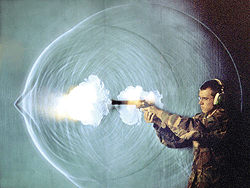
Shock waves from explosions are incredibly weird things. They travel at supersonic speeds, are really nonlinear, and though they measure only nanometers in amplitude, they produce intense jumps in atmospheric pressure: A wave travelling at Mach 2 can produce 4.5 atmospheres of pressure and destroy the human hearing system. Indeed, shock waves from the Hiroshama and Nagasaki nuclear bombs, as well as the traditional-means Oklahama City bombing, that caused much of the serious physical damage in those attacks.
It’s traditionally been hard for scientists to visualize shock waves — until now, when a team of Penn State scientists developed a technique that uses high-speed videography to capture the nearly-instantaneous atmospheric pressure changes of explosions and make them visible. An article at American Scientist explains the technique, and includes some mind-boggling pix of the shock waves created by gunfire.
The article concludes with a very cool summary of the psychoacoustic dimensions of being shot at:
The first visible phenomenon at the muzzle is the emergence of the bullet-driven shock wave, followed immediately by the bullet itself. Then the propellant gases, the products of gunpowder combustion, exit and expand tremendously as they transfer from high pressure inside the barrel to one atmosphere outside. This rapid expansion behaves like an explosion in pushing the air out of the way and thus generating a strong spherical shock wave, or muzzle blast. The “bang” of a gunshot is almost always caused by this muzzle blast.
If you are unlucky enough to be shot at but lucky enough to be missed, sometimes you hear instead the sound of the bullet itself. Inertia keeps supersonic bullets moving at high speed, while the muzzle blast rapidly decays in strength like the spherical shock wave from an explosion. So the bullet inexorably pulls ahead of the decaying muzzle blast, trailing oblique shock waves. These shock waves produce the sensation of a sharp “crack” as the bullet passes, followed later by the “bang” of the muzzle blast. This sequence varies with timing and the hearer’s position with respect to the bullet’s path, making it very difficult to determine the direction of gunfire from its perceived sounds.
(Arg — I’ve lost the email of who sent me this item. Please email me so I can attribute this to you!)
I'm Clive Thompson, the author of Smarter Than You Think: How Technology is Changing Our Minds for the Better (Penguin Press). You can order the book now at Amazon, Barnes and Noble, Powells, Indiebound, or through your local bookstore! I'm also a contributing writer for the New York Times Magazine and a columnist for Wired magazine. Email is here or ping me via the antiquated form of AOL IM (pomeranian99).

ECHO
Erik Weissengruber
Vespaboy
Terri Senft
Tom Igoe
El Rey Del Art
Morgan Noel
Maura Johnston
Cori Eckert
Heather Gold
Andrew Hearst
Chris Allbritton
Bret Dawson
Michele Tepper
Sharyn November
Gail Jaitin
Barnaby Marshall
Frankly, I'd Rather Not
The Shifted Librarian
Ryan Bigge
Nick Denton
Howard Sherman's Nuggets
Serial Deviant
Ellen McDermott
Jeff Liu
Marc Kelsey
Chris Shieh
Iron Monkey
Diversions
Rob Toole
Donut Rock City
Ross Judson
Idle Words
J-Walk Blog
The Antic Muse
Tribblescape
Little Things
Jeff Heer
Abstract Dynamics
Snark Market
Plastic Bag
Sensory Impact
Incoming Signals
MemeFirst
MemoryCard
Majikthise
Ludonauts
Boing Boing
Slashdot
Atrios
Smart Mobs
Plastic
Ludology.org
The Feature
Gizmodo
game girl
Mindjack
Techdirt Wireless News
Corante Gaming blog
Corante Social Software blog
ECHO
SciTech Daily
Arts and Letters Daily
Textually.org
BlogPulse
Robots.net
Alan Reiter's Wireless Data Weblog
Brad DeLong
Viral Marketing Blog
Gameblogs
Slashdot Games

