
« PREVIOUS ENTRY
Why did we evolve personalities?
NEXT ENTRY »
Octopus attacks research submarine
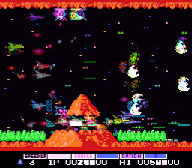
When different people play the same video game, do they play in similar ways? Do they rely on similar manouevers — or does each gamer have a unique way of navigating a level? Obviously, since the enemies in a game are programmed to have some artificial intelligence and to respond somewhat uniquely to each player, theoretically there ought to be at least a handful of different ways to play a game. But how varied are our responses?
To find out, the writer R. LeFeuvre performed an intriguing experiment: He took screengrab recordings of 15 people playing the first level of the classic sidescrolling shoot-‘em-up Gradius, merged them into a single video, and studied the results. In a fun story called “Averaging Gradius” at The New Gamer, he reports on his findings. An excerpt:
The average time taken to kill the end level boss was 20.055 seconds, with the fastest player finishing him off in a mere 10.01 seconds. Six people finished the boss off at nearly identical moments. It would seem that the boss, bored with the player, actually self-destructs after 27 seconds. Beyond the almost perfectly synchronized explosions, further proof of this self-destruction can be found in the videos: no 10,000 point bonus (given to players when the boss is defeated) was awarded to these six players and, in a few of the runs, the boss detonated when when there wasn’t a single bullet near it.
Obviously, Gradius is a pretty tightly constricted game — the action scrolls relentlessly rightwards, so players have a relatively limited number of things they can do. It’d be really interesting to average out the games played by, say, 100 players the first time they cracked open a more open-ended world like Grand Theft Auto. I suspect that even with an open-ended game, people’s behavior would still fall into fairly regular patterns, because of the very nature of games. They’re systems composed of rules that set up arbitrary goals; even the most seemingly freeform game will inherently include design elements that coax players into a few common forms of behavior. Without limits, a game isn’t a game. As a writer back in the 80s once said — I’m being intentionally vague because I can’t remember who the heck this was — “it is ironic that a video game is said to be ‘mastered’ when the player has fully subjugated his behavior to its will.”
I'm Clive Thompson, the author of Smarter Than You Think: How Technology is Changing Our Minds for the Better (Penguin Press). You can order the book now at Amazon, Barnes and Noble, Powells, Indiebound, or through your local bookstore! I'm also a contributing writer for the New York Times Magazine and a columnist for Wired magazine. Email is here or ping me via the antiquated form of AOL IM (pomeranian99).

ECHO
Erik Weissengruber
Vespaboy
Terri Senft
Tom Igoe
El Rey Del Art
Morgan Noel
Maura Johnston
Cori Eckert
Heather Gold
Andrew Hearst
Chris Allbritton
Bret Dawson
Michele Tepper
Sharyn November
Gail Jaitin
Barnaby Marshall
Frankly, I'd Rather Not
The Shifted Librarian
Ryan Bigge
Nick Denton
Howard Sherman's Nuggets
Serial Deviant
Ellen McDermott
Jeff Liu
Marc Kelsey
Chris Shieh
Iron Monkey
Diversions
Rob Toole
Donut Rock City
Ross Judson
Idle Words
J-Walk Blog
The Antic Muse
Tribblescape
Little Things
Jeff Heer
Abstract Dynamics
Snark Market
Plastic Bag
Sensory Impact
Incoming Signals
MemeFirst
MemoryCard
Majikthise
Ludonauts
Boing Boing
Slashdot
Atrios
Smart Mobs
Plastic
Ludology.org
The Feature
Gizmodo
game girl
Mindjack
Techdirt Wireless News
Corante Gaming blog
Corante Social Software blog
ECHO
SciTech Daily
Arts and Letters Daily
Textually.org
BlogPulse
Robots.net
Alan Reiter's Wireless Data Weblog
Brad DeLong
Viral Marketing Blog
Gameblogs
Slashdot Games

