
« PREVIOUS ENTRY
Do iPods help Olympic athletes perform better?
NEXT ENTRY »
KFC ad uses steganography to hack Tivo
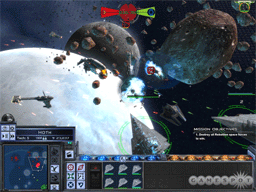
Wired News has just published my latest video-game column, and this one points out an interesting trend: While George Lucas’ movies have declined drastically in quality, his video-games have begun to rock with voluminous force. Why? I think it’s because video-games have begun to siphon off most of the cultural juice of sci-fi.
The piece is online here, and I’ve archived a copy below. It’s also available as a podcast, with me doing an oh-so-dramatic reading of it, complete with beyoo-beyoo sound f/x from the game:
Forget Film, Games Do Sci-Fi Best
by Clive ThompsonAh, the subtle pleasures of intergalactic fascism. My flotilla of TIE fighters swarmed through space like locusts, picking off rebel troops at will. My mammoth Star Destroyers had reduced a rebel base to a smoldering hulk, and Darth Vader had personally blown up the Millennium Falcon and killed that jackass Han Solo — twice.
As you might have guessed, I was playing Star Wars: Empire at War, the latest strategy title from Lucas Games. And something quite rare was happening: Even though I was deep inside a George Lucas creation, I was having a total blast.
Normally, I cringe whenever Lucas launches another movie. Ever since the Ewoks appeared in 1983’s Return of the Jedi, his films have steadily tobogganed downwards into a vale of unwatchability. It’s hard to figure out what Lucas has done worse: Is it his increasingly Disneyfied characters? His wooden scripts? Or the plots that, having been carefully denuded of action sequences, instead focus on, y’know, trade disputes?
Which brings me to my point: In the last 20 years, Lucas’ vision has arguably been far better expressed in video games than in movies.
For me, this epiphany began back in 1998, when Rogue Squadron came out on the Nintendo 64 — a note-perfect evocation of in-flight combat. I played it nonstop for four months. Then every year or so, another superb Star Wars title came along to get me addicted, from Knights of the Old Republic to Jedi Starfighter to Battlefront. Each time, Lucas did a much better job of recapturing the original spirit of his universe: A mix of campy voice-acting, moral dread, and — most of all — pell-mell action.Why were the games so comparatively good? A cynic would say it’s because Lucas probably isn’t as closely involved in the games, so his young designers aren’t hampered by his inane creative decisions. But I actually suspect it’s deeper than that. I think it’s because games are beginning to rival film — and even eclipse it — as the prime vehicle for sci-fi and fantasy.
After all, there have been vanishingly few original, mass-market, sci-fi or fantasy movies in recent years. We had The Matrix and then … what? (I said “original” movies. Stuff like The Lord of the Rings, I, Robot and Minority Report were all based — however loosely — on pre-existing books. The shining exception is Joss Whedon’s superb Serenity, a movie that, sadly, tanked at the box office.)
In contrast, the game industry has produced dozens of worlds as lovingly rendered and lush in detail as a Bruegel painting. Think of the weird, vaulting steampunk buildings of Oddworld: Abe’s Oddysee, the operatic scope of the Final Fantasy series, or the calm beauty of Ico.
Perhaps this shift is taking place because games have an inherent affinity with sci-fi and fantasy. Those genres are based on what-if premises; they’re the literary version of the Sim, the author as world-builder. Part of the fun of watching a sci-fi movie is mentally inhabiting a new world and imagining what it feels like to be inside. But now there’s a medium that actually puts you in. It’s why I reacted to Rogue Squadron with such a jolt of deja vu: As a kid, I’d fantasized about flying my own X-wing fighter — and suddenly, bang, there I was.
So if you were a creator wandering around Los Angeles and hankering to forge a new universe, why do a movie? Why not try for a game? For today’s youth, the go-anywhere, exploratory feel of immersive worlds is where the cultural mojo resides. Even the few popular fantasy stories in the mainstream today borrow from this vibe. When J. J. Abrams and Damon Lindelof were writing Lost, they explicitly modeled it on a video-game world: An overarching mythology and a cohesive world-picture, slowly revealed through creepy exploration by the main characters.
Of course, assuming I’m right about this trend, it’s not all good. There’s arguably something lost when games become the central site for flights of fancy. Even the best “narrative” games can’t replicate the emotional undertow of a good film. When I wander through Shadow of the Colossus — or even the old Myst series — I’m filled with a sense of awe. It’s like visiting a breathtaking Renaissance church; I’m struck by the beauty and the neoclassical detail. But it doesn’t drag my heart along a path the way a plain ol’ linear movie does.
Then again, when’s the last time Lucas did that on the silver screen? So I take what solace I can. I boot up Empire at War again, join the dark side, summon Emperor Palpatine, send another couple hundred TIE fighters off on howling suicide missions. Plenty more where they came from, m’lord. My training is complete.
I'm Clive Thompson, the author of Smarter Than You Think: How Technology is Changing Our Minds for the Better (Penguin Press). You can order the book now at Amazon, Barnes and Noble, Powells, Indiebound, or through your local bookstore! I'm also a contributing writer for the New York Times Magazine and a columnist for Wired magazine. Email is here or ping me via the antiquated form of AOL IM (pomeranian99).
ECHO
Erik Weissengruber
Vespaboy
Terri Senft
Tom Igoe
El Rey Del Art
Morgan Noel
Maura Johnston
Cori Eckert
Heather Gold
Andrew Hearst
Chris Allbritton
Bret Dawson
Michele Tepper
Sharyn November
Gail Jaitin
Barnaby Marshall
Frankly, I'd Rather Not
The Shifted Librarian
Ryan Bigge
Nick Denton
Howard Sherman's Nuggets
Serial Deviant
Ellen McDermott
Jeff Liu
Marc Kelsey
Chris Shieh
Iron Monkey
Diversions
Rob Toole
Donut Rock City
Ross Judson
Idle Words
J-Walk Blog
The Antic Muse
Tribblescape
Little Things
Jeff Heer
Abstract Dynamics
Snark Market
Plastic Bag
Sensory Impact
Incoming Signals
MemeFirst
MemoryCard
Majikthise
Ludonauts
Boing Boing
Slashdot
Atrios
Smart Mobs
Plastic
Ludology.org
The Feature
Gizmodo
game girl
Mindjack
Techdirt Wireless News
Corante Gaming blog
Corante Social Software blog
ECHO
SciTech Daily
Arts and Letters Daily
Textually.org
BlogPulse
Robots.net
Alan Reiter's Wireless Data Weblog
Brad DeLong
Viral Marketing Blog
Gameblogs
Slashdot Games

