
« PREVIOUS ENTRY
How Lara Croft steals hearts: My latest Wired News gaming column
NEXT ENTRY »
Songbirds have a concept of grammar
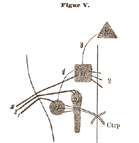
Few people know this, but Sigmund Freud began his career with some rather humble work: Dissecting eel testicles. Nonetheless, he was a skilled lab researcher, and produced painstakingly careful drawings of what he found. When he later began studying human brain function, he drew equally detailed pictures of neurons and their connecting fibers.
But then something happened: Freud became more interested in the psyche — an artifact that is intangible, and thus cannot literally be drawn. His sketches became increasingly abstract; they looked less like photographs and more like the wiring schematics for a circuit — as with this illustration, above, of the human auditory system. Then, as the New York Times reports in this week’s Science section, came one particularly historic sketch:
In … an unpublished essay titled, “Introduction to Neuropathology,” looping lines connect several nodes in a diagram intended to show how areas of the brain represent the body, arms, face, hands.
“It is no exaggeration to say that this insight is the precise point at which the mind — that aspect of the organism which represents the body not concretely but rather functionally, abstractly and symbolically — entered Freud’s scientific work,” Mark Solms wrote in a commentary that accompanies the drawings.
Cool, eh? It reminds me one of my big obsessions: That your tools help determine how you think. So long as Freud used realistic modes of drawing, he was hemmed in by the dictates of straightforward physiology. To ponder the abstracts of human behavior, he needed to turn to abstract comix. Of course, there are plenty of people today who probably wish he’d stayed dissecting eel testicles instead of pondering the psychic traumas of bourgeoise ladies in Vienna, heh. Anyway, Freud’s drawings are on display beginning May 11 at the New York Academy of Medicine. I’m going to go check them out!
I'm Clive Thompson, the author of Smarter Than You Think: How Technology is Changing Our Minds for the Better (Penguin Press). You can order the book now at Amazon, Barnes and Noble, Powells, Indiebound, or through your local bookstore! I'm also a contributing writer for the New York Times Magazine and a columnist for Wired magazine. Email is here or ping me via the antiquated form of AOL IM (pomeranian99).
ECHO
Erik Weissengruber
Vespaboy
Terri Senft
Tom Igoe
El Rey Del Art
Morgan Noel
Maura Johnston
Cori Eckert
Heather Gold
Andrew Hearst
Chris Allbritton
Bret Dawson
Michele Tepper
Sharyn November
Gail Jaitin
Barnaby Marshall
Frankly, I'd Rather Not
The Shifted Librarian
Ryan Bigge
Nick Denton
Howard Sherman's Nuggets
Serial Deviant
Ellen McDermott
Jeff Liu
Marc Kelsey
Chris Shieh
Iron Monkey
Diversions
Rob Toole
Donut Rock City
Ross Judson
Idle Words
J-Walk Blog
The Antic Muse
Tribblescape
Little Things
Jeff Heer
Abstract Dynamics
Snark Market
Plastic Bag
Sensory Impact
Incoming Signals
MemeFirst
MemoryCard
Majikthise
Ludonauts
Boing Boing
Slashdot
Atrios
Smart Mobs
Plastic
Ludology.org
The Feature
Gizmodo
game girl
Mindjack
Techdirt Wireless News
Corante Gaming blog
Corante Social Software blog
ECHO
SciTech Daily
Arts and Letters Daily
Textually.org
BlogPulse
Robots.net
Alan Reiter's Wireless Data Weblog
Brad DeLong
Viral Marketing Blog
Gameblogs
Slashdot Games

