
« PREVIOUS ENTRY
Can you hear me now?
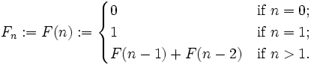
I love strict poetic forms. I think creativity comes not from total freedom — but from arbitrary structural limitations that compel artists to be concise, or to take the history of their media into account. That’s why, for example, I love a tightly-structured pop song more than freeform jazz. In poetry, I think the single-coolest form is the nonrhyming petrarchan sonnet executed in a loose iambic pentameter: A perfect amalgam of structure and freedom. (This is also why I think e. e. cummings is the finest modern poet in English, because he perfectly balanced a love of structure with the liberating dictates of free verse. His sonnets are just off-the-hook fantastic, and despite the apparent chaos of his more open-ended writing, there is virtually always a meticulously architected subskeleton of meter or rhyme.)
I was thus delighted to discover “The Fib”, a new poetic form based on … the Fibonacci sequence!
It’s the invention of Gregory K, a blogger and L.A. screenwriter, and it’s a simple conceit: Each line of the poem has as many syllables as its corresponding place in the Fibonacci sequence. The sequence, for those who aren’t familiar with it, is a neatly recursive thing: Each number is the product of the last two in line, with 0 and 1 being the first two digits to start the sequence running. So it goes 0, 1, 1, 2, 3, 5, 8, 13, 21, 33, etc. As a poetic device, this produces poems that slowly cascade from terse, haiku-like concision into a waterfall of prose. Several people showed up at Gregory’s blog to try their hand at writing some; an example:
I
want
to be
all the things
my mother said I
couldn’t be in my own life time.
The thing about the Fib, though, is that after the ninth line, you’re dealing with 50-plus syllables, which means you’re essentially writing prose paragraphs. By the 21st line, you’re dealing with a hefty 10,946 syllables — which translates to about 6,700 words of English prose. That’s an entire short story on its own, or a chapter from a book.
Thus, the Fib is an incredibly unique form, in that it spans the entire spectrum of literature: It begins with uses of language so concise that meaning and beauty hang on a single word, then transforms into a Proustian torrent of storytelling. Imagine the cool ways those two polar opposites could work together!
Even more lovely is the fact that the Fibonacci sequence officially begins with a zero. That means that the true first line of every Fib is always the same: Silence.
(Thanks to Slashdot for this one!)
I'm Clive Thompson, the author of Smarter Than You Think: How Technology is Changing Our Minds for the Better (Penguin Press). You can order the book now at Amazon, Barnes and Noble, Powells, Indiebound, or through your local bookstore! I'm also a contributing writer for the New York Times Magazine and a columnist for Wired magazine. Email is here or ping me via the antiquated form of AOL IM (pomeranian99).
ECHO
Erik Weissengruber
Vespaboy
Terri Senft
Tom Igoe
El Rey Del Art
Morgan Noel
Maura Johnston
Cori Eckert
Heather Gold
Andrew Hearst
Chris Allbritton
Bret Dawson
Michele Tepper
Sharyn November
Gail Jaitin
Barnaby Marshall
Frankly, I'd Rather Not
The Shifted Librarian
Ryan Bigge
Nick Denton
Howard Sherman's Nuggets
Serial Deviant
Ellen McDermott
Jeff Liu
Marc Kelsey
Chris Shieh
Iron Monkey
Diversions
Rob Toole
Donut Rock City
Ross Judson
Idle Words
J-Walk Blog
The Antic Muse
Tribblescape
Little Things
Jeff Heer
Abstract Dynamics
Snark Market
Plastic Bag
Sensory Impact
Incoming Signals
MemeFirst
MemoryCard
Majikthise
Ludonauts
Boing Boing
Slashdot
Atrios
Smart Mobs
Plastic
Ludology.org
The Feature
Gizmodo
game girl
Mindjack
Techdirt Wireless News
Corante Gaming blog
Corante Social Software blog
ECHO
SciTech Daily
Arts and Letters Daily
Textually.org
BlogPulse
Robots.net
Alan Reiter's Wireless Data Weblog
Brad DeLong
Viral Marketing Blog
Gameblogs
Slashdot Games

