
« PREVIOUS ENTRY
“The Fib”: A new poetic form based on the Fibonacci sequence!

I’m coming late to this, but Wired New recently published my latest video-game column. In this one, I defend the undefensible: The joys of highly violent first-person shooters. You can read it online here, or find the archived copy below!
The Glory of the Shooter
by Clive ThompsonLet us now praise insanely violent first-person-shooters.
Let us praise the joys of double-wielding a pair of Uzis with unlimited ammo; let us delight in the gorgeous fractal carnage of a rocket launcher as it slams into your target. Let us talk openly about how just totally awesome it is to grab a fully loaded railgun in Quake 4 and wade into a mass of gibbering Strogg aliens and kill and kill and kill again, until there are guts on, like, the ceiling.
While we’re at it, let us meditate on the subtle joys of deciding, while playing Far Cry, that this sneaking-around “stealth” stuff is for the birds, and it’s way more excellent to just barge out into the open with fully loaded machine guns and slice through waves of oncoming mercenaries with the crimson fury of the angel of death himself, blasting and blasting until your trigger finger is aching and you are basically tripping over the corpses, and the battlefield is silent but for the distant plaintive cawing of seagulls on a far-off beach.
I probably sound like I’ve lost my mind.
I haven’t. No — it’s just time to defend the indefensible: The allure of grotesquely violent shoot’em-ups.
This is a subject that huge numbers of gamers feel strongly about, but are terrified of saying out loud. After all, we now live in an age where the pop-culture mainstream has decided that games are fascinating — but only the “complex,” socially nuanced ones. Everyone moons over Will Wright’s emotionally sophisticated Sims, and his impending, world-modeling Spore. Critics gush over the social valences of life inside World of Warcraft, or the cinematic scope of the Final Fantasy series, or the massive forking narratives of The Elder Scrolls IV: Oblivion.
But when it comes to shooters — the Cro-Magnon sector of the gaming world? Everyone recoils. If only gamers would grow up, sigh the pundits, these infantile titles would finally vanish, and gaming would finally be respectable. Even the most eloquent, game-positive pop-culture critics fall into this trap. Steven Johnson — whose book Everything Bad Is Good for You I praised in my last column — is a big fan of games, but only insofar as their extreme complexity helps challenge your brain.
But you know what? Sometimes complexity sucks. I recently began playing Oblivion, which I’ll agree is a truly superb role-playing game. But there was one point at about 2 a.m. where my backpack was so full I couldn’t move, and I spent five minutes trying to figure out which item to dispense with. My rusty battle-ax? My iron shortsword? My store of rat meat?
And it suddenly hit me that I was spending a Friday night doing inventory management. Last time I checked, I get enough bean counting at my day job; do I really need to spend my weekends pondering whether I should carry an extra set of warhammers just in case I run into a merchant who might be able to buy them off me? Sure, I enjoy having a virtual life — but as a virtual accountant?
Yeah, no.
Moments like that make me re-appreciate the true value of a good first-person shooter: its raw, modernist simplicity. Like a cool, refreshing glass of water on a smog-choked summer day, a shooter cuts through the fog of everyday life.
That’s what made Halo the top-selling game for the Xbox, after all. Everyone blathered on and on about the immersive story, the fleshed-out characters, the great script, yadda yadda. But that wasn’t why they played it. No, they played it because of what the designers called the game’s ability to deliver “30 seconds of fun,” over and over again. And those 30 seconds didn’t consist of moderating a frickin’ guild meeting, if you know what I mean. Nosiree: They consisted of wasting every last freaky alien that wandered anywhere near your muzzle.
Repetitive? Sure. But repetition of a simple activity, over and over again, is a classic form of play; the fun is in slowly honing your ability at an artificially meaningful task. Ask anyone who’s ever spent hours batting 500 tennis balls over a net about that.
Granted, the critics are right about many things. We love shooters for plenty of culturally unsavory reasons. They tap into our adolescent power fantasies; their hollow-point bloodshed seems transgressive, which is why video games are to this century what rock ‘n’ roll was to the last. Worse, the Manichean view of a kill-or-be-killed game is uncomfortably close to today’s real-life religious fanaticism.
And I’m not saying that complicated role-playing games aren’t worth the time. Quite the contrary: I’ll tire of Far Cry in a weekend, while I’ll enjoy Oblivion for weeks on end. One is a light snack, and the other is a many-course meal. These genres aren’t in competition with one another.
No, the problem is that the violent shooter has become the game that dares not speak its name, even amongst the people who design them. Rockstar Games recently issued a statement essentially apologizing for its new title, Bully, even before the game was released — which is kind of like Eminem holding a press conference to sheepishly disavow his next album.
Possibly it’s because everyone so desperately craves mainstream approval. When your boss asks you what you did on the weekend, are you gonna tell him you spent 10 hours shooting at already-dead bodies during slow-mo mode in Half-Life 2 just so you could play physics experiments with them? No, it’s easier to stroke your chin and muse on the advent of “narrative” games that will “rival movies” and finally “break games into the mainstream.”
Maybe that halcyon day will come. Maybe we’ll all have personal PlayStation holodecks, and we’ll sit around role-playing byzantine social sims crafted with Shakespearean heft. Bring it on, I say!
Just so long as you toss me a few shooters, too. Even in this glorious future, my old lizard brain is going to need something to do.
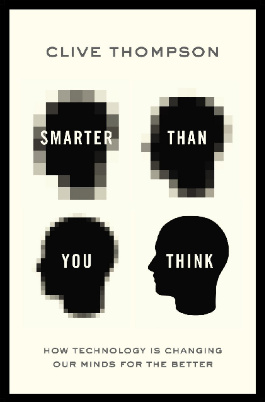
I'm Clive Thompson, the author of Smarter Than You Think: How Technology is Changing Our Minds for the Better (Penguin Press). You can order the book now at Amazon, Barnes and Noble, Powells, Indiebound, or through your local bookstore! I'm also a contributing writer for the New York Times Magazine and a columnist for Wired magazine. Email is here or ping me via the antiquated form of AOL IM (pomeranian99).
ECHO
Erik Weissengruber
Vespaboy
Terri Senft
Tom Igoe
El Rey Del Art
Morgan Noel
Maura Johnston
Cori Eckert
Heather Gold
Andrew Hearst
Chris Allbritton
Bret Dawson
Michele Tepper
Sharyn November
Gail Jaitin
Barnaby Marshall
Frankly, I'd Rather Not
The Shifted Librarian
Ryan Bigge
Nick Denton
Howard Sherman's Nuggets
Serial Deviant
Ellen McDermott
Jeff Liu
Marc Kelsey
Chris Shieh
Iron Monkey
Diversions
Rob Toole
Donut Rock City
Ross Judson
Idle Words
J-Walk Blog
The Antic Muse
Tribblescape
Little Things
Jeff Heer
Abstract Dynamics
Snark Market
Plastic Bag
Sensory Impact
Incoming Signals
MemeFirst
MemoryCard
Majikthise
Ludonauts
Boing Boing
Slashdot
Atrios
Smart Mobs
Plastic
Ludology.org
The Feature
Gizmodo
game girl
Mindjack
Techdirt Wireless News
Corante Gaming blog
Corante Social Software blog
ECHO
SciTech Daily
Arts and Letters Daily
Textually.org
BlogPulse
Robots.net
Alan Reiter's Wireless Data Weblog
Brad DeLong
Viral Marketing Blog
Gameblogs
Slashdot Games

