
« PREVIOUS ENTRY
The Gillette Singularity
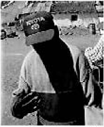
Does our language change our conceptions of how time works? In a neat Cognitive Science paper called “With the Future Behind Them”, some researchers document the intriguing culture of the Aymara Indians of the high Andes. Their language inverts our traditional metaphors of time, as a column in today’s New York Times Science section notes:
The Aymara call the future qhipa pacha/timpu, meaning back or behind time, and the past nayra pacha/timpu, meaning front time. And they gesture ahead of them when remembering things past, and backward when talking about the future.
These are not mere mannerisms, the researchers argue; they are windows into the minds of Aymara speakers, who have a conception of future and past that is different from just about everyone else’s.
The authors say the Aymara speakers see the difference between what is known and not known as paramount, and what is known is what you see in front of you, with your own eyes.
The past is known, so it lies ahead of you. (Nayra, or “past,” literally means eye and sight, as well as front.) The future is unknown, so it lies behind you, where you can’t see.
It’s such a neat concept. It reminds me of the way that conservatives — real, serious conservatives, by which I mean the Burkean type — regard the future as so exhaustively predicted by the past that it is far more important to examine the latter than to speculate about the former. That picture above — which I pulled from the PDF of the paper, online here — is of an Aymaran talking about the future of his community. He’s gesturing behind him as he says “it seems we are going toward the worst”. Ironically, the Aymarans are indeed dying out, so before long their language will vanish into that vast expanse of the past that lies, I suppose, before us.
I'm Clive Thompson, the author of Smarter Than You Think: How Technology is Changing Our Minds for the Better (Penguin Press). You can order the book now at Amazon, Barnes and Noble, Powells, Indiebound, or through your local bookstore! I'm also a contributing writer for the New York Times Magazine and a columnist for Wired magazine. Email is here or ping me via the antiquated form of AOL IM (pomeranian99).
ECHO
Erik Weissengruber
Vespaboy
Terri Senft
Tom Igoe
El Rey Del Art
Morgan Noel
Maura Johnston
Cori Eckert
Heather Gold
Andrew Hearst
Chris Allbritton
Bret Dawson
Michele Tepper
Sharyn November
Gail Jaitin
Barnaby Marshall
Frankly, I'd Rather Not
The Shifted Librarian
Ryan Bigge
Nick Denton
Howard Sherman's Nuggets
Serial Deviant
Ellen McDermott
Jeff Liu
Marc Kelsey
Chris Shieh
Iron Monkey
Diversions
Rob Toole
Donut Rock City
Ross Judson
Idle Words
J-Walk Blog
The Antic Muse
Tribblescape
Little Things
Jeff Heer
Abstract Dynamics
Snark Market
Plastic Bag
Sensory Impact
Incoming Signals
MemeFirst
MemoryCard
Majikthise
Ludonauts
Boing Boing
Slashdot
Atrios
Smart Mobs
Plastic
Ludology.org
The Feature
Gizmodo
game girl
Mindjack
Techdirt Wireless News
Corante Gaming blog
Corante Social Software blog
ECHO
SciTech Daily
Arts and Letters Daily
Textually.org
BlogPulse
Robots.net
Alan Reiter's Wireless Data Weblog
Brad DeLong
Viral Marketing Blog
Gameblogs
Slashdot Games

