
« PREVIOUS ENTRY
Will Shortz, crosswords, and the perplexing rise of Sudoku: My latest New York magazine article
Here’s some fascinating economic work: Recent studies show that if you graduate into a recession, it’ll hurt your earnings for the rest of your life.
The New York Times recently reported on this work, and it’s pretty freaky stuff. In one study, Paul Oyer of Stanford tracked the earnings of biz-school grads from 1960 to 1997. His results? As the Times reports:
He found that the performance of the stock market in the two years the students were in business school played a major role in whether they took an investment banking job upon graduating and, because such jobs pay extremely well, upon the average salary of the class. That is no surprise. The startling thing about the data was his finding that the relative income differences among classes remained, even as much as 20 years later.
The Stanford class of 1988, for example, entered the job market just after the market crash of 1987. Banks were not hiring, and so average wages for that class were lower than for the class of 1987 or for later classes that came out after the market recovered. Even a decade or more later, the class of 1988 was still earning significantly less. They missed the plum jobs right out of the gate and never recovered.
Apparently, America is no longer a country where you can start at the bottom of the greasy pole and work your way up. Nope — nowadays, people care about where you start, so if your first job out of college needs to be impressive and high-earning right off the bat. If it is, then you lock into a cycle of self-perpetuating mythology: “Hey, that guy’s paid so much, he must be good. We should offer even more and hire him away.” The dismal reverse is equally as true.
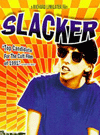
In one sense, this is just another manifestation of the winner-take-all dynamics that emerge in our power-law-dominated world. It would also explain why the folks who graduated in the early 90s — in the trough of a nasty recession — were slagged as “slackers”, while the “Generation Y” kids who graduated into the Caligulan dot-com boom of the late 90s were revered as energetic, idealistic, forward-thinking, woof woof, ribbit ribbit. They were tarred — or starred — by their economic context.
Mind you, since I personally graduated in 1992 in Toronto, when unemployment was a mindboggling 25% for people under 25, I’m trying not to dwell too much on this, heh.
I'm Clive Thompson, the author of Smarter Than You Think: How Technology is Changing Our Minds for the Better (Penguin Press). You can order the book now at Amazon, Barnes and Noble, Powells, Indiebound, or through your local bookstore! I'm also a contributing writer for the New York Times Magazine and a columnist for Wired magazine. Email is here or ping me via the antiquated form of AOL IM (pomeranian99).
ECHO
Erik Weissengruber
Vespaboy
Terri Senft
Tom Igoe
El Rey Del Art
Morgan Noel
Maura Johnston
Cori Eckert
Heather Gold
Andrew Hearst
Chris Allbritton
Bret Dawson
Michele Tepper
Sharyn November
Gail Jaitin
Barnaby Marshall
Frankly, I'd Rather Not
The Shifted Librarian
Ryan Bigge
Nick Denton
Howard Sherman's Nuggets
Serial Deviant
Ellen McDermott
Jeff Liu
Marc Kelsey
Chris Shieh
Iron Monkey
Diversions
Rob Toole
Donut Rock City
Ross Judson
Idle Words
J-Walk Blog
The Antic Muse
Tribblescape
Little Things
Jeff Heer
Abstract Dynamics
Snark Market
Plastic Bag
Sensory Impact
Incoming Signals
MemeFirst
MemoryCard
Majikthise
Ludonauts
Boing Boing
Slashdot
Atrios
Smart Mobs
Plastic
Ludology.org
The Feature
Gizmodo
game girl
Mindjack
Techdirt Wireless News
Corante Gaming blog
Corante Social Software blog
ECHO
SciTech Daily
Arts and Letters Daily
Textually.org
BlogPulse
Robots.net
Alan Reiter's Wireless Data Weblog
Brad DeLong
Viral Marketing Blog
Gameblogs
Slashdot Games

