
« PREVIOUS ENTRY
The dawn of “episodic gaming”: My latest Wired News column
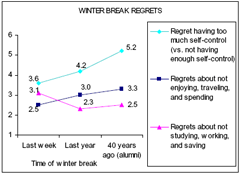
Hedonists, rejoice! A couple of Columbia University researchers have found that in the long run, people tend to regret having missed out on opportunities for pleasure — and they wish they hadn’t been so diligent about working. What’s more, our attitudes reverse over time. In the short run, we’re proud of our ability to work hard and delay gratification. But years later, we regret that choice.
For example, in one of the Columbia experiments, subjects were asked recall two points in time — one week ago, and five years ago. They were asked whether they were working or relaxing at that point in time, and whether they regretted it. When the point in time was a week ago, the workers were happy they were toiling, and the relaxers regretted their lassitude. When the point in time was five years ago, though, the opposite was true: People regretted being in the office, and wished they’d been slacking.
In another experiment, students who’d just come back from their break were polled. The ones who’d partied it up regretted their actions — while those who studied were virtuously smug. But when asked to recall the spring break from the previous year, suddenly more students regretted their choice not to party. When alumni were asked to recall their spring breaks of 40 years ago, the results were even starker: Those who hadn’t been doing beer shots out of a barber’s chair were striken with remorse.
Check out that diagram above: It’s a Chart of Regret from the spring-break example. The top line shows the intensity — on a scale from 1 to 7 — of how much subjects regretted “having too much self control”. It’s an unmistakeable trend: As they get older, people are increasingly pissed that they were such goody two-shoes when they were young.
Of course, these findings totally violate how we’re told about to behave. It also violates how we think about ourselves. When asked to define their values in the abstract, people regularly claim that delaying gratification gives you a better life. Yet when asked to think about specific incidents in our lives — as these researchers did — those values crumble, obviously.
Why the reversal? Why do we opt for virtue in the short term, but prefer vice in the long? The reason, the researchers suggest, is in the mechanics of guilt: It’s intense and painful emotion in the here-and-how, but fades over time. As they write:
Whereas guilt is an acute, hot emotion, missing out is a colder, contemplative feeling. Therefore, indulgence guilt is expected to predominate in the temporal proximity of the relevant self-control choice, but subsequently diminish over time.
Now there’s a conclusion that will deeply freak out social conservatives.
Though one could also question whether we’re seeing the whole picture here. When you poll people who are in college and have graduated from it, you’ve got a distorted landscape; these are people who have already opted for an activity (college) that inherently involves putting aside some pleasure for long-term gain, and who are going to benefit from it. But what it if you took a bunch of people who’d dropped out of college or high-school for hedonistic reasons — i.e. not because they couldn’t afford to attend, but because they found it boring — and polled them ten years later? Would you get the same response? If they’d failed to get good jobs and were scrabbling to get by, would their youthful trade-off still seem worth it?
I'm Clive Thompson, the author of Smarter Than You Think: How Technology is Changing Our Minds for the Better (Penguin Press). You can order the book now at Amazon, Barnes and Noble, Powells, Indiebound, or through your local bookstore! I'm also a contributing writer for the New York Times Magazine and a columnist for Wired magazine. Email is here or ping me via the antiquated form of AOL IM (pomeranian99).
ECHO
Erik Weissengruber
Vespaboy
Terri Senft
Tom Igoe
El Rey Del Art
Morgan Noel
Maura Johnston
Cori Eckert
Heather Gold
Andrew Hearst
Chris Allbritton
Bret Dawson
Michele Tepper
Sharyn November
Gail Jaitin
Barnaby Marshall
Frankly, I'd Rather Not
The Shifted Librarian
Ryan Bigge
Nick Denton
Howard Sherman's Nuggets
Serial Deviant
Ellen McDermott
Jeff Liu
Marc Kelsey
Chris Shieh
Iron Monkey
Diversions
Rob Toole
Donut Rock City
Ross Judson
Idle Words
J-Walk Blog
The Antic Muse
Tribblescape
Little Things
Jeff Heer
Abstract Dynamics
Snark Market
Plastic Bag
Sensory Impact
Incoming Signals
MemeFirst
MemoryCard
Majikthise
Ludonauts
Boing Boing
Slashdot
Atrios
Smart Mobs
Plastic
Ludology.org
The Feature
Gizmodo
game girl
Mindjack
Techdirt Wireless News
Corante Gaming blog
Corante Social Software blog
ECHO
SciTech Daily
Arts and Letters Daily
Textually.org
BlogPulse
Robots.net
Alan Reiter's Wireless Data Weblog
Brad DeLong
Viral Marketing Blog
Gameblogs
Slashdot Games

