
« PREVIOUS ENTRY
One drink can make you blind drunk
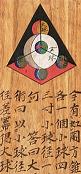
Behold an ancient Japanese “Sangaku” table — the Sudoku of the 17th century.
Sangaku emerged during the 100-year period that Japan forcibly cut itself off from West, allowing only one Dutch ship a year to dock. The cultural isolation did some weird things to the country’s mathematicians. Because they never heard about calculus — which was developed in Europe — they developed brute-force ways of solving classic calculus problems, such as how many circles of a particular size fit in a square. They’d draw the enormous, sprawling solutions out on beautifully illustrated wooden tables, which they regarded as religious offerings. (I love it: Using math to praise God. Man, wouldn’t it be nice if more religious conservatives in the US made that connection? It’s quite a venerable once, too, since many historic mathematicians — most particularly Newton — regarded math as the language in which God spoke.)
Anyway, Sangaku fell into disrepute during the 20th century, but Tony Rothman, a Princeton Nobel nominee, is helping spearhead a movement to restore what he calls the sudoku of the 17th century. Like Sudoku, Sangaku was based in principles so simple that children could solve them, as Rothman says in this story:
“Some of the tablets feature solutions provided by 12-year-olds,” he said. “But that doesn’t mean they were easy. Today’s high school geometry problems tend to require only five or six lines to solve, whereas the old problems often demand pages and pages of work. Sangaku were more like math Olympics problems, or the sort of thing your teacher might have put on the wall for extra credit.”
I'm Clive Thompson, the author of Smarter Than You Think: How Technology is Changing Our Minds for the Better (Penguin Press). You can order the book now at Amazon, Barnes and Noble, Powells, Indiebound, or through your local bookstore! I'm also a contributing writer for the New York Times Magazine and a columnist for Wired magazine. Email is here or ping me via the antiquated form of AOL IM (pomeranian99).
ECHO
Erik Weissengruber
Vespaboy
Terri Senft
Tom Igoe
El Rey Del Art
Morgan Noel
Maura Johnston
Cori Eckert
Heather Gold
Andrew Hearst
Chris Allbritton
Bret Dawson
Michele Tepper
Sharyn November
Gail Jaitin
Barnaby Marshall
Frankly, I'd Rather Not
The Shifted Librarian
Ryan Bigge
Nick Denton
Howard Sherman's Nuggets
Serial Deviant
Ellen McDermott
Jeff Liu
Marc Kelsey
Chris Shieh
Iron Monkey
Diversions
Rob Toole
Donut Rock City
Ross Judson
Idle Words
J-Walk Blog
The Antic Muse
Tribblescape
Little Things
Jeff Heer
Abstract Dynamics
Snark Market
Plastic Bag
Sensory Impact
Incoming Signals
MemeFirst
MemoryCard
Majikthise
Ludonauts
Boing Boing
Slashdot
Atrios
Smart Mobs
Plastic
Ludology.org
The Feature
Gizmodo
game girl
Mindjack
Techdirt Wireless News
Corante Gaming blog
Corante Social Software blog
ECHO
SciTech Daily
Arts and Letters Daily
Textually.org
BlogPulse
Robots.net
Alan Reiter's Wireless Data Weblog
Brad DeLong
Viral Marketing Blog
Gameblogs
Slashdot Games

