
« PREVIOUS ENTRY
My New York Times article on “serious games”
NEXT ENTRY »
Sudoku continues to trample the crossword
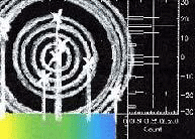
This Sunday, Jonathon Keats unveiled the world’s first exhibit of extraterrestrial art — art generated by intelligent signals he claims were received by the Arecibo Observatory in Puerto Rico. That’s a sample above. A press release from the Magnes gallery, where the art is one display, calls it “most significant addition to the artistic canon since the Mona Lisa, or even the Venus of Willendorf.” Ahem. As the artist himself notes:
“This is the ultimate outsider art,” notes Keats. “Historically our culture has ignored extraterrestrial artistic expression. Exhibited at the Magnes, the art becomes accessible to everyone … It’s a familiar story. Researchers expect intelligent life elsewhere in the universe to behave just like them. Since scientists are mathematical, they expect extraterrestrials to broadcast the digits of pi or the Pythagorean theorem.”
Keats began seriously to question the wisdom of these assumptions while conducting independent research early last year. “If I were an extraterrestrial trying to communicate with beings elsewhere in the universe, I certainly wouldn’t transmit something they already knew,” he argues. “I’d try to express something about myself, as profound as possible, in the most universal language I could imagine: I’d send art.”
At first I thought, man, this Keats guy is off his rocker. But then I did a bit of research and realized he’s off his rocker in a calculated fashion. Keats is famous for prank-style art projects, including one in which he sat in a chair and thought for 24 hours, then sold his thoughts to patrons as art. In 2002 he held a petition drive for the city of Berkeley, California to pass a version of A=A, a logical law, as statutory law (“every entity shall be identical to itself,” as his proposed law read).
So once I realized he was pulling our legs, I also realized he’s made a sort of interesting point. Why do we expect that an extraterrestrial race would broadcast mathematical concepts — such as a sequence of prime numbers — as a transmission? Obviously we suppose that math is universal, and thus transcends whatever weird tentacle-based language the aliens speak. But the fact is that we humans broadcast our first official message to aliens — a series of recordings sent aboard the Voyager interstellar mission — we included, yep, art: The first movement of the Brandenburg Concerto and Chuck Berry’s “Johnny B. Goode”, among other things.
I'm Clive Thompson, the author of Smarter Than You Think: How Technology is Changing Our Minds for the Better (Penguin Press). You can order the book now at Amazon, Barnes and Noble, Powells, Indiebound, or through your local bookstore! I'm also a contributing writer for the New York Times Magazine and a columnist for Wired magazine. Email is here or ping me via the antiquated form of AOL IM (pomeranian99).
ECHO
Erik Weissengruber
Vespaboy
Terri Senft
Tom Igoe
El Rey Del Art
Morgan Noel
Maura Johnston
Cori Eckert
Heather Gold
Andrew Hearst
Chris Allbritton
Bret Dawson
Michele Tepper
Sharyn November
Gail Jaitin
Barnaby Marshall
Frankly, I'd Rather Not
The Shifted Librarian
Ryan Bigge
Nick Denton
Howard Sherman's Nuggets
Serial Deviant
Ellen McDermott
Jeff Liu
Marc Kelsey
Chris Shieh
Iron Monkey
Diversions
Rob Toole
Donut Rock City
Ross Judson
Idle Words
J-Walk Blog
The Antic Muse
Tribblescape
Little Things
Jeff Heer
Abstract Dynamics
Snark Market
Plastic Bag
Sensory Impact
Incoming Signals
MemeFirst
MemoryCard
Majikthise
Ludonauts
Boing Boing
Slashdot
Atrios
Smart Mobs
Plastic
Ludology.org
The Feature
Gizmodo
game girl
Mindjack
Techdirt Wireless News
Corante Gaming blog
Corante Social Software blog
ECHO
SciTech Daily
Arts and Letters Daily
Textually.org
BlogPulse
Robots.net
Alan Reiter's Wireless Data Weblog
Brad DeLong
Viral Marketing Blog
Gameblogs
Slashdot Games

