
« PREVIOUS ENTRY
How to make an artificial shark uterus
NEXT ENTRY »
Live chat transcript from 9/11
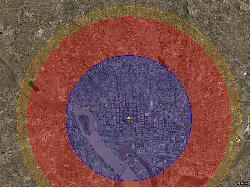
Want to know how badly your city would be destroyed if it were hit by a nuclear bomb? Hie thee to the Nuclear Weapon Effects Calculator at the web site of the Federation of American Scientists and find out. Plug your city in, pick the location where you want the bomb to land, select the kiloton size and the method of delivery — “automobile” or “aircraft” — and presto: It generates a set of concentric rings that illustrate the damage.
In the picture above, that’s Washington, DC. In this scenario, a 400 kiloton bomb is driven up in a truck and detonated in front of the White House. In the blue circle, a high-pressure blast flattens all homes and many commercial buildings. In the red circle, “intense heat” causes widespread fires, while buildings in the yellow circle suffer “moderate damage” and people are hit by flying debris.
For those interested in the technical details, this tool is based upon data obtained from The Effects of Nuclear Weapons. The blue and yellow contours mark overpressures of 5 psi and 2 psi, respectively. The blast radius scales with the weapon’s yield as a cube root law. Choosing to deliver the bomb by aircraft assumes it is flying at an altitude which maximizes the size of the 5 psi contour. The red contour marks the region in which the thermal flux is 15 cal/cm2 or higher. This is likely to cause many materials to begin combustion, which can then spread into much larger fires. This model, however, does not take into account obstructions that may block some of the heat radiating from the fireball.
Unfortunately, it doesn’t have Manhattan as an option, otherwise I’d have run the simulation to find out how badly I’ll be vaporized.
I have to admit, it’s a pretty convincing little app. Obviously, anti-nuclear advocates have long turned to new media as a way of demonstrating the peculiarly horrifying effect of nukes. I remember the 1983 airing of The Day After as a sort of cultural tipping point: Watching a dramatization of the gruesome aftermath of a nuclear strike made disarmament talks with the USSR seem a heck of a lot more sensible an option.
Given the current interest around “serious games”, it occurred to me that if the FAS really wanted to get people agitated about nuclear weapons, they should make a game about it. Hire a game-design company to produce a little 3D sim that lets you pick the city, the weapon — and then reproduces the strike in real-time. You could play it in slow-mo, or view the destruction of the city in wire-frame mode, or zoom in on an individual building. Maybe your own building! Now that‘d be a persuasive meme.
I'm Clive Thompson, the author of Smarter Than You Think: How Technology is Changing Our Minds for the Better (Penguin Press). You can order the book now at Amazon, Barnes and Noble, Powells, Indiebound, or through your local bookstore! I'm also a contributing writer for the New York Times Magazine and a columnist for Wired magazine. Email is here or ping me via the antiquated form of AOL IM (pomeranian99).
ECHO
Erik Weissengruber
Vespaboy
Terri Senft
Tom Igoe
El Rey Del Art
Morgan Noel
Maura Johnston
Cori Eckert
Heather Gold
Andrew Hearst
Chris Allbritton
Bret Dawson
Michele Tepper
Sharyn November
Gail Jaitin
Barnaby Marshall
Frankly, I'd Rather Not
The Shifted Librarian
Ryan Bigge
Nick Denton
Howard Sherman's Nuggets
Serial Deviant
Ellen McDermott
Jeff Liu
Marc Kelsey
Chris Shieh
Iron Monkey
Diversions
Rob Toole
Donut Rock City
Ross Judson
Idle Words
J-Walk Blog
The Antic Muse
Tribblescape
Little Things
Jeff Heer
Abstract Dynamics
Snark Market
Plastic Bag
Sensory Impact
Incoming Signals
MemeFirst
MemoryCard
Majikthise
Ludonauts
Boing Boing
Slashdot
Atrios
Smart Mobs
Plastic
Ludology.org
The Feature
Gizmodo
game girl
Mindjack
Techdirt Wireless News
Corante Gaming blog
Corante Social Software blog
ECHO
SciTech Daily
Arts and Letters Daily
Textually.org
BlogPulse
Robots.net
Alan Reiter's Wireless Data Weblog
Brad DeLong
Viral Marketing Blog
Gameblogs
Slashdot Games

