
« PREVIOUS ENTRY
The Internet weighs two ounces
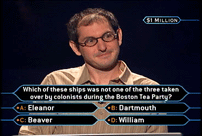
Here’s another one I’m coming late to, but it’s so cool I can’t pass it up: Ogi Ogas, a cognitive neuroscientist, won $500,000 on “Who Wants To Be A Millionaire” — and he did so by employing a handful of mind-hacking tricks he derived from his knowledge of the brain.
For example, for his $16,000 question, he relied on the technique of “priming”. Because memories are stored in many different parts of the brain, if you can manage to recall any single part of a pattern, your brain can often fill in missing, related parts. In a superb piece about the experience in Seed magazine, Ogas explains how priming helped him out:
Since the producers allow contestants unlimited time to work out answers (as long as they’re not just stalling), I knew that I could employ the most basic of priming tactics: talking about the question, posing scenarios, throwing out wild speculations, even just babbling — trying to cajole my prefrontal neurons onto any cue that could trigger the buried neocortical circuits holding the key to the answer.
I used priming on my $16,000 question: “This past spring, which country first published inflammatory cartoons of the prophet Mohammed?” I did not know the answer. But I did know I had a long conversation with my friend Gena about the cartoons. So I chatted with [Who Wants To Be A Millionaire host] Meredith about Gena. I tried to remember where we discussed the cartoons and the way Gena flutters his hands. As I pictured how he rolls his eyes to express disdain, Gena’s remark popped into my mind: “What else would you expect from Denmark?”
I personally am all in favor of the trend towards using brain-hacking and mind-hacking tricks in everyday life. It’s like a sort of fine-grained version of cognitive behavioral therapy — observing yourself and your mind’s odd, curious spastic gestures to help navigate life.
(Thanks to the Corante Brain Waves blog for this one!)
I'm Clive Thompson, the author of Smarter Than You Think: How Technology is Changing Our Minds for the Better (Penguin Press). You can order the book now at Amazon, Barnes and Noble, Powells, Indiebound, or through your local bookstore! I'm also a contributing writer for the New York Times Magazine and a columnist for Wired magazine. Email is here or ping me via the antiquated form of AOL IM (pomeranian99).
ECHO
Erik Weissengruber
Vespaboy
Terri Senft
Tom Igoe
El Rey Del Art
Morgan Noel
Maura Johnston
Cori Eckert
Heather Gold
Andrew Hearst
Chris Allbritton
Bret Dawson
Michele Tepper
Sharyn November
Gail Jaitin
Barnaby Marshall
Frankly, I'd Rather Not
The Shifted Librarian
Ryan Bigge
Nick Denton
Howard Sherman's Nuggets
Serial Deviant
Ellen McDermott
Jeff Liu
Marc Kelsey
Chris Shieh
Iron Monkey
Diversions
Rob Toole
Donut Rock City
Ross Judson
Idle Words
J-Walk Blog
The Antic Muse
Tribblescape
Little Things
Jeff Heer
Abstract Dynamics
Snark Market
Plastic Bag
Sensory Impact
Incoming Signals
MemeFirst
MemoryCard
Majikthise
Ludonauts
Boing Boing
Slashdot
Atrios
Smart Mobs
Plastic
Ludology.org
The Feature
Gizmodo
game girl
Mindjack
Techdirt Wireless News
Corante Gaming blog
Corante Social Software blog
ECHO
SciTech Daily
Arts and Letters Daily
Textually.org
BlogPulse
Robots.net
Alan Reiter's Wireless Data Weblog
Brad DeLong
Viral Marketing Blog
Gameblogs
Slashdot Games

