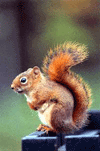
Squirrel ESP
Dig this: A group of researchers has discovered that red squirrels appear to be able to predict the future.
At least, the future of the forests in which they live. American and Eurasian red squirrels live in spruce trees, and love to eat spruce tree seeds. To try and thwart the squirrels, the trees long ago evolved an interesting defense: An unpredictable boom-and-bust period of seed production. The trees will produce several low-seed years in a row and then, boom, outta nowhere and seemingly at random, a bumper crop of seeds. The idea is that the trees will starve the squirrels in the lean years, thus reducing the squirrel population -- whereupon the trees will launch a massive seed offensive to try and frantically reproduce while the squirrels are on the ropes.
But here's the thing: The squirrels have fought back. A team led by Stan Boutin of the University of Alberta studied the squirrels' mating patterns, and Boutin found something remarkable: The squirrels appear to be able to predict when the trees are going to randomly produce a bumper crop. In a high-yield year, several months before the trees produce their seeds, the squirrels engage in a second mating cycle, doubling the size of their broods. The squirrels are somehow seeing into the future of the trees -- or at least making incredibly accurate bets.
As Boutin said in a press release:
"It's like the squirrels are using a very successful stock market strategy. Most of us invest conservatively when the market is down because our funds are tight and we can't predict when things will turn around. It's not until the market has improved and is humming along that we increase our investment. Squirrels do the opposite, investing heavily when they have barely enough to get by but just before the market turns favorable. The result is that their investment 'their babies' pay big dividends in the upcoming favorable market, which in this case is lots of seed."
So maybe we should all have red squirrels managing our financial portfolios, kind of like the way monkeys throwing darts at a board full of stock symbols tend to outperform the S&P 500. Seriously, though, it's still a mystery as to how the squirrels pull off this trick. Clearly, the trees are giving off some sort of signal that they're about to jump into high-seed production. But what?
(Thanks to Ian Daly for this one!)
Posted by Clive Thompson at January 06, 2007 10:49 AM
Trackback Pings
TrackBack URL for this entry: http://www.collisiondetection.net/mt3/mt-tb.cgi/1602
Obviously I'm not going to complain about a squirrel post, given my proclivities... :D However, I take task with the following assumption:
"To try and thwart the squirrels, the trees long ago evolved an interesting defense: An unpredictable boom-and-bust period of seed production."
This is a hypothesis, and it is this hypothesis which leads to the confusion in the conclusion. Change this hypothesis, change the conclusion.
The relationship between most squirrel species and the trees they relate to is close to symbiotic - although some squirrel species disable the seeds by biting the ends off, this is not a given, and even in the cases of squirrels that do this many still germinate. Certain tree species are dependant upon (or at least heavily benefit from) animals to spread their seeds.
The assumption that the squirrels are in a competitive cycle with the trees creates the confusion. If the squirrels and the trees are treated as a co-operative biome element, then the behaviour of the squirrels becomes less surprising, as what we are talking about is synchronisation of life cycle between symbiotes, which is more or less expected behaviour.
In short, I suggest that this mystery occurs solely as a result of treating the situation between squirrels and trees as antagonistic.
I'll wager if you run a computer simulation on this, you'll find that a boom period of seeds works better for both the trees and the squirrels - an annual boom would kill off the squirrels through overpopulation, and not help the trees significantly. But an intermittant boom helps both the trees (larger harvest carried further afield) and the squirrels (regenerative population cycle) - it's a potential selective advantage for both.
That's my take on this, at least, but of course there are many other possible models.
Take care!
Posted by: Chris at January 8, 2007 6:54 AM
PS: Of course, this doesn't answer your question about signalling. ;) It is possible for the two species to be in synch without a signalling mechanism, though - but we couldn't prove it easily. :)
I really suspect that an unpredictable boom period is of more benefit to the squirrels than to the trees, though, because the predators who feed on arboreal mammals have populations that vary with their food source and cannot compensate for unpredictable booms, but I've already rambled on for too long.
Best wishes!
Posted by: Chris at January 8, 2007 7:01 AM
Excellent post! I don't follow evolutionary theory closely enough to know whether there's any cognitive disjoint between the concept of competition to keep your species alive and the symbiosis that marks many groups' interactions. Is there? Or is the concept/metaphor of competition here just another way of looking at the concept/metaphor of symbiosis, and vice versa?
Posted by: Clive at January 8, 2007 1:49 PM
I think your latter comment is on the ball - interpretation of biological behaviour depends greatly upon the metaphor/model you choose - different model, different conclusion (in general terms, at least).
Best wishes!
Posted by: Chris at January 9, 2007 4:52 AM
Post a comment
Obviously I'm not going to complain about a squirrel post, given my proclivities... :D However, I take task with the following assumption:
"To try and thwart the squirrels, the trees long ago evolved an interesting defense: An unpredictable boom-and-bust period of seed production."
This is a hypothesis, and it is this hypothesis which leads to the confusion in the conclusion. Change this hypothesis, change the conclusion.
The relationship between most squirrel species and the trees they relate to is close to symbiotic - although some squirrel species disable the seeds by biting the ends off, this is not a given, and even in the cases of squirrels that do this many still germinate. Certain tree species are dependant upon (or at least heavily benefit from) animals to spread their seeds.
The assumption that the squirrels are in a competitive cycle with the trees creates the confusion. If the squirrels and the trees are treated as a co-operative biome element, then the behaviour of the squirrels becomes less surprising, as what we are talking about is synchronisation of life cycle between symbiotes, which is more or less expected behaviour.
In short, I suggest that this mystery occurs solely as a result of treating the situation between squirrels and trees as antagonistic.
I'll wager if you run a computer simulation on this, you'll find that a boom period of seeds works better for both the trees and the squirrels - an annual boom would kill off the squirrels through overpopulation, and not help the trees significantly. But an intermittant boom helps both the trees (larger harvest carried further afield) and the squirrels (regenerative population cycle) - it's a potential selective advantage for both.
That's my take on this, at least, but of course there are many other possible models.
Take care!
Posted by: Chris
at January 8, 2007 6:54 AM
PS: Of course, this doesn't answer your question about signalling. ;) It is possible for the two species to be in synch without a signalling mechanism, though - but we couldn't prove it easily. :)
I really suspect that an unpredictable boom period is of more benefit to the squirrels than to the trees, though, because the predators who feed on arboreal mammals have populations that vary with their food source and cannot compensate for unpredictable booms, but I've already rambled on for too long.
Best wishes!
Posted by: Chris
at January 8, 2007 7:01 AM
Excellent post! I don't follow evolutionary theory closely enough to know whether there's any cognitive disjoint between the concept of competition to keep your species alive and the symbiosis that marks many groups' interactions. Is there? Or is the concept/metaphor of competition here just another way of looking at the concept/metaphor of symbiosis, and vice versa?
Posted by: Clive
at January 8, 2007 1:49 PM
I think your latter comment is on the ball - interpretation of biological behaviour depends greatly upon the metaphor/model you choose - different model, different conclusion (in general terms, at least).
Best wishes!
Posted by: Chris
at January 9, 2007 4:52 AM