
« PREVIOUS ENTRY
How YouTube is saving the lost art of guitar wanking
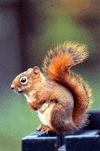
Dig this: A group of researchers has discovered that red squirrels appear to be able to predict the future.
At least, the future of the forests in which they live. American and Eurasian red squirrels live in spruce trees, and love to eat spruce tree seeds. To try and thwart the squirrels, the trees long ago evolved an interesting defense: An unpredictable boom-and-bust period of seed production. The trees will produce several low-seed years in a row and then, boom, outta nowhere and seemingly at random, a bumper crop of seeds. The idea is that the trees will starve the squirrels in the lean years, thus reducing the squirrel population — whereupon the trees will launch a massive seed offensive to try and frantically reproduce while the squirrels are on the ropes.
But here’s the thing: The squirrels have fought back. A team led by Stan Boutin of the University of Alberta studied the squirrels’ mating patterns, and Boutin found something remarkable: The squirrels appear to be able to predict when the trees are going to randomly produce a bumper crop. In a high-yield year, several months before the trees produce their seeds, the squirrels engage in a second mating cycle, doubling the size of their broods. The squirrels are somehow seeing into the future of the trees — or at least making incredibly accurate bets.
As Boutin said in a press release:
“It’s like the squirrels are using a very successful stock market strategy. Most of us invest conservatively when the market is down because our funds are tight and we can’t predict when things will turn around. It’s not until the market has improved and is humming along that we increase our investment. Squirrels do the opposite, investing heavily when they have barely enough to get by but just before the market turns favorable. The result is that their investment ‘their babies’ pay big dividends in the upcoming favorable market, which in this case is lots of seed.”
So maybe we should all have red squirrels managing our financial portfolios, kind of like the way monkeys throwing darts at a board full of stock symbols tend to outperform the S&P 500. Seriously, though, it’s still a mystery as to how the squirrels pull off this trick. Clearly, the trees are giving off some sort of signal that they’re about to jump into high-seed production. But what?
(Thanks to Ian Daly for this one!)
I'm Clive Thompson, the author of Smarter Than You Think: How Technology is Changing Our Minds for the Better (Penguin Press). You can order the book now at Amazon, Barnes and Noble, Powells, Indiebound, or through your local bookstore! I'm also a contributing writer for the New York Times Magazine and a columnist for Wired magazine. Email is here or ping me via the antiquated form of AOL IM (pomeranian99).
ECHO
Erik Weissengruber
Vespaboy
Terri Senft
Tom Igoe
El Rey Del Art
Morgan Noel
Maura Johnston
Cori Eckert
Heather Gold
Andrew Hearst
Chris Allbritton
Bret Dawson
Michele Tepper
Sharyn November
Gail Jaitin
Barnaby Marshall
Frankly, I'd Rather Not
The Shifted Librarian
Ryan Bigge
Nick Denton
Howard Sherman's Nuggets
Serial Deviant
Ellen McDermott
Jeff Liu
Marc Kelsey
Chris Shieh
Iron Monkey
Diversions
Rob Toole
Donut Rock City
Ross Judson
Idle Words
J-Walk Blog
The Antic Muse
Tribblescape
Little Things
Jeff Heer
Abstract Dynamics
Snark Market
Plastic Bag
Sensory Impact
Incoming Signals
MemeFirst
MemoryCard
Majikthise
Ludonauts
Boing Boing
Slashdot
Atrios
Smart Mobs
Plastic
Ludology.org
The Feature
Gizmodo
game girl
Mindjack
Techdirt Wireless News
Corante Gaming blog
Corante Social Software blog
ECHO
SciTech Daily
Arts and Letters Daily
Textually.org
BlogPulse
Robots.net
Alan Reiter's Wireless Data Weblog
Brad DeLong
Viral Marketing Blog
Gameblogs
Slashdot Games

