
« PREVIOUS ENTRY
I, Columbine Killer: My latest video-game column for Wired News
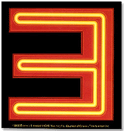
“No man,” as Mme. Cornuel observed three hundred years ago, “is a hero to his valet.” Or, as we might phrase it in more modern language: Powerful people tend to be total dicks to the people beneath them. Though it sounds like classic playah-hatah griping, experiments by psychologists have pretty much proven this to be an ironclad law of human behavior: The more powerful you are, the more clueless you are about the lives, concerns, and needs of those beneath you.
In fact, the latest bit of proof comes in the form of a hilarious study that found that powerful people can’t draw a “E” on their foreheads in a way that other people can read. Specifically, the experiment worked like this: The psychologists took a bunch of subjects and tested them for their relative sense of powerfulness. Then, as they write in their paper (DOC version here) …
… We used a procedure created by Hass (1984) in which participants are asked to draw an “E” on their foreheads. One way to complete the task is to draw an “E” as though the self is reading it, which leads to a backward and illegible “E” from the perspective of another person. The other way to approach the task is to draw the “E” as though another person is reading it, which leads to production of an “E” that is backward to the self (see Figure 1). We predicted that participants in the high power condition would be more likely to draw the “E” in the “self-oriented” direction, indicating a lesser tendency to spontaneously adopt another’s perspective, than would participants in the low power condition.
The results? Sure enough, the people who reported high senses of personal power drew their E’s in a “self-oriented” direction — ignoring the perspective of other people. Those who reported low senses of personal power did the reverse, and drew an E oriented so that others could read it.
Why are people in power so gormlessly self-absorbed? Possibly, the psychologists note, because powerful people by definition tend to have control over scarce resources — ranging from water to money to reputation to physical beauty — and thus are less dependent on other people, which means they don’t need to rely on accurately observing or empathizing with those beneath them. Also, powerful people tend to have a zillion demands on their attention, leaving them less time to muse on what those around them are feeling. (The valet’s experience is precisely the opposite, of course: If you’re someone’s servant, you have to be slavishly devoted to observing your master’s internal state, less you screw up and get canned.) What’s more, their powerful roles may require them to be jerks. Many CEOs claim they’d be psychologically paralyzed and unable to make hard decisions if they thought deeply about the implications for their subalterns, and the same likely holds true for many politicians.
Yet what’s interesting in this study is how easy it is to tweak someone’s sense of personal power, nudging it higher and turning them, at least temporarily, into a self-regarding twit. The people in this study weren’t CEOs or political powerhouses, after all. No, they were just regular students. To provoke feelings of powerfulness, the scientists used a “priming” device that has been reliably shown to work: They had some of the students “recall and write about a personal incident in which they had power over another individual or individuals.” This was enough to momentarily elevate their perception of themselves as powerful, and presto: They drew “self-oriented” Es on their foreheads. Another group of students were told to do the opposite — to recall a position when they were subject to another’s power — and their Es came out in the opposite direction.
I suppose this also tells us something about the whole “be the ball,” Tony-Robbinsesque power-of-positive thinking rubric of today’s self-help psychology, eh? Just focus enough on your inner sense of power and you, too, can transform yourself into a narcissitic creep!
I'm Clive Thompson, the author of Smarter Than You Think: How Technology is Changing Our Minds for the Better (Penguin Press). You can order the book now at Amazon, Barnes and Noble, Powells, Indiebound, or through your local bookstore! I'm also a contributing writer for the New York Times Magazine and a columnist for Wired magazine. Email is here or ping me via the antiquated form of AOL IM (pomeranian99).
ECHO
Erik Weissengruber
Vespaboy
Terri Senft
Tom Igoe
El Rey Del Art
Morgan Noel
Maura Johnston
Cori Eckert
Heather Gold
Andrew Hearst
Chris Allbritton
Bret Dawson
Michele Tepper
Sharyn November
Gail Jaitin
Barnaby Marshall
Frankly, I'd Rather Not
The Shifted Librarian
Ryan Bigge
Nick Denton
Howard Sherman's Nuggets
Serial Deviant
Ellen McDermott
Jeff Liu
Marc Kelsey
Chris Shieh
Iron Monkey
Diversions
Rob Toole
Donut Rock City
Ross Judson
Idle Words
J-Walk Blog
The Antic Muse
Tribblescape
Little Things
Jeff Heer
Abstract Dynamics
Snark Market
Plastic Bag
Sensory Impact
Incoming Signals
MemeFirst
MemoryCard
Majikthise
Ludonauts
Boing Boing
Slashdot
Atrios
Smart Mobs
Plastic
Ludology.org
The Feature
Gizmodo
game girl
Mindjack
Techdirt Wireless News
Corante Gaming blog
Corante Social Software blog
ECHO
SciTech Daily
Arts and Letters Daily
Textually.org
BlogPulse
Robots.net
Alan Reiter's Wireless Data Weblog
Brad DeLong
Viral Marketing Blog
Gameblogs
Slashdot Games

