
« PREVIOUS ENTRY
Radical transparency: First the blog entry, then the article
NEXT ENTRY »
How food illusions trick us into overeating
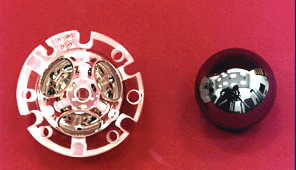
See that object above, on the right? It’s the most perfectly spherical object ever made by hand. It’s only the size of a ping pong ball, but its surfaces are so smooth that were it blown up to the size of Earth, the tallest mountain would be only eight feet high. It’s one of four spheres that are current floating in Gravity Probe B, which is possibly the coolest piece of space engineering evah.
Gravity Probe B is an audacious attempt by NASA and Stanford to confirm Einsteinian physics by measuring, with utterly berserk precision, how much Earth’s enormous mass curves space-time around it. The Probe is a satellite that contains four chambers of superfluid helium, chilled to a martini-like minus-271 degrees Celsius. A sphere — composed of fused quartz — floats inside each chamber and spins rapidly, forming a three-dimensional gyroscope. They’re so free of any physical disturbance that they form an almost perfect space-time reference system. The spheres can detect changes in their positioning as small as 0.5 milliarcseconds — roughly the width of a human hair viewed from 20 miles away. Heh.
So here’s how it works: The Probe is aligned to a distant guide star, IM Pegasi. According to Newtonian physics, a gyroscope free of any interference ought to point in the same direction for eternity. So if the spheres inside Gravity Probe B drift away from their orientation to IM Pegasi, they’re being affected by the Earth’s space-time pull — and we’ll be able to measure it and see if it conforms to Einsteinian predictions. Specifically, the two effects we’ll be able to see are “frame dragging” and the “geodetic effect”. As one scientist described it:
“If experimental science is an art, then I would look at GP-B as a Renaissance masterpiece,” says Jeff Kolodziejczak, NASA’s Project Scientist for GP-B at the Marshall Space Flight Center.
The whole reason I’m blogging about the Probe now is that it’s been in orbit for three years, and NASA is finally getting preliminary data out of it. Apparently the gyroscopes indeed appear to be drifting, though it’ll take a while to separate the signal from the noise to fully confirm the frame-dragging effect. In the meantime, if you want to built a papercraft model of the Probe, there are plans here.
I’ve always wanted to write a humungous magazine feature about Gravity Probe B, because it’s such a freaky epitome of the wonderful craziness and bulldogged tenacity of scientists. It was originally proposed 47 years ago (!!) — but was delayed for decades waiting for funding, waiting for the shuttles to be built to get it aloft, then discovering that, whoops, the shuttles couldn’t actually handle that sort of payload, then designing a rocket to finally get it aloft. They also had wait for all manner of engineering breakthroughs to make those spheres. But what a metaphorically lovely finale: The most perfectly round objects ever made by humanity, flying through the void on one of the purest scientific quests ever.
I'm Clive Thompson, the author of Smarter Than You Think: How Technology is Changing Our Minds for the Better (Penguin Press). You can order the book now at Amazon, Barnes and Noble, Powells, Indiebound, or through your local bookstore! I'm also a contributing writer for the New York Times Magazine and a columnist for Wired magazine. Email is here or ping me via the antiquated form of AOL IM (pomeranian99).

ECHO
Erik Weissengruber
Vespaboy
Terri Senft
Tom Igoe
El Rey Del Art
Morgan Noel
Maura Johnston
Cori Eckert
Heather Gold
Andrew Hearst
Chris Allbritton
Bret Dawson
Michele Tepper
Sharyn November
Gail Jaitin
Barnaby Marshall
Frankly, I'd Rather Not
The Shifted Librarian
Ryan Bigge
Nick Denton
Howard Sherman's Nuggets
Serial Deviant
Ellen McDermott
Jeff Liu
Marc Kelsey
Chris Shieh
Iron Monkey
Diversions
Rob Toole
Donut Rock City
Ross Judson
Idle Words
J-Walk Blog
The Antic Muse
Tribblescape
Little Things
Jeff Heer
Abstract Dynamics
Snark Market
Plastic Bag
Sensory Impact
Incoming Signals
MemeFirst
MemoryCard
Majikthise
Ludonauts
Boing Boing
Slashdot
Atrios
Smart Mobs
Plastic
Ludology.org
The Feature
Gizmodo
game girl
Mindjack
Techdirt Wireless News
Corante Gaming blog
Corante Social Software blog
ECHO
SciTech Daily
Arts and Letters Daily
Textually.org
BlogPulse
Robots.net
Alan Reiter's Wireless Data Weblog
Brad DeLong
Viral Marketing Blog
Gameblogs
Slashdot Games

