
« PREVIOUS ENTRY
Preschoolers can engage in “metacognition”
Last week, Wired News published my latest video-game column, and it centers on topic I’ve long obsessed about: The relationship between architecture and the design of a good game — or even the appreciation of a good game.
The piece is online here, and a copy is archived below:
The Subtle Pleasures of Building a Dungeon
by Clive ThompsonI’ve been stumping down this long, stony corridor for about five minutes, trying to reach a remote chamber where I’ll battle a dread knight. But it’s ponderously slow going, because there’s too many twisty nooks — which attract evil bats, so I’m forced to stop and fight every 20 seconds. So, like many RPG gamers, I start bitching: Who designed this place?
Ah, that’s the problem. I did.
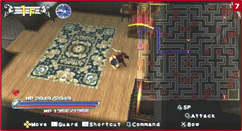
I was playing Dungeon Maker: Hunting Ground on my PSP. It’s a fairly by-the-numbers role-playing game, with one twist: You create the dungeon yourself.
Basically, you build a small dungeon, then wander around in it in real time, killing any monsters that show up. You use the loot from your kills to build an even more tricked-out, phat dungeon — which attracts ever more lethal and profitable monsters. This allows you to build an even bigger dungeon, attracting yet more monsters, etc., etc. It is, if you can dig this, a recursive dungeon crawler.
And it isn’t enough merely to build your dungeon big. No, if you want to attract really top-flight monsters you need to understand their psychology, and even their aesthetics. Evil spirits and mongrels? They like twisty, winding passages. Intellectual Kobolds? They prefer book-lined studies, so they can get in a quiet evening of reading before you kill them. The gameplay quickly turns into a sort of Extreme Makeover of the damned. Before I knew it, I’d spent seven hours frantically rearranging furniture and building new wings.
Basically, if you strip away the ghouls and enchanted magikal attacks, it’s a game about … architecture.
Yet here’s the thing: In a way, all games are. That’s what “level design” is, after all: Architecture and landscape design. If you listen to gamers rave — or complain — about their latest title, half the time they’re talking about what urban theorists would call the “built environment.”
When we assess the multiplayer maps for Halo 3, we argue about whether there are enough nooks to hide inside, or sufficiently sneaky promontories from which to snipe. We whine about the monotonous corridor design in most RPGs. One of my only major complaints about Super Paper Mario was entirely architectural: The game forced you to ponderously double back every time you wanted to reach a save point.
Similarly, one of the biggest complaints about multiplayer world games is that they force you spend hours meandering around on foot to reach quest points that are, virtually, miles apart. (It’s like playing golf, without a golf cart, eternally, in hell.) Why are online worlds created that way? It’s intentional: The goal is to motivate newbies to “level up” high enough to get a mount they can ride around. The design exists purely to nudge our behavior in a certain direction. I understand the architectural intent, and I despise it.
Dungeon Maker, however, also managed to quell much of my whining, because it confronted me for the first time with how damn hard is it to build a good video-game dungeon. Sure, I tried to avoid tediously long corridor crawls. But every time I added another parlor room to lure another gibbering fiend, I inevitably added more complexity and more sprawl. Then I’d go into my creation and — whoops — my thumbs were numbed with the effort of schlepping from place to place.
By the time I’d crafted my fourth level, I had the surreal experience of revisiting my first level and literally being unable to remember why the hell I made the creative decisions I’d made. Stupid, stupid: Putting the staircase in the far northeast passage? What was I thinking? “Man,” I thought as I lumbered down yet another passageway, “this dungeon blows.”
Granted, there have been previous video games that included level-design as a core part of the play — such as Neverwinter Nights, RPG Maker, or almost any moddable shooter. But these usually required a level of scripting geekery that I (and most average gamers) did not possess. Dungeon Maker makes it point-and-click easy.
I now wish that more RPGs offered DIY dungeon crafting — because as I’ve discovered, architecture can be a weirdly enjoyable pastime. Dungeon Maker was fun, but not because of the actual fighting: The rote, button-mashing combat seemed practically to be an afterthought. No, the joy was entirely in building. It reminded me of when I was a kid and I’d sit around with graph paper, designing massive Dungeons & Dragons levels and imagining how badly I’d p0wn my friends. (It was more fun making them than playing them, really.)
The design theorist Christopher Alexander used to claim that all humans have an innate facility for architecture — that everyone is capable of visualizing and imagining good living spaces. Looking at today’s pop culture, where there are about 47 different reality TV shows devoted to home renovation, you could argue that he was right.
And did you ever wonder how The Sims became the world’s top-selling game? It’s not because people actually play it. Most players set up a couple of families and watch them evolve, but this quickly gets dull. Ah, but then Sims gamers discover the real game within the game. They learn about the cheats that give them infinite simoleans — whereupon they begin joyfully building uninhabited monster homes, a pastime that accounts for the vast majority of the game’s replayability.
Will Wright’s genius wasn’t in making a sim of human life. It was in making the world’s easiest-to-use CAD tool. Apparently, there’s a dungeonmaster in all of us — just waiting to come out.
I'm Clive Thompson, the author of Smarter Than You Think: How Technology is Changing Our Minds for the Better (Penguin Press). You can order the book now at Amazon, Barnes and Noble, Powells, Indiebound, or through your local bookstore! I'm also a contributing writer for the New York Times Magazine and a columnist for Wired magazine. Email is here or ping me via the antiquated form of AOL IM (pomeranian99).

ECHO
Erik Weissengruber
Vespaboy
Terri Senft
Tom Igoe
El Rey Del Art
Morgan Noel
Maura Johnston
Cori Eckert
Heather Gold
Andrew Hearst
Chris Allbritton
Bret Dawson
Michele Tepper
Sharyn November
Gail Jaitin
Barnaby Marshall
Frankly, I'd Rather Not
The Shifted Librarian
Ryan Bigge
Nick Denton
Howard Sherman's Nuggets
Serial Deviant
Ellen McDermott
Jeff Liu
Marc Kelsey
Chris Shieh
Iron Monkey
Diversions
Rob Toole
Donut Rock City
Ross Judson
Idle Words
J-Walk Blog
The Antic Muse
Tribblescape
Little Things
Jeff Heer
Abstract Dynamics
Snark Market
Plastic Bag
Sensory Impact
Incoming Signals
MemeFirst
MemoryCard
Majikthise
Ludonauts
Boing Boing
Slashdot
Atrios
Smart Mobs
Plastic
Ludology.org
The Feature
Gizmodo
game girl
Mindjack
Techdirt Wireless News
Corante Gaming blog
Corante Social Software blog
ECHO
SciTech Daily
Arts and Letters Daily
Textually.org
BlogPulse
Robots.net
Alan Reiter's Wireless Data Weblog
Brad DeLong
Viral Marketing Blog
Gameblogs
Slashdot Games

