

I’m really not a morning person. But according to a new study, this tells you a lot about my personality: I’m more likely to be “creative”, “risk-taking”, “non-conformist” and “independent” than early risers.
This work came from the psychologist Juan Francisco Diaz-Morales, who recently decided to see if there were any regularities in the personality traits of early risers versus evening people. He took 360 undergraduates, ranked their relative sleep/wake habits, and then scaled them on the Millon Index of Personality Styles. According to the blog of the British Psychological Society, here’s what he found:
[Morning people] tend to be of a certain personality: they favour the tangible and concrete, they trust their experience and the observable over intuition and feelings; they have an attention to detail and a preference for logic. They are respectful of authority, care about social conventions and are rarely politically radical. [snip]
In contrast to morning types, evening people preferred the symbolic over the concrete, were creative and risk-taking, and tended to be non-conformist and independent.
Assuming this finding holds water, it’d have some pretty interesting implications for the workplace, eh? A smart company would organize its workday to optimize tasks based on which type of person is needed for the job — a logic-crunching task versus a blue-skying brainstorm — and when they’re likely to be at their best.
Indeed, I’ve long suspected that the 9 to 5 schedule is kind of suboptimal for productivity; it’s patently clear that different people shine at different times in the day. And you could argue that — for white-collar work, at least — the time-delimited bounds of the workday are more up for grabs now than they’ve ever been. Historically, one big reason we settled on the 9 to 5 timeslot is for purposes of industrial efficiency: We needed people to be at their desks for roughly the same time period so they could work together. But email, mobile phones, and digital documents obviate a lot of those old-skool practical considerations. A lot of the rationale for 9 to 5 worktimes is now practically a phantom-limb phenomenon in corporate culture.
(Alas, the full study is behind a paywall, so I couldn’t read it, but here’s the official link.)
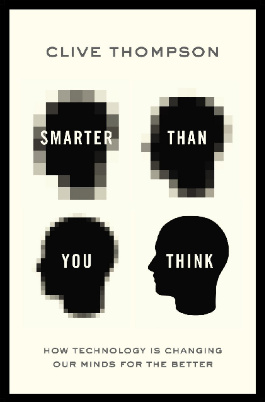
I'm Clive Thompson, the author of Smarter Than You Think: How Technology is Changing Our Minds for the Better (Penguin Press). You can order the book now at Amazon, Barnes and Noble, Powells, Indiebound, or through your local bookstore! I'm also a contributing writer for the New York Times Magazine and a columnist for Wired magazine. Email is here or ping me via the antiquated form of AOL IM (pomeranian99).
ECHO
Erik Weissengruber
Vespaboy
Terri Senft
Tom Igoe
El Rey Del Art
Morgan Noel
Maura Johnston
Cori Eckert
Heather Gold
Andrew Hearst
Chris Allbritton
Bret Dawson
Michele Tepper
Sharyn November
Gail Jaitin
Barnaby Marshall
Frankly, I'd Rather Not
The Shifted Librarian
Ryan Bigge
Nick Denton
Howard Sherman's Nuggets
Serial Deviant
Ellen McDermott
Jeff Liu
Marc Kelsey
Chris Shieh
Iron Monkey
Diversions
Rob Toole
Donut Rock City
Ross Judson
Idle Words
J-Walk Blog
The Antic Muse
Tribblescape
Little Things
Jeff Heer
Abstract Dynamics
Snark Market
Plastic Bag
Sensory Impact
Incoming Signals
MemeFirst
MemoryCard
Majikthise
Ludonauts
Boing Boing
Slashdot
Atrios
Smart Mobs
Plastic
Ludology.org
The Feature
Gizmodo
game girl
Mindjack
Techdirt Wireless News
Corante Gaming blog
Corante Social Software blog
ECHO
SciTech Daily
Arts and Letters Daily
Textually.org
BlogPulse
Robots.net
Alan Reiter's Wireless Data Weblog
Brad DeLong
Viral Marketing Blog
Gameblogs
Slashdot Games

