
« PREVIOUS ENTRY
The acrobatic balance of Halo 3: My latest Wired News column
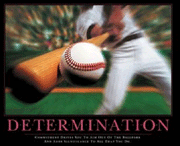
“Never give in!” Winston Churchill famous intoned. “Never give in! Never, never, never, never — in nothing great or small, large or petty.”
Good advice for winning a world war, clearly! But apparently it’s unhealthy to behave this way in everyday life. According to a new study out of the University of British Columbia, sometimes it’s psychologically healthier to just give up.
The scientists who did the study ran three experiments where they gathered physiological data about a bunch of teenagers with various attitudes towards achieving hard goals. As a press release notes …
… The psychologists followed teenagers for a full year. Over that time, individuals who did not persist obtaining hard to reach goals had much lower levels of a protein called CRP, an indicator of bodily inflammation. Inflammation has recently been linked to several serious diseases, including diabetes and heart disease, suggesting that healthy but overly tenacious teens may already be on the road toward chronic illness later in life.
Accordingly, Miller and Wrosch suggest it may be more prudent to cut one’s losses in the face of an insurmountable obstacle. “When people are faced with situations in which they cannot realize a key life goal, the most adaptive response for physical and mental health may be to disengage from this goal,” write the authors.
Apparently the healthiest teens of all were the ones who quickly figured out when a goal was going to be overly hard to achieve, quit — but then immediately honed in on a new, more achievable goal. (A PDF of the study is here.)
In a sense, this is another case of “science confirms the obvious”, but it’s nice to actually have some hard data in defense of the fine art of throwing in the towel. There are way too many managers in this country who deploy Successories posters unironically, and they desperately need someone to hand them a copy of this research.
I'm Clive Thompson, the author of Smarter Than You Think: How Technology is Changing Our Minds for the Better (Penguin Press). You can order the book now at Amazon, Barnes and Noble, Powells, Indiebound, or through your local bookstore! I'm also a contributing writer for the New York Times Magazine and a columnist for Wired magazine. Email is here or ping me via the antiquated form of AOL IM (pomeranian99).
ECHO
Erik Weissengruber
Vespaboy
Terri Senft
Tom Igoe
El Rey Del Art
Morgan Noel
Maura Johnston
Cori Eckert
Heather Gold
Andrew Hearst
Chris Allbritton
Bret Dawson
Michele Tepper
Sharyn November
Gail Jaitin
Barnaby Marshall
Frankly, I'd Rather Not
The Shifted Librarian
Ryan Bigge
Nick Denton
Howard Sherman's Nuggets
Serial Deviant
Ellen McDermott
Jeff Liu
Marc Kelsey
Chris Shieh
Iron Monkey
Diversions
Rob Toole
Donut Rock City
Ross Judson
Idle Words
J-Walk Blog
The Antic Muse
Tribblescape
Little Things
Jeff Heer
Abstract Dynamics
Snark Market
Plastic Bag
Sensory Impact
Incoming Signals
MemeFirst
MemoryCard
Majikthise
Ludonauts
Boing Boing
Slashdot
Atrios
Smart Mobs
Plastic
Ludology.org
The Feature
Gizmodo
game girl
Mindjack
Techdirt Wireless News
Corante Gaming blog
Corante Social Software blog
ECHO
SciTech Daily
Arts and Letters Daily
Textually.org
BlogPulse
Robots.net
Alan Reiter's Wireless Data Weblog
Brad DeLong
Viral Marketing Blog
Gameblogs
Slashdot Games

