
« PREVIOUS ENTRY
How to defend Larry Craig with communications theory
NEXT ENTRY »
Bloxorz!
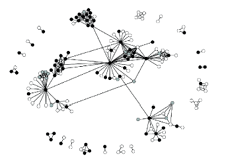
This is beyond awesome: Pablo Gleiser, a physicist, took 12,942 issues of various Marvel comics, traced all the connections between 6,486 different characters — and produced a massive social-network map of the Marvel Universe.
Some of his findings? Superheroes have way more connections than villians — which may help explain why they win so often. “Only heroes team up,” Gleiser notes, “while villains do not.” Superheroes are superconnectors; villians sit on the periphery of the social web. This, he theorizes, is probably due to the built-in rules that comic-book authors must follow. As he writes in his paper, the PDF of which you can download here:
We believe that the origin of this division is due to the fact that, although the Marvel Universe incorporates elements from fantasy and science-fiction the arguments of the stories were restricted by a set of rules established in the Comics Authority Code of the Comics Magazine Association of America. In particular, rule number five in part A of the code for editorial matter states that “Criminals shall not be presented so as to be rendered glamorous or to occupy a position which creates the desire for emulation …”
With great power comes great responsibility. Speaking of which, Gleiser found that the single-strongest bond in the network — i.e. the tie most commonly reiterated in Marvel plots — is between Peter Parker and Mary Jane. (“A fact,” he writes, “that shows that although the [Marvel Universe] deals mainly with superheroes and villians the most popular plot is a love story.”) The next most-important superconnectors? The Thing, the Beast, Namor, and the Hulk.
That map above illustrates the sad plight of villians. It shows the strongest 300 links. The black dots are heroes — most of which are nicely and tightly interconnected. The white dots are villians, which tend to be connected only to a black dot — usually their sworn arch-enemy. (The grey dots are “other types of characters, such as people, gods or nodes with no classification.”)
But here’s a thought, fanboys. Network theory also predicts “the strength of weak ties”: I.e. the fact that while superconnectors have lots of strong connections, the most interesting, creative and unpredictable social effects come from weak links — connections between people only slightly joined. Does this hold true for the Marvel Universe? Are the stories in which those weak ties appear particularly intriguing, wacky, or unexpected than the ones that are characterized purely by strong ties? I want some grad student to tackle this one and get a PhD for it.
(Thanks to the New Scientist for this one!)
I'm Clive Thompson, the author of Smarter Than You Think: How Technology is Changing Our Minds for the Better (Penguin Press). You can order the book now at Amazon, Barnes and Noble, Powells, Indiebound, or through your local bookstore! I'm also a contributing writer for the New York Times Magazine and a columnist for Wired magazine. Email is here or ping me via the antiquated form of AOL IM (pomeranian99).
ECHO
Erik Weissengruber
Vespaboy
Terri Senft
Tom Igoe
El Rey Del Art
Morgan Noel
Maura Johnston
Cori Eckert
Heather Gold
Andrew Hearst
Chris Allbritton
Bret Dawson
Michele Tepper
Sharyn November
Gail Jaitin
Barnaby Marshall
Frankly, I'd Rather Not
The Shifted Librarian
Ryan Bigge
Nick Denton
Howard Sherman's Nuggets
Serial Deviant
Ellen McDermott
Jeff Liu
Marc Kelsey
Chris Shieh
Iron Monkey
Diversions
Rob Toole
Donut Rock City
Ross Judson
Idle Words
J-Walk Blog
The Antic Muse
Tribblescape
Little Things
Jeff Heer
Abstract Dynamics
Snark Market
Plastic Bag
Sensory Impact
Incoming Signals
MemeFirst
MemoryCard
Majikthise
Ludonauts
Boing Boing
Slashdot
Atrios
Smart Mobs
Plastic
Ludology.org
The Feature
Gizmodo
game girl
Mindjack
Techdirt Wireless News
Corante Gaming blog
Corante Social Software blog
ECHO
SciTech Daily
Arts and Letters Daily
Textually.org
BlogPulse
Robots.net
Alan Reiter's Wireless Data Weblog
Brad DeLong
Viral Marketing Blog
Gameblogs
Slashdot Games

