
« PREVIOUS ENTRY
Why geeks will rescue the Earth: My latest Wired magazine column
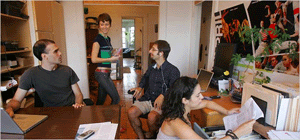
Do you work from home? When you answer the phone, do you try to pretend you’re at an “office” — or do you let your colleagues know where you are? Marci Alboher wrote an interesting trend story in today’s New York Times claiming that work-from-home entrepreneurs are increasingly candid about the fact that they work from home. If noise leaks in from the dog or kids in the background, it’s not longer a big deal, according to the enterpreneurs that Alboher interviews, as well as this pundit:
“It is no longer a faux pas to have a life at the other end of the telephone line.” Ms. Jackson said. “It can make you feel like you’re dealing with a holistic person. And it is just another sign that we are moving away from the industrial age in that we no longer have two totally separate spheres called work and home.”
This trend is certainly true for me. When I first started working from home in 1994, I’d go to considerable pains to disguise the fact that I was working from my crummy bedroom, because a lot of interviewees were uncomfortable with it. It didn’t seem professional to them; they expected reporters to be working in some 1940s-style office tower that looked like The Daily Planet or something. But in the last few years, this bias has dropped entirely. Nobody could really care less where I am, so long as I’m on the phone.
The article offers a few reasons explaining this shift, but neglects one that I think is the most powerful: The mobile phone.
In the last five years, mobile phones have transformed the acoustic and geographic environments in which people conduct business. They, almost more than the Internet, decoupled the relationship between “work” and an “office.” These days, my interviewees are half the time talking to me while they walk down the street or hang out in hotel conference hallways or ride in their diamond/titanium UFOs to their secret Arctic lairs — so why would they care, or even notice, that I’m not working from an office too?
(The picture above is from the article — the home-office of some Brooklyn dance company.)
I'm Clive Thompson, the author of Smarter Than You Think: How Technology is Changing Our Minds for the Better (Penguin Press). You can order the book now at Amazon, Barnes and Noble, Powells, Indiebound, or through your local bookstore! I'm also a contributing writer for the New York Times Magazine and a columnist for Wired magazine. Email is here or ping me via the antiquated form of AOL IM (pomeranian99).
ECHO
Erik Weissengruber
Vespaboy
Terri Senft
Tom Igoe
El Rey Del Art
Morgan Noel
Maura Johnston
Cori Eckert
Heather Gold
Andrew Hearst
Chris Allbritton
Bret Dawson
Michele Tepper
Sharyn November
Gail Jaitin
Barnaby Marshall
Frankly, I'd Rather Not
The Shifted Librarian
Ryan Bigge
Nick Denton
Howard Sherman's Nuggets
Serial Deviant
Ellen McDermott
Jeff Liu
Marc Kelsey
Chris Shieh
Iron Monkey
Diversions
Rob Toole
Donut Rock City
Ross Judson
Idle Words
J-Walk Blog
The Antic Muse
Tribblescape
Little Things
Jeff Heer
Abstract Dynamics
Snark Market
Plastic Bag
Sensory Impact
Incoming Signals
MemeFirst
MemoryCard
Majikthise
Ludonauts
Boing Boing
Slashdot
Atrios
Smart Mobs
Plastic
Ludology.org
The Feature
Gizmodo
game girl
Mindjack
Techdirt Wireless News
Corante Gaming blog
Corante Social Software blog
ECHO
SciTech Daily
Arts and Letters Daily
Textually.org
BlogPulse
Robots.net
Alan Reiter's Wireless Data Weblog
Brad DeLong
Viral Marketing Blog
Gameblogs
Slashdot Games

