
« PREVIOUS ENTRY
The cyborg of the Red Sox
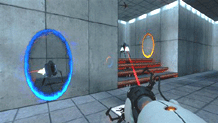
Last week, Wired News published my latest video-game column — and this one is about Portal, an incredibly weird and cool teleportation game that, as I discover, winds up playing some nifty tricks with physics.
The column is online here, and a permanent copy is below!
In Portal, Violating Physics Proves Weirdly Satisfying
by Clive ThompsonFanboy warning: This column contains some mild gameplay spoilers.
Pretty much everyone who plays Portal, the new space-bending videogame, immediately tries a little physics experiment.
In Portal, you control a gun that can blast two connected oval portals on different surfaces — floors, ceilings and walls. If you step through the first portal, you emerge immediately from the other, teleported instantaneously through space, as if you walked through a magic mirror.
This quickly leads any curious player to try a little stunt: You put a portal on the floor in front of you, and then one on the ceiling directly above it. Step into the first hole, and you instantly fall out of the hole in the ceiling — whereupon you fall back into the hole on the ground. Woo hoo! You are now falling endlessly through the holes, over and over again, in a dreamlike, self-created infinite loop.
Let me tell you: It is awesomely fun. And it’s only the beginning of the seriously weird things you can do inside Portal, a game that neatly blows open the way you’ll think about the space inside games.
At heart, Portal is a puzzle game that adheres religiously to the traditions of the genre. You must navigate blocky 3-D obstacle courses while avoiding various hazards and tripping switches with weights — often in cunningly difficult sequences — while trying all the time to keep from falling off a ledge into the fatal muck below. This is quite standard puzzle gruel.
It’s the teleportation that transforms the game, because it allows the designers to craft challenges that seem, at first, flatly impossible — until you grasp some of the deeply odd tricks the portals let you accomplish.
For example, one stunt I used frequently involved setting up a portal somewhere high above me on a wall. Then I’d jump off a cliff, start falling — and then open a portal precisely at the spot where I was due to hit the ground. My momentum would blast me out the portal high above the ground, shooting me like a bullet through the air to a far-off ledge I couldn’t otherwise reach.
The game constantly challenges you to invent ever more paradoxical feats of self-propulsion. I used the same momentum-gathering technique to bounce myself vertically upward out of a hole in the ground, and then, while flying through the air, shoot another portal in a nearby piece of ground. (Think of a groundhog popping in and out of his hole, except the holes keep moving.)
The upshot is that Portal, perhaps inadvertently, makes for a hell of an educational game — because you’re constantly mentally calculating the vectors of force and direction you’ll generate by falling through and out of strategically placed holes. Physics teachers could have an absolute field day with this thing — using it to help kids grasp, in a really visceral way, how Newtonian laws of motion work.
Extreme physics-geek warning here: A decent teacher would have to point out that teleportation violates the law of conservation of energy. When you teleport yourself up high on a ledge, you’re effectively “creating” potential energy out of nothing — which is impossible in the real world. Yet this, really, is the genius of the game. The game designers produce their coolest tricks by ruthlessly adhering to most of Newtonian physics but then cleverly violate one key rule — thus allowing you, the gamer, to explore what happens in such a world.
This is precisely the sort of mental thought-experiment that really well-designed games can provide.
Indeed, as I played, I experienced a ton of other delightful “aha” moments, as I deduced clever new ways to use the portals. I’d coax an enemy to fire at me, then use a set of portals to reroute his bullets back at him. (Insanely satisfying.) In another situation, I was trying unsuccessfully to crane my neck to get a view of a remote upper level. Then I realized I could open a portal high on the wall, and use it to simply peer through. Presto: the portal as a surveillance device.
Personally, I hope Valve — or some other game designer — takes this concept up a notch. Why not use this game mechanic to shake up other well-worn genres? Imagine a first-person shooter where you can trigger portals on the fly, popping through them to snipe an enemy. Or think how weird a Mario racing game would be if you could shoot portals that wreak havoc on the racetrack? (And hey — since I find pro sports kind of dull, I suspect football, basketball and soccer videogames could all be awesomely torqued if you allowed players or coaches to generate a few portals.)
Extending the conceit to other forms of gameplay would also give the concept of portals new life. Because as much fun as Portal is, it’s not really something you’re going to want to play for more than five or six hours. It’s more an object lesson in breakthrough game design. Tweak one part of a well-worn game mechanic, and presto — you can open a door to something really new.
I'm Clive Thompson, the author of Smarter Than You Think: How Technology is Changing Our Minds for the Better (Penguin Press). You can order the book now at Amazon, Barnes and Noble, Powells, Indiebound, or through your local bookstore! I'm also a contributing writer for the New York Times Magazine and a columnist for Wired magazine. Email is here or ping me via the antiquated form of AOL IM (pomeranian99).

ECHO
Erik Weissengruber
Vespaboy
Terri Senft
Tom Igoe
El Rey Del Art
Morgan Noel
Maura Johnston
Cori Eckert
Heather Gold
Andrew Hearst
Chris Allbritton
Bret Dawson
Michele Tepper
Sharyn November
Gail Jaitin
Barnaby Marshall
Frankly, I'd Rather Not
The Shifted Librarian
Ryan Bigge
Nick Denton
Howard Sherman's Nuggets
Serial Deviant
Ellen McDermott
Jeff Liu
Marc Kelsey
Chris Shieh
Iron Monkey
Diversions
Rob Toole
Donut Rock City
Ross Judson
Idle Words
J-Walk Blog
The Antic Muse
Tribblescape
Little Things
Jeff Heer
Abstract Dynamics
Snark Market
Plastic Bag
Sensory Impact
Incoming Signals
MemeFirst
MemoryCard
Majikthise
Ludonauts
Boing Boing
Slashdot
Atrios
Smart Mobs
Plastic
Ludology.org
The Feature
Gizmodo
game girl
Mindjack
Techdirt Wireless News
Corante Gaming blog
Corante Social Software blog
ECHO
SciTech Daily
Arts and Letters Daily
Textually.org
BlogPulse
Robots.net
Alan Reiter's Wireless Data Weblog
Brad DeLong
Viral Marketing Blog
Gameblogs
Slashdot Games

