Alas, it also sounds more monotonous, and psychoacousticians have long argued that highly compressed music leads to "ear fatigue". So the upshot is today's music sounds less and less distinctive, with performances that have less and less nuance. It's gotten so bad that even the music industry is getting worried that they're ruining music. According to a great piece on this subject in the latest issue of Rolling Stone, a panel at last year's South by Southwest music conference -- entitled "Why Does Today's Music Sound Like Shit?" -- was focused almost exclusively on the problem of overcompression. The producers suggested that it's time to start recording music with far less compression, so that the true sonic variety of a song can be re-experienced.
Fair enough. But here's the really interesting thing: The story goes on to point out that it may simply be too late:
When I read that final line, I was, I have to confesss, struck by a powerful -- if snotty -- thought: Thank god the age of audiophiles is over. Speaking as someone who loves music, who has actually played and recorded pop music for 20 years, and who still plays six different instruments, I think music is crucial to the human spirit.
I think what annoys me about audiophiles -- and perhaps what has begun to annoy me, ever so slightly, about the handwringing over "the loudness wars" -- is that they posit a way-too-fussy, sancitmonious attitude towards how one ought to listen to pop music. Because when it comes to pop music, are ultra-high-precision sound systems really so necessary, or even desirable? After all, pop music originally came to life in the 50s and 60s on horrifically tinny AM radios. Indeed, the playback devices were so crude that producers had to mix the stuff specifically to take account for the jurassic properties of the godawful speakers. (One of main reasons Phil Spector invented the "Wall of Sound" was that it gave a relatively fat sound when played on jukebox-primitive sound systems.)
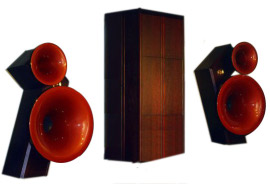
In fact, I've come to believe that crappy technology -- lousy studios, horrible playback devices -- is a boon to pop music. Because when you strip out the superhigh and superlow frequencies that send audiophiles -- planted with geometric triangulation betwixt their $325,000 Acapella speakers (pictured above!) -- into such supposedly quivering raptures, you're forced to reckon with a music simpler question, which is: Is the song any good? A really terrific pop song can survive almost any acoustic mangling and still be delightful. A mediocre one can't. A mediocre song needs a doubleplusgood sound-system to bring out its half-baked appeal; a truly excellent tune is catchy even when played on a kazoo. For years, I have listened to all of my music either via a) a pair of $25 Harmon Kardon speakers attached to my computer, or b) an MP3 player of dubious provenance, outfitted with earbuds that I buy, well, at whatever electronics store I happen to be nearest when the old ones break down, and with whatever spare change I have in my pockets -- and I do not think my soul is any the worse for wear.
Granted, maybe I'd think differently if the main thing I was listening to were classic music or opera, instead of pop music. But pop music is supposed to be a disposable, gritty little lo-fi affair.
The audiophile is dead. Long live the audiophile!
A few years ago I read a single sentence that has stuck with me, essentially summarizing this debate: "At some point you stop listening to the music and start listening to the equipment."
That pretty much killed any snobby ambitions I had about trying to buy high end gear.
I think the more legit concern over compression would be damage it does to non-pop music. Pop music is supposed to be like pop corn - cheap, artificial, and pretty much disposable. Non pop music may actually have more of an impact on you if it has some quiet parts and some loud parts.
But I agree that you can get perfectly adequate speakers for under $100, and have no problem enjoying every kind of music with them. I've heard plenty of speakers made in the 1970s that sound utterly amazing; the basic technology today is the same, just less expensive.
Thankfully I'm not old enough to have any friends with crazy expensive equipment and shelves of old vinyl. I can only imagine how dreadful that would be.
BTW Clive, I write better when I'm angry, too.
Posted by: Peter at January 6, 2008 11:56 PM
"At some point you stop listening to the music and start listening to the equipment": Heh -- precisely. Mind you, since I'm a huge gearhead, I have enormous sympathy for people who are more interested in their medium than its message. So my loyalties are divided here.
As to the quality of speakers under $100 -- you're right, many are quite good, and it's partly because of technological advances. The same thing is happening with recording technologies, too. Speaking of compression, I own a couple of recently-made cheap compressors -- each cost $500 or less, and I got them on sale for $300 each -- that perform as well as $2,000 compressors would have 15 years ago.
Posted by: Clive at January 7, 2008 11:20 AM
I'd assume that true audiophiles would probably have musical tastes ranging beyond even great lo-fi-friendly pop music to classical, jazz, etc., and would thus need better equipment to partake in the full range of their tastes.
Posted by: braine at January 7, 2008 12:20 PM
I'm not an audiophile by any means, but I disagree wholeheartedly, and so does this guy, based on some studies from last year:
"Poorer-fidelity music stimulates the brain in different ways," says Dr. Robert Sweetow, head of UCSF audiology department. "With different neurons, perhaps lesser neurons, stimulated, there are fewer cortical neurons connected back to the limbic system, where the emotions are stored."
http://www.sfgate.com/cgi-bin/article.cgi?f=/c/a/2007/08/08/DDEJR7KN11.DTL
Posted by: Chad at January 7, 2008 1:52 PM
braine, sure, I can see where an audiophile that has a big collection of jazz or classical -- or even, say, acoustic blues -- would want a high-fidelity system. But the specific context in which the Rolling Stone interviewee raised the issue of audiophilia was with respect to rock and pop music, where I think this applies rather less, if at all.
Chad, yeah, good point. There are lots of studies arguing that low-fidelity sound produces all manner of mental fatigue. I think I blogged about the question of MP3-mental-damage back when it first came up a few years ago, though I can't find my posting now ... The question is, what precisely consists of high-fidelity music, or rather, adequate fidelity music? A pair of $100 speakers or earphones? A pair that costs $4,000? Or $25? Or the absence of a power amp -- or the presence of one that costs $50, $500, $5,000?
Posted by: Clive at January 7, 2008 2:20 PM
It's good to have audiophiles around for the same reason it's good to have foodies--crap still exists, and so does the phenomenon of most people not paying very much attention or caring enough to raise a stink. Maybe I wouldn't enjoy 12 hours in a car with Alice Waters, but I'm glad she's been out there talking and showing off to somebody. Being obsessive doesn't necessarily imply being demeaning to others who care less either. Everybody loved Julia Child.
Posted by: MT at January 7, 2008 3:04 PM
Clive, you are writing about something that you don't understand. The contradiction of your diatribe is that you vent hatred of other people, referring to audiophiles as jackasses, because of their sanctimonious attitude. The thing is, I don't consider myself an audiophile by any means, but I do like equipment that provides better sound. Some of the expensive stuff is way overpriced and you can definitely find less costly components that produce great sound. But I dare you to take the time to listen to and compare great sounding high-end speakers to inexpensive ones. You might be surprised by what you hear. But you have to take the time to listen. Have you done that? Or are you just being sanctimonious?
Posted by: Mark at January 7, 2008 8:36 PM
I think of audiophile equipment as analogous to formula one cars, or the space programme: somebody, somewhere has to be always trying to build the very best, so that technology can advance and eventually trickle down to the rest of us.
Posted by: Tony at January 8, 2008 7:25 AM
Clive, since you're forcing musicians to use crappy speakers, could you please also force them to use crappy synths? There's a reason 80's music sounds so good, it's because back when all the synths were crap you needed an actual melody.
Posted by: Bram at January 8, 2008 9:52 AM
I'm not sure that I see the problem of this musical age as over-compression in pop music CDs. Though it could be blamed as being one of the primary causes. and I think we all agree that young people nowadays _hear_ music differently than we once did. What I think I notice most is the general but very absolute lack of command over chords, voicing and harmonic complexity that is demonstrated in all musical genres across the board with out exception as compared to achievements in the same genre one or more generations ago. The very best pop songs now (there are plenty, if you look hard enough) barely hold a candle to the magnificent achievements of the last generation. Film scores is another genre that is a mere specter of its former self.
Why, whats different? Because they had record players back then? Because they were forced to use record players? ...maybe. Our music has completely become infused by the touch of digital electronics. There is hardly anything analog at all about it anymore. except for the part where you put it in your ears. I also have been a musician for over 20 years and play 6 instruments, and as a general rule of thumb I have always noticed that when musical sound waves touch digitization, it almost always loses something.
Though I think this part is subtle. For instance, if you record on reel-to-reel tape and transfer to pro-tools, you're set, as long as you captured the live sound with tape. but if you record straight to DAT or whatever they are using now, you're screwed. I don't know why this is. I just know that there are very subtle do's and dont's and I am not sure that anyone acknowledges what these are correctly... except Steve Albini.
Posted by: Greg at January 8, 2008 8:49 PM
MT, Tony, sure -- the trickle-down effect certainly holds true in tech terms. And I have no problem with audio *enthusiasts* ... I'm talking more of the people who literally turn their noses up at anyone who *doesn't* obsess over their audio quality.
A while ago, Details magazine asked me to write a story about awesome speakers. I visited Singer Audio in New York, where the owner, Andy Singer, let me listen to some bluegrass music on a pair of $40,000 speakers. And I have to admit, the sound was really spectacular! So I can certainly understand the joy of experiencing that level of sound regularly. But as I wandered around the store talking to the staff and customers, it was also true that they were all kind of ... I dunno, sour. They pretty much stared down their noses at anyone who didn't seek out such rich audio experiences.
Which is by way of saying, Mark, that yes indeed, I've experienced really super-high end audio, and I found it incredibly impressive! I didn't find it necessary, however; and I did find the audiophiles I encountered to be incredibly sanctimonious. As for me? I don't think I'm being sanctimonious here ... I'm being obnoxious, and probably just flat-out wrong. There's a difference!
Greg, that's a really interesting point. I'm sure changes in audio tech "train" people to hear in different ways.
Posted by: Clive at January 9, 2008 11:47 AM
Are you sure that there were even that many audiophiles in the first place? I don't think I've ever met one...
Posted by: lewiz at January 9, 2008 9:49 PM
Clive, sorry to get far off-topic. I have always dreamed of owning some klipsch corner horns and a McIntosh amplifier. Good audio equipment sounds great, its just that I definitely see the audio universe has changed. Its different now. I wouldn't even say better or worse. I can't listen to a lot of things now that were gold for me several years ago. Before the internet grew into its own music was the way that young generations communicated to each other. It was how non-jocks got girls. and I think that this has been abandoned to some extent in lieu of the web. Music has lost most of its market-share as a viable medium for idea exchange, so-to-speak. Now music just sounds like an assemblage of sounds. and the great conveyors of old like Bob Dylan have these poignant messages, but they are not for us, not now. so its all outta whack for me for the most part.
Posted by: Greg at January 10, 2008 5:21 AM
My favorite thing to do to an audiophile is casually mention to them that the song they are listening to on their $100k system was recorded with a $50 Shure mic, transmitted over miles of non-oxygen-free cable then through thousands of non-gold connections, maybe even with a few crappy Radio Shack adapters that the intern had to run out and buy, then mixed over $300 Yamaha NS-10 monitors.
Then I watch their heads explode.
Posted by: hendmik at January 10, 2008 1:30 PM
lewiz, heh, yeah, good point -- it was always probably a fairly small crowd.
Greg, that makes sense: If the emotional import of music changes for you -- and its social role -- then that changes the way you listen to it, technologically and otherwise, eh?
hendmik, ahahahaha!
Posted by: Clive at January 10, 2008 3:17 PM
I missed this a few days ago when you first posted it.
Where to begin? There are so many great quotes in your piece that I think I may just have to blog about it at my own place to hit them all.
I love the prisine, clear sound that was all but impossible before the advent of digital. And I do think the loudness wars argument is worth having, to a point. If nothing else, it has made the industry, including producers, think.
Nonetheless, your point about the gritty, lo-fi-ness of pop music is a very good one. I've done a bit of music production and although that era of my life has (sadly) passed, I still listen critically to everything I hear. One thing lacking I don't discern in modern (popular) music is flaws. It's perfect. And much of the time, lifeless.
Listen back to some of those mid-career Beatles recordings. You'll actually here edit points and even mistakes, studio noise, mic hiss. It's all there. Yet it still rocks. If the Beatles aren't your cup of joe, I'm sure Zep hit an H note or two here and there, or maybe the Stones.
I think if we allow some spontaneous error into our music, it might be a bit more human. We might even like it more.
Human beings don't perform at that level of perfection. I'm reminded of that Dove ad where the average looking model is transformed into a goddess by thousands of tiny, artificial touches.
Posted by: Jim at January 10, 2008 7:03 PM
I'm pretty much totally with you on this one, Clive. I love music but I've never had anything but the crappiest playback devices (way back before there were Mp3s).
A simple solution occurs to me: just like DVDs come in widescreen and fullscreen flavors, CDs could be released in compressed and uncompressed versions. After all, the music industry could use some new way to make a buck (I guess). Kind of like when all the Marvel comics storylines depended on buying tons of cross-overs in order to actually get the full plot.
Now *there's* an idea! A cross-over narrative marketing structure for music. I guess to make it really work, you'd have to separate the tracks and sell them on different disks (ideally through the most convoluted and hidden path possible). To own the hit single you hear on the radio, you'd have to track down, buy and compile all the tracks on a proprietary ulti-disc-playing device. Heh. Might even make it harder to encode the stuff into digital files. There, I've just saved the record industry, just for fun, even though they're at the very top of my most hated list. See how generous I can be with evil ideas?
Posted by: johntunger at January 14, 2008 1:51 PM
Jim, awesome post. I agree that the flawlessness of modern music is its most arid quality. It's hard to figure out when that sound began, though it's probably got to do with the increasing computerization of music-production facilities. The more control you have over the mix, the more your desire to make it "perfect".
I once knew a graphic designer who decried the same thing happening to graphic design: The advent of desktop publishing had made everything too neat and "clean".
John, ahahaahah! Mail your idea to that music-industry exec who was just profiled in the last issue of Wired. The one whose most recent cultural reference point was ... L'il Abner.
Posted by: Clive at January 14, 2008 3:06 PM
Firstly, in addition to being a musician, I've been a professional engineer for 8 years.
To Greg: You don't lose anything when you use a digital medium. DAT, or anything close to it, sucks, always did, and hasn't been a viable recording medium for almost a decade. "Whatever we record to now" is pretty incredible shit. The fidelity of modern digital recording decimates any analog medium you could conceive of. You can make the subjective argument that tape-based mediums were so crappy they were *good*, but ironically, the character they add to a recording is called saturation (aka compression). There is absolutely some over-compressed lifeless stuff on the market right, but it's asinine to assert that it's just how 'music these days' is made. There is a lot more music coming out now due to how damn cheap it is to make a record, and it's of all kinds of varying quality, compression levels, and styles. To use an incredibly trite argument, turn off your radio for a sec, dude. There's some killer stuff out there.
Bram and Greg both made reference to how the musicians of yore had a total command over such and such compositional talent. That's a completely subjective argument that does nothing but date you. Those tunes weren't composed any 'better', you just grew up with them. One of the musical trends of the 90's was a backlash against the complicated compositions of the 80's. That's just the nature of art. That itself has been backlashed against in this decade by some through-composing dudes that could smoke their 80's counterparts in terms of melodic and harmonic obsession.
Also, some guy talked about music sucking now because it's too perfect. Making something perfect is just one of many tools that an engineer has in his or her toolbox. That tool previously didn't exist. You can make the argument that pop music was better without it, but it's indisputable that there is more 'imperfect' music than there ever was in the 60's and 70's just because it cost a small fortune to do record a tune then, and it's next to free now. Any one of us could record our tune as imperfectly as we care to, and have it distribution-ready for under a couple hundred bucks. Many people do, and a lot of that stuff sells.
The modern recording age kicks ass, that's my story, and I'm sticking to it.
-Kyle
Posted by: audiorogue at January 15, 2008 5:53 AM
Kyle, excellent post, sir!
Posted by: Clive at January 18, 2008 11:38 AM
A few years ago I read a single sentence that has stuck with me, essentially summarizing this debate: "At some point you stop listening to the music and start listening to the equipment."
That pretty much killed any snobby ambitions I had about trying to buy high end gear.
I think the more legit concern over compression would be damage it does to non-pop music. Pop music is supposed to be like pop corn - cheap, artificial, and pretty much disposable. Non pop music may actually have more of an impact on you if it has some quiet parts and some loud parts.
But I agree that you can get perfectly adequate speakers for under $100, and have no problem enjoying every kind of music with them. I've heard plenty of speakers made in the 1970s that sound utterly amazing; the basic technology today is the same, just less expensive.
Thankfully I'm not old enough to have any friends with crazy expensive equipment and shelves of old vinyl. I can only imagine how dreadful that would be.
BTW Clive, I write better when I'm angry, too.
Posted by: Peter
at January 6, 2008 11:56 PM
"At some point you stop listening to the music and start listening to the equipment": Heh -- precisely. Mind you, since I'm a huge gearhead, I have enormous sympathy for people who are more interested in their medium than its message. So my loyalties are divided here.
As to the quality of speakers under $100 -- you're right, many are quite good, and it's partly because of technological advances. The same thing is happening with recording technologies, too. Speaking of compression, I own a couple of recently-made cheap compressors -- each cost $500 or less, and I got them on sale for $300 each -- that perform as well as $2,000 compressors would have 15 years ago.
Posted by: Clive
at January 7, 2008 11:20 AM
I'd assume that true audiophiles would probably have musical tastes ranging beyond even great lo-fi-friendly pop music to classical, jazz, etc., and would thus need better equipment to partake in the full range of their tastes.
Posted by: braine
at January 7, 2008 12:20 PM
I'm not an audiophile by any means, but I disagree wholeheartedly, and so does this guy, based on some studies from last year:
"Poorer-fidelity music stimulates the brain in different ways," says Dr. Robert Sweetow, head of UCSF audiology department. "With different neurons, perhaps lesser neurons, stimulated, there are fewer cortical neurons connected back to the limbic system, where the emotions are stored."
http://www.sfgate.com/cgi-bin/article.cgi?f=/c/a/2007/08/08/DDEJR7KN11.DTL
Posted by: Chad
at January 7, 2008 1:52 PM
braine, sure, I can see where an audiophile that has a big collection of jazz or classical -- or even, say, acoustic blues -- would want a high-fidelity system. But the specific context in which the Rolling Stone interviewee raised the issue of audiophilia was with respect to rock and pop music, where I think this applies rather less, if at all.
Chad, yeah, good point. There are lots of studies arguing that low-fidelity sound produces all manner of mental fatigue. I think I blogged about the question of MP3-mental-damage back when it first came up a few years ago, though I can't find my posting now ... The question is, what precisely consists of high-fidelity music, or rather, adequate fidelity music? A pair of $100 speakers or earphones? A pair that costs $4,000? Or $25? Or the absence of a power amp -- or the presence of one that costs $50, $500, $5,000?
Posted by: Clive
at January 7, 2008 2:20 PM
It's good to have audiophiles around for the same reason it's good to have foodies--crap still exists, and so does the phenomenon of most people not paying very much attention or caring enough to raise a stink. Maybe I wouldn't enjoy 12 hours in a car with Alice Waters, but I'm glad she's been out there talking and showing off to somebody. Being obsessive doesn't necessarily imply being demeaning to others who care less either. Everybody loved Julia Child.
Posted by: MT
at January 7, 2008 3:04 PM
Clive, you are writing about something that you don't understand. The contradiction of your diatribe is that you vent hatred of other people, referring to audiophiles as jackasses, because of their sanctimonious attitude. The thing is, I don't consider myself an audiophile by any means, but I do like equipment that provides better sound. Some of the expensive stuff is way overpriced and you can definitely find less costly components that produce great sound. But I dare you to take the time to listen to and compare great sounding high-end speakers to inexpensive ones. You might be surprised by what you hear. But you have to take the time to listen. Have you done that? Or are you just being sanctimonious?
Posted by: Mark
at January 7, 2008 8:36 PM
I think of audiophile equipment as analogous to formula one cars, or the space programme: somebody, somewhere has to be always trying to build the very best, so that technology can advance and eventually trickle down to the rest of us.
Posted by: Tony
at January 8, 2008 7:25 AM
Clive, since you're forcing musicians to use crappy speakers, could you please also force them to use crappy synths? There's a reason 80's music sounds so good, it's because back when all the synths were crap you needed an actual melody.
Posted by: Bram
at January 8, 2008 9:52 AM
I'm not sure that I see the problem of this musical age as over-compression in pop music CDs. Though it could be blamed as being one of the primary causes. and I think we all agree that young people nowadays _hear_ music differently than we once did. What I think I notice most is the general but very absolute lack of command over chords, voicing and harmonic complexity that is demonstrated in all musical genres across the board with out exception as compared to achievements in the same genre one or more generations ago. The very best pop songs now (there are plenty, if you look hard enough) barely hold a candle to the magnificent achievements of the last generation. Film scores is another genre that is a mere specter of its former self.
Why, whats different? Because they had record players back then? Because they were forced to use record players? ...maybe. Our music has completely become infused by the touch of digital electronics. There is hardly anything analog at all about it anymore. except for the part where you put it in your ears. I also have been a musician for over 20 years and play 6 instruments, and as a general rule of thumb I have always noticed that when musical sound waves touch digitization, it almost always loses something.
Though I think this part is subtle. For instance, if you record on reel-to-reel tape and transfer to pro-tools, you're set, as long as you captured the live sound with tape. but if you record straight to DAT or whatever they are using now, you're screwed. I don't know why this is. I just know that there are very subtle do's and dont's and I am not sure that anyone acknowledges what these are correctly... except Steve Albini.
Posted by: Greg
at January 8, 2008 8:49 PM
MT, Tony, sure -- the trickle-down effect certainly holds true in tech terms. And I have no problem with audio *enthusiasts* ... I'm talking more of the people who literally turn their noses up at anyone who *doesn't* obsess over their audio quality.
A while ago, Details magazine asked me to write a story about awesome speakers. I visited Singer Audio in New York, where the owner, Andy Singer, let me listen to some bluegrass music on a pair of $40,000 speakers. And I have to admit, the sound was really spectacular! So I can certainly understand the joy of experiencing that level of sound regularly. But as I wandered around the store talking to the staff and customers, it was also true that they were all kind of ... I dunno, sour. They pretty much stared down their noses at anyone who didn't seek out such rich audio experiences.
Which is by way of saying, Mark, that yes indeed, I've experienced really super-high end audio, and I found it incredibly impressive! I didn't find it necessary, however; and I did find the audiophiles I encountered to be incredibly sanctimonious. As for me? I don't think I'm being sanctimonious here ... I'm being obnoxious, and probably just flat-out wrong. There's a difference!
Greg, that's a really interesting point. I'm sure changes in audio tech "train" people to hear in different ways.
Posted by: Clive
at January 9, 2008 11:47 AM
Are you sure that there were even that many audiophiles in the first place? I don't think I've ever met one...
Posted by: lewiz
at January 9, 2008 9:49 PM
Clive, sorry to get far off-topic. I have always dreamed of owning some klipsch corner horns and a McIntosh amplifier. Good audio equipment sounds great, its just that I definitely see the audio universe has changed. Its different now. I wouldn't even say better or worse. I can't listen to a lot of things now that were gold for me several years ago. Before the internet grew into its own music was the way that young generations communicated to each other. It was how non-jocks got girls. and I think that this has been abandoned to some extent in lieu of the web. Music has lost most of its market-share as a viable medium for idea exchange, so-to-speak. Now music just sounds like an assemblage of sounds. and the great conveyors of old like Bob Dylan have these poignant messages, but they are not for us, not now. so its all outta whack for me for the most part.
Posted by: Greg
at January 10, 2008 5:21 AM
My favorite thing to do to an audiophile is casually mention to them that the song they are listening to on their $100k system was recorded with a $50 Shure mic, transmitted over miles of non-oxygen-free cable then through thousands of non-gold connections, maybe even with a few crappy Radio Shack adapters that the intern had to run out and buy, then mixed over $300 Yamaha NS-10 monitors.
Then I watch their heads explode.
Posted by: hendmik
at January 10, 2008 1:30 PM
lewiz, heh, yeah, good point -- it was always probably a fairly small crowd.
Greg, that makes sense: If the emotional import of music changes for you -- and its social role -- then that changes the way you listen to it, technologically and otherwise, eh?
hendmik, ahahahaha!
Posted by: Clive
at January 10, 2008 3:17 PM
I missed this a few days ago when you first posted it.
Where to begin? There are so many great quotes in your piece that I think I may just have to blog about it at my own place to hit them all.
I love the prisine, clear sound that was all but impossible before the advent of digital. And I do think the loudness wars argument is worth having, to a point. If nothing else, it has made the industry, including producers, think.
Nonetheless, your point about the gritty, lo-fi-ness of pop music is a very good one. I've done a bit of music production and although that era of my life has (sadly) passed, I still listen critically to everything I hear. One thing lacking I don't discern in modern (popular) music is flaws. It's perfect. And much of the time, lifeless.
Listen back to some of those mid-career Beatles recordings. You'll actually here edit points and even mistakes, studio noise, mic hiss. It's all there. Yet it still rocks. If the Beatles aren't your cup of joe, I'm sure Zep hit an H note or two here and there, or maybe the Stones.
I think if we allow some spontaneous error into our music, it might be a bit more human. We might even like it more.
Human beings don't perform at that level of perfection. I'm reminded of that Dove ad where the average looking model is transformed into a goddess by thousands of tiny, artificial touches.
Posted by: Jim
at January 10, 2008 7:03 PM
I'm pretty much totally with you on this one, Clive. I love music but I've never had anything but the crappiest playback devices (way back before there were Mp3s).
A simple solution occurs to me: just like DVDs come in widescreen and fullscreen flavors, CDs could be released in compressed and uncompressed versions. After all, the music industry could use some new way to make a buck (I guess). Kind of like when all the Marvel comics storylines depended on buying tons of cross-overs in order to actually get the full plot.
Now *there's* an idea! A cross-over narrative marketing structure for music. I guess to make it really work, you'd have to separate the tracks and sell them on different disks (ideally through the most convoluted and hidden path possible). To own the hit single you hear on the radio, you'd have to track down, buy and compile all the tracks on a proprietary ulti-disc-playing device. Heh. Might even make it harder to encode the stuff into digital files. There, I've just saved the record industry, just for fun, even though they're at the very top of my most hated list. See how generous I can be with evil ideas?
Posted by: johntunger
at January 14, 2008 1:51 PM
Jim, awesome post. I agree that the flawlessness of modern music is its most arid quality. It's hard to figure out when that sound began, though it's probably got to do with the increasing computerization of music-production facilities. The more control you have over the mix, the more your desire to make it "perfect".
I once knew a graphic designer who decried the same thing happening to graphic design: The advent of desktop publishing had made everything too neat and "clean".
John, ahahaahah! Mail your idea to that music-industry exec who was just profiled in the last issue of Wired. The one whose most recent cultural reference point was ... L'il Abner.
Posted by: Clive
at January 14, 2008 3:06 PM
Firstly, in addition to being a musician, I've been a professional engineer for 8 years.
To Greg: You don't lose anything when you use a digital medium. DAT, or anything close to it, sucks, always did, and hasn't been a viable recording medium for almost a decade. "Whatever we record to now" is pretty incredible shit. The fidelity of modern digital recording decimates any analog medium you could conceive of. You can make the subjective argument that tape-based mediums were so crappy they were *good*, but ironically, the character they add to a recording is called saturation (aka compression). There is absolutely some over-compressed lifeless stuff on the market right, but it's asinine to assert that it's just how 'music these days' is made. There is a lot more music coming out now due to how damn cheap it is to make a record, and it's of all kinds of varying quality, compression levels, and styles. To use an incredibly trite argument, turn off your radio for a sec, dude. There's some killer stuff out there.
Bram and Greg both made reference to how the musicians of yore had a total command over such and such compositional talent. That's a completely subjective argument that does nothing but date you. Those tunes weren't composed any 'better', you just grew up with them. One of the musical trends of the 90's was a backlash against the complicated compositions of the 80's. That's just the nature of art. That itself has been backlashed against in this decade by some through-composing dudes that could smoke their 80's counterparts in terms of melodic and harmonic obsession.
Also, some guy talked about music sucking now because it's too perfect. Making something perfect is just one of many tools that an engineer has in his or her toolbox. That tool previously didn't exist. You can make the argument that pop music was better without it, but it's indisputable that there is more 'imperfect' music than there ever was in the 60's and 70's just because it cost a small fortune to do record a tune then, and it's next to free now. Any one of us could record our tune as imperfectly as we care to, and have it distribution-ready for under a couple hundred bucks. Many people do, and a lot of that stuff sells.
The modern recording age kicks ass, that's my story, and I'm sticking to it.
-Kyle
Posted by: audiorogue
at January 15, 2008 5:53 AM
Kyle, excellent post, sir!
Posted by: Clive
at January 18, 2008 11:38 AM