
« PREVIOUS ENTRY
Why audiophiles are dying out

There’s a fascinating piece in today’s New York Times about a new legal fight: Should border guards be able to search through the contents of your laptop when you’re entering the US? Apparently this question is being decided, as we speak, by several federal courts. The administration argues that yes, it should be allowed to look through your hard drive, partly for practical reasons — for example, they’ve discovered people with child pornography crossing the border — and for legal reasons: A search through a hard drive is no different than searching through one’s paper records in a briefcase. Most federal courts have agreed with this reasoning.
But one judge — Dean D. Pregerson of Federal District Court in Los Angeles — recently disagreed, and barred the results of an airport laptop search. Why? Because, as the story notes:
“Electronic storage devices function as an extension of our own memory,” Judge Pregerson wrote, in explaining why the government should not be allowed to inspect them without cause. “They are capable of storing our thoughts, ranging from the most whimsical to the most profound.”
This is incredibly fascinating stuff. It’s also going to become more and more crucial, because — as I’ve noted in a recent Wired column, and my profile last year of Gordon Bell, the guy who’s outsourcing all his memory to a terabyte hard drive — we’re offloading more and more of our grey matter to our silicon matter. Pregerson is precisely right. In an era where the line between our artificial memory and our real one is becoming increasingly blurry, searching through a hard drive is going to be more and more like reading your mind.
Here’s an easy prediction: Anyone who’s worried about memory-privacy at the border will start storing most of their silicon thoughts online, where border guards won’t have access to it. Of course, leaving all your stuff on Google Drive has its own problems; it’s another easy place for the government to subpoena. So there’ll be other solutions, probably, including steganographic memory storage — hiding documents inside other documents — and new forms of crypto. Either way, interesting times ahead, eh?
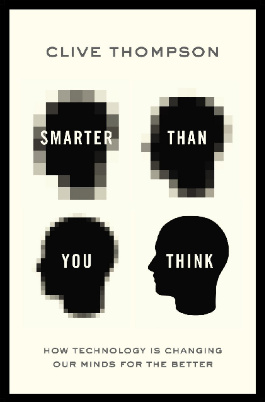
I'm Clive Thompson, the author of Smarter Than You Think: How Technology is Changing Our Minds for the Better (Penguin Press). You can order the book now at Amazon, Barnes and Noble, Powells, Indiebound, or through your local bookstore! I'm also a contributing writer for the New York Times Magazine and a columnist for Wired magazine. Email is here or ping me via the antiquated form of AOL IM (pomeranian99).
ECHO
Erik Weissengruber
Vespaboy
Terri Senft
Tom Igoe
El Rey Del Art
Morgan Noel
Maura Johnston
Cori Eckert
Heather Gold
Andrew Hearst
Chris Allbritton
Bret Dawson
Michele Tepper
Sharyn November
Gail Jaitin
Barnaby Marshall
Frankly, I'd Rather Not
The Shifted Librarian
Ryan Bigge
Nick Denton
Howard Sherman's Nuggets
Serial Deviant
Ellen McDermott
Jeff Liu
Marc Kelsey
Chris Shieh
Iron Monkey
Diversions
Rob Toole
Donut Rock City
Ross Judson
Idle Words
J-Walk Blog
The Antic Muse
Tribblescape
Little Things
Jeff Heer
Abstract Dynamics
Snark Market
Plastic Bag
Sensory Impact
Incoming Signals
MemeFirst
MemoryCard
Majikthise
Ludonauts
Boing Boing
Slashdot
Atrios
Smart Mobs
Plastic
Ludology.org
The Feature
Gizmodo
game girl
Mindjack
Techdirt Wireless News
Corante Gaming blog
Corante Social Software blog
ECHO
SciTech Daily
Arts and Letters Daily
Textually.org
BlogPulse
Robots.net
Alan Reiter's Wireless Data Weblog
Brad DeLong
Viral Marketing Blog
Gameblogs
Slashdot Games

