
« PREVIOUS ENTRY
Hiccups due to our fish ancestry
NEXT ENTRY »
A possible explanation for “email apnea”
This is just about the oddest bit of research I’ve recently come across: Apparently C-sections might cause eczema in babies.
No one fully knows what causes eczema, of course. But immunologists have for years been suspecting that eczema is linked, in some way, to autoimmune disorders. And they’ve also been learning that if you want to have a good immune system, you need to have a healthy balance of intestinal bacteria.
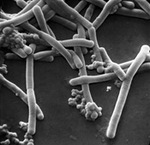
New evidence supporting this argument comes in the latest Journal of Allergy and Clinical Immunology, which reports on a fascinating study by some scientists out of Lund University in Sweden. The reseachers studied the feces of babies one week after birth to get a sense of how well-balanced the bacteria in their gut were. They found that newborn infants who had imbalanced intestinal bacteria often developed atopical eczema by the age of 18 months.
But here’s the interesting thing: How do newborn infants wind up with bacterial imbalances? Because of their mothers. During vaginal delivery, the children are pick up a lot of lactobacilli — lactic acid bacteria — from their mother’s vagina. Lactobacilli are crucial for maintaining a healthy balance of intestinal flora. If the mother has any bacterial imbalances, the babies won’t pick up enough lactobacilli, as this press release notes:
“With a vaginal delivery the child will come into close contact with the mother’s bacteria. If the mother has a good flora of bacteria, the contact is an important help for the child to be able to be colonized by bacteria in the proper way. It can be assumed that certain hygiene measures, such as antibiotics given in some countries in connection with deliveries, in normal cases may have a deleterious effect, since the mother then is at risk to get a skewed bacteria flora, which she passes on to the child,” Goran Molin reasons.
And as Molin goes on to point out, in the US today, one third of all women have bacterial vaginosis — a condition in which bacteria other than lactobacilli dominate.
What Molin doesn’t talk about, but which is equally interesting, is the drastic increase in the use of ceasarean-section delivery in the last few decades. If there’s no vaginal delivery, then there’s presumably no way to pass on a healthy dose of lactobacilli, either.
This made me wonder about myself, actually. I developed atopical eczema in my late teens, and it’s slowly grown more annoying over the years; and I was born by C-section. Ditto for the younger of my two older sisters. My eldest sister wasn’t born via C-section and she has no eczema. A vanishingly small and subjective sample, of course, but it fits the pattern the Swedish guys would predict.
Given the roaring debate around C-sections in this country, I’m surprised I haven’t heard much about this study. Though that’s probably because it doesn’t exactly lead to particularly palatable Thanksgiving conversations, eh? Hey mom: What was the bacterial count in your vagina when I was born? Oh boy.
I'm Clive Thompson, the author of Smarter Than You Think: How Technology is Changing Our Minds for the Better (Penguin Press). You can order the book now at Amazon, Barnes and Noble, Powells, Indiebound, or through your local bookstore! I'm also a contributing writer for the New York Times Magazine and a columnist for Wired magazine. Email is here or ping me via the antiquated form of AOL IM (pomeranian99).

ECHO
Erik Weissengruber
Vespaboy
Terri Senft
Tom Igoe
El Rey Del Art
Morgan Noel
Maura Johnston
Cori Eckert
Heather Gold
Andrew Hearst
Chris Allbritton
Bret Dawson
Michele Tepper
Sharyn November
Gail Jaitin
Barnaby Marshall
Frankly, I'd Rather Not
The Shifted Librarian
Ryan Bigge
Nick Denton
Howard Sherman's Nuggets
Serial Deviant
Ellen McDermott
Jeff Liu
Marc Kelsey
Chris Shieh
Iron Monkey
Diversions
Rob Toole
Donut Rock City
Ross Judson
Idle Words
J-Walk Blog
The Antic Muse
Tribblescape
Little Things
Jeff Heer
Abstract Dynamics
Snark Market
Plastic Bag
Sensory Impact
Incoming Signals
MemeFirst
MemoryCard
Majikthise
Ludonauts
Boing Boing
Slashdot
Atrios
Smart Mobs
Plastic
Ludology.org
The Feature
Gizmodo
game girl
Mindjack
Techdirt Wireless News
Corante Gaming blog
Corante Social Software blog
ECHO
SciTech Daily
Arts and Letters Daily
Textually.org
BlogPulse
Robots.net
Alan Reiter's Wireless Data Weblog
Brad DeLong
Viral Marketing Blog
Gameblogs
Slashdot Games

