
« PREVIOUS ENTRY
The Humboldt squid beak: Diamond-sharp mystery of the briny deep
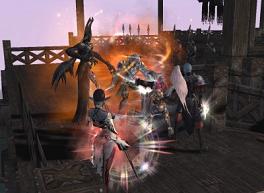
Wired News just published my latest video-game column, and it’s a pretty fun subject. It’s about how teenagers, while deducing how to beat bosses inside online video games, have unwittingly stumbled upon the scientific method. It’s online for free at Wired’s site, and a copy is archived below!
How Videogames Blind Us With Science
by Clive Thompson
A few years ago, Constance Steinkuehler — a game academic at the University of Wisconsin — was spending 12 hours a day playing Lineage, the online world game. She was, as she puts it, a “siege princess,” running 150-person raids on hellishly difficult bosses. Most of her guild members were teenage boys.
But they were pretty good at figuring out how to defeat the bosses. One day she found out why. A group of them were building Excel spreadsheets into which they’d dump all the information they’d gathered about how each boss behaved: What potions affected it, what attacks it would use, with what damage, and when. Then they’d develop a mathematical model to explain how the boss worked — and to predict how to beat it.
Often, the first model wouldn’t work very well, so the group would argue about how to strengthen it. Some would offer up new data they’d collected, and suggest tweaks to the model. “They’d be sitting around arguing about what model was the best, which was most predictive,” Steinkuehler recalls.
That’s when it hit her: The kids were practicing science.
They were using the scientific method. They’d think of a hypothesis — This boss is really susceptible to fire spells — and then collect evidence to see if the hypothesis was correct. If it wasn’t, they’d improve it until it accounted for the observed data.
This led Steinkuehler to a fascinating and provocative conclusion: Videogames are becoming the new hotbed of scientific thinking for kids today.
This makes sense if you think about it for a second. After all, what is science? It’s a technique for uncovering the hidden rules that govern the world. And videogames are simulated worlds that kids are constantly trying to master. Lineage and World of Warcraft aren’t “real” world, of course, but they are consistent — the behavior of the environment and the creatures in it are governed by hidden and generally unchanging rules, encoded by the game designers. In the process of learning a game, gamers try to deduce those rules.
This leads them, without them even realizing it, to the scientific method.
This is what Steinkuehler reports in a research paper — “Scientific Habits of Mind in Virtual Worlds” (.pdf) — that she will publish in this spring’s Journal of Science Education and Technology. She and her co-author, Sean Duncan, downloaded the content of 1,984 posts in 85 threads in a discussion board for players of World of Warcraft.
What did they find? Only a minority of the postings were “banter” or idle chat. In contrast, a majority — 86 percent — were aimed specifically at analyzing the hidden ruleset of games.
More than half the gamers used “systems-based reasoning” — analyzing the game as a complex, dynamic system. And one-tenth actually constructed specific models to explain the behavior of a monster or situation; they would often use their model to generate predictions. Meanwhile, one-quarter of the commentors would build on someone else’s previous argument, and another quarter would issue rebuttals of previous arguments and models.
These are all hallmarks of scientific thought. Indeed, the conversations often had the precise flow of a scientific salon, or even a journal series: Someone would pose a question — like what sort of potions a high-class priest ought to carry around, or how to defeat a particular monster — and another would post a reply, offering data and facts gathered from their own observations. Others would jump into the fray, disputing the theory, refining it, offering other facts. Eventually, once everyone was convinced the theory was supported by the data, the discussion would peter out.
“It blew my mind,” Steinkuehler tells me.
And here’s the thing: The (mostly) young people engaging in these sciencelike conversations are precisely the same ones who are, more and more, tuning out of science in the classroom. Every study shows science literacy in school is plummeting, with barely one-fifth of students graduating with any sort of sense of how the scientific method works. The situation is far worse for boys than girls.
Steinkuehler thinks videogames are the way to reverse this sorry trend. She argues that schools ought to be embracing games as places to show kids the value of scientific scrutiny — the way it helps us make sense of the world.
One of the reasons kids get bored by science is that too many teachers present it as a fusty collection of facts for memorization. This is precisely wrong. Science isn’t about facts. It’s about the quest for facts — the scientific method, the process by which we hash through confusing thickets of ignorance. It’s dynamic, argumentative, collaborative, competitive, filled with flashes of crazy excitement and hours of drudgework, and driven by ego: Our desire to be the one who figures it out, at least for now. It’s dramatic and nutty and fun.
And it’s pretty much how kids already approach the games they love. They’re already scientists; they already know the value of the scientific method. Teachers just need to talk to them in their language, so that the kids can begin to understand the joy of puzzling through the offline, “real” world too.
At one point, Steinkuehler met up with one of the kids who’d built the Excel model to crack the boss. “Do you realize that what you’re doing is the essence of science?” she asked.
He smiled at her. “Dude, I’m not doing science,” he replied. “I’m just cheating the game!”
I'm Clive Thompson, the author of Smarter Than You Think: How Technology is Changing Our Minds for the Better (Penguin Press). You can order the book now at Amazon, Barnes and Noble, Powells, Indiebound, or through your local bookstore! I'm also a contributing writer for the New York Times Magazine and a columnist for Wired magazine. Email is here or ping me via the antiquated form of AOL IM (pomeranian99).
ECHO
Erik Weissengruber
Vespaboy
Terri Senft
Tom Igoe
El Rey Del Art
Morgan Noel
Maura Johnston
Cori Eckert
Heather Gold
Andrew Hearst
Chris Allbritton
Bret Dawson
Michele Tepper
Sharyn November
Gail Jaitin
Barnaby Marshall
Frankly, I'd Rather Not
The Shifted Librarian
Ryan Bigge
Nick Denton
Howard Sherman's Nuggets
Serial Deviant
Ellen McDermott
Jeff Liu
Marc Kelsey
Chris Shieh
Iron Monkey
Diversions
Rob Toole
Donut Rock City
Ross Judson
Idle Words
J-Walk Blog
The Antic Muse
Tribblescape
Little Things
Jeff Heer
Abstract Dynamics
Snark Market
Plastic Bag
Sensory Impact
Incoming Signals
MemeFirst
MemoryCard
Majikthise
Ludonauts
Boing Boing
Slashdot
Atrios
Smart Mobs
Plastic
Ludology.org
The Feature
Gizmodo
game girl
Mindjack
Techdirt Wireless News
Corante Gaming blog
Corante Social Software blog
ECHO
SciTech Daily
Arts and Letters Daily
Textually.org
BlogPulse
Robots.net
Alan Reiter's Wireless Data Weblog
Brad DeLong
Viral Marketing Blog
Gameblogs
Slashdot Games

