
« PREVIOUS ENTRY
Cows align themselves with magnetic north
NEXT ENTRY »
Binary marble adding machine
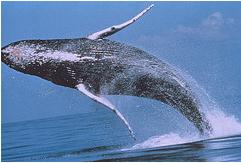
As you’ve probably heard, the rise of noise-pollution in the oceans has caused huge problems for marine life. Animals that echolocate — like whales — are increasingly deafened by the din of shipping vessels and military sonar. Indeed, it’s apparently gotten so bad that we are now seeing a rise in collisions between whales and boats; it’s bad for the whales, of course, but if if a small vessel hits a whale, even humans can die too.
This inspired Michel André, a marine biologist and biotechnology engineer, to develop a whale-avoidance system so that boats could detect nearby whales and steer away. The problem is that any “active” system — something that sent our sonar probes — would just add more noise to the oceans and further confuse the whales. He wanted to do it passively. So he started designing an array of listening devices that would listen for the clicks and whoops of whale-call, or even the sound of rain and waves splashing along silent whales.
But here’s the really awesome part. As Gizmag reports:
A remarkable feature of his system is its ability to single out and track an individual whale among all its “family” members in the same area — a breakthrough made with the help of a West African musician. After years of research, André’s discovery that the sequence of acoustic signals transmitted by the sperm whales could be used to identify individual mammals — a process called Rhythmic Identity Measurement (RIME) — was almost by chance. In attempting to unravel the chaotic rhythms of the sperm whale clicks, he was struck by the similarity between his underwater recordings and African tribal music. A Senegalese griot (drummer) confirmed the likeness and — amazingly — was able to pick individual whales from André’s recordings through their distinctive rhythmic structures.
A whale-detection system powered by algorithms derived from African drumming. Oh yes. I love the way that musicians always wind up being the ones who can understand whalespeak better than anyone else, like that guy who figured out that whales appear to have a particular affection for the clarinet note G.
I'm Clive Thompson, the author of Smarter Than You Think: How Technology is Changing Our Minds for the Better (Penguin Press). You can order the book now at Amazon, Barnes and Noble, Powells, Indiebound, or through your local bookstore! I'm also a contributing writer for the New York Times Magazine and a columnist for Wired magazine. Email is here or ping me via the antiquated form of AOL IM (pomeranian99).
ECHO
Erik Weissengruber
Vespaboy
Terri Senft
Tom Igoe
El Rey Del Art
Morgan Noel
Maura Johnston
Cori Eckert
Heather Gold
Andrew Hearst
Chris Allbritton
Bret Dawson
Michele Tepper
Sharyn November
Gail Jaitin
Barnaby Marshall
Frankly, I'd Rather Not
The Shifted Librarian
Ryan Bigge
Nick Denton
Howard Sherman's Nuggets
Serial Deviant
Ellen McDermott
Jeff Liu
Marc Kelsey
Chris Shieh
Iron Monkey
Diversions
Rob Toole
Donut Rock City
Ross Judson
Idle Words
J-Walk Blog
The Antic Muse
Tribblescape
Little Things
Jeff Heer
Abstract Dynamics
Snark Market
Plastic Bag
Sensory Impact
Incoming Signals
MemeFirst
MemoryCard
Majikthise
Ludonauts
Boing Boing
Slashdot
Atrios
Smart Mobs
Plastic
Ludology.org
The Feature
Gizmodo
game girl
Mindjack
Techdirt Wireless News
Corante Gaming blog
Corante Social Software blog
ECHO
SciTech Daily
Arts and Letters Daily
Textually.org
BlogPulse
Robots.net
Alan Reiter's Wireless Data Weblog
Brad DeLong
Viral Marketing Blog
Gameblogs
Slashdot Games

