
« PREVIOUS ENTRY
Humboldt squid: Soft, gentle kittens of the briny deep?
NEXT ENTRY »
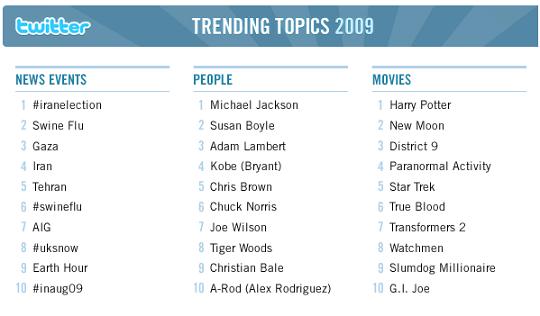
Why are the “trending topics” on Twitter so frequently dull?
When Twitter first began running trending topics, I was kind of excited. I loved the idea that we could spot emerging areas of interest in the overmind, and get intriguing insights into what Americans, and people the world over, were thinking about.
Alas, that’s not quite the way it has worked out. Twitter recently published its Top Twitter Trends of 2009; they’re excerpted above, and as you can see, the overmind has apparently been obsessing over the swine flu, Iran, Michael Jackson and Tiger Woods. Of course, these subjects are all screamingly obvious, each having been long ago chewed into a tasteless cud by the 24-hour news cycle.
Did we really need a mathematically-ranked, up-to-the-minute amalgamation of the utterances of millions of everyday citizens to give us this snapshot of our collective attention span? Chris Brown, Paranormal Activity, Snow Leopard, Kobe Bryant … man, you could have predicted those topics by lazily wandering down to your local newsstand like once a month and noting the boldface names on the magazines. The overmind appears to be spending a lot of time ZOMGing over the same stuff as the undermind, as it were.
The problem here is the problem with all mainstream, middle-of-the-road subjects: They’re not going to be surprising, and information that isn’t surprising often isn’t useful or interesting either. (The way I see it, mainstream topics mostly useful in social bonding: Heavily-trod subject matter is great when you need to make pleasant chatter with strangers. “Crazy weather we’re having, eh?”) It’s not that the concept of “trending topics” is itself useless. It’s that sampling the entire population of Twitter is often pointless, because it’s too broad.
So what would be more intriguing? I think you’d get cooler trends by sampling the Twitter flow of a smaller, more cohesive group of people — like your friends, your co-workers, or even a collection of strangers in which you’re interested. In that case, the trending subjects are possibly going to be more eclectic and unexpected. I wasn’t sure whether there were any Twitter tools that actually did this, so I posed the question on — where else? — Twitter, whereupon @johntunger suggested FlockingMe.
FlockingMe is a simple web app: You select a subgroup of people you follow on Twitter, and it shows you all their latest tweets … with a list of trending topics at the top. As of five minutes ago, here were the hot topics amongst the group of 30 Twitter friends I picked:
venturebeat’s list
things
damn
discovered
struggling
passed
gets
building
snark
chocolate
Which is quite a bit different from the topics currently trending on Twitter overall, which were thus:
#whoremembers
#nowplaying
Whore Members
#Imfrom
Happy Palindrome Day
Avatar
RT if
#in2010
UFC 108
Nick’s
As you can see, the results from FlockingMe were sometimes useless because they didn’t filter out overly common words, like “gets”. The overall Twitter trending topics contained far more hashtags — including some really funny ones, like Whore Members (I thought I was the only one who was misreading the nostalgic #whoremembers tag!) — because when you’re looking for common word-usage amongst millions of folks, hashtags are more likely to be a common occurrence than amongst a small group of 30 people. On the other hand, the tags from my small group were so suggestively strange I clicked on a few to figure out what the hell was going on. (“Struggling” came from a Tweet about an Onion story and a tweet about the Washington Post; “chocolate” was … well, a lot of people I know are binging on chocolate right now.)
So the experiment was only partially successful. I suspect that FlockingMe would produce better results if I seeded it with larger groups that had a greater internal focus (and if FlockingMe tweaked their algorithm a bit). But I still think this concept has a lot of promise.
By the way, FlockingMe apparently isn’t the only app that does this. Several of my Twitter followers suggested other tools: @jelefant and @taylordobbs said Tweetdeck can show you the trending topics for a specific group, which sounds great except that I don’t like using a Twitter desktop client. (I’m too lazy, and I bounce between four different computers weekly.) @kevinmarks and @pistacio suggested TuneIn, but when I tried it out I couldn’t figure out where exactly the trending topics were on the page. (Was I doing something wrong?) And @digiphile pointed me to TwitterTim.es, which shows you any links that your Twitter posse are passing around (It worked well, but was too complex for my tastes: All I want is a simple, clean, text list of trending topics). Thanks to everyone for responding so quickly!
I'm Clive Thompson, the author of Smarter Than You Think: How Technology is Changing Our Minds for the Better (Penguin Press). You can order the book now at Amazon, Barnes and Noble, Powells, Indiebound, or through your local bookstore! I'm also a contributing writer for the New York Times Magazine and a columnist for Wired magazine. Email is here or ping me via the antiquated form of AOL IM (pomeranian99).

ECHO
Erik Weissengruber
Vespaboy
Terri Senft
Tom Igoe
El Rey Del Art
Morgan Noel
Maura Johnston
Cori Eckert
Heather Gold
Andrew Hearst
Chris Allbritton
Bret Dawson
Michele Tepper
Sharyn November
Gail Jaitin
Barnaby Marshall
Frankly, I'd Rather Not
The Shifted Librarian
Ryan Bigge
Nick Denton
Howard Sherman's Nuggets
Serial Deviant
Ellen McDermott
Jeff Liu
Marc Kelsey
Chris Shieh
Iron Monkey
Diversions
Rob Toole
Donut Rock City
Ross Judson
Idle Words
J-Walk Blog
The Antic Muse
Tribblescape
Little Things
Jeff Heer
Abstract Dynamics
Snark Market
Plastic Bag
Sensory Impact
Incoming Signals
MemeFirst
MemoryCard
Majikthise
Ludonauts
Boing Boing
Slashdot
Atrios
Smart Mobs
Plastic
Ludology.org
The Feature
Gizmodo
game girl
Mindjack
Techdirt Wireless News
Corante Gaming blog
Corante Social Software blog
ECHO
SciTech Daily
Arts and Letters Daily
Textually.org
BlogPulse
Robots.net
Alan Reiter's Wireless Data Weblog
Brad DeLong
Viral Marketing Blog
Gameblogs
Slashdot Games

