
« PREVIOUS ENTRY
Back online, finally
NEXT ENTRY »
Rental justice
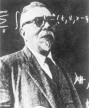
The New York Times Book Review asked me to review an excellent new biography of Norbert Wiener — who was the famous pioneer of “cybernetics”, and who had a life more insanely strange that I could possibly have imagined. The review ran last Sunday; it’s online here, and I’ve archived it below too:
The Original Computer Geek
by Clive ThompsonTo be a truly famous scientist, you need to have a hit single. Einstein had E = mc2. Newton had the apple and gravity. Even the lesser rock-star scientists have one shining achievement for which they’re known — such as Niels Bohr’s theory of the atom.
But there’s another kind of scientist who never breaks through, usually because while his discovery is revolutionary it’s also maddeningly hard to summarize in a simple sentence or two. He never produces a catchy hit single. He’s more like a back-room influencer: his work inspires dozens of other innovators who absorb the idea, produce more easily comprehensible innovations and become more famous than their mentor could have dreamed. Find an influencer, and you’ll find a deeply bitter man.
Norbert Wiener — the inventor of “cybernetics” — is precisely this type of scientist. Odds are that you are only dimly aware of cybernetics, if at all. (A friend asked me, “Isn’t that like Dianetics?”) “Dark Hero of the Information Age,” by the journalists Flo Conway and Jim Siegelman, intends to correct this, but their book struggles with the circular tautologies of fame: it must continually plead the case of why the guy ought to have been better known.
Cybernetics is the science of feedback — how information can help self-regulate a system. That includes everything from biological mechanisms (like the human immune system) to artificial ones, like thermostats that regulate a building’s temperature. Even in the early 20th century, when Wiener did his work, feedback mechanics weren’t new; engineers had long been building steam engines that self-regulated their speed. But Wiener’s genius was to label the mysterious ghost that powered feedback: information.
It’s hard to imagine now, in our modern digital world — where “cyber” is a prefix for everything from sex to pets — but “information” as a discrete concept did not widely exist before Wiener. (Early Bell engineers referred to the signal traveling over telephone wires as “the commodity to be transported by a telephone system.”) By separating out information as a kind of Platonic solid unto itself, Wiener created the idea that scientists could measure information in a system and tweak it for optimal efficiency.
The idea resonated in every field. The anthropologist Margaret Mead began studying cultural taboos as flows of self-regulating information inside a society. Wiener used his feedback theory to create an antiaircraft gun that tracked a plane in the air as if it were alive. And neurologists started using cybernetic theory to explain mental diseases as self-reinforcing patterns of behavior — a brain that gets stuck in a bad biochemical rut.
Wiener knew about those ruts himself, tortured as he was by lifelong manic depression. Though he produced his defining works in hypertalkative bursts of productivity, he would regularly plunge into moods of near-suicidal intensity. The authors suggest Wiener’s swings were exacerbated by his oppressive upbringing: home-schooled by a scold of a father, Wiener started college at the age of 11 in 1906, earned his Harvard Ph.D. by 18 and, like most prodigies, remained a socially awkward geek forever after. Myopic nearly to the point of blindness, the rotund Wiener was famous for wandering the grounds of the Massachusetts Institute of Technology with a cigar, buttonholing anyone he met and pouring out his latest theories in a rapid-fire spray. (Some M.I.T. engineers even developed the “Wiener Early Warning System” to avoid him by ducking away.)
For a while, Wiener seemed destined to be as celebrated as Einstein. Like Einstein, he issued dark social warnings about the misuse of science and technology, including his own. In his two most popular books — Cybernetics” and “The Human Use of Human Beings” — Wiener warned that mass media were concentrated in too few hands, and were losing their power as a feedback device for society. Appalled by the atom bomb, he defiantly refused to accept any government money for research. (When he visited an M.I.T. professor who accepted military money, he’d hover on the doorstep, refusing to walk into what he called “federal territory.”) Given that postwar research was increasingly paid for by the military, this is partly why Wiener got sidelined by history: he didn’t participate in much of the seminal military-financed work on computation, where his ideas might have been useful.
But the real problem, the authors argue, was personal. At the crest of his career, Wiener’s life imploded, almost like a feedback system falling out of equilibrium with itself. And this is where the book really shines, because it offers a fascinating account of how a personal crisis can destroy a scientific revolution.
The catastrophe emerged from Wiener’s German-born wife, Margaret, and their almost gothically weird relationship. Though Wiener was Jewish, Margaret became an outspoken Nazi supporter during World War II. (She kept a copy of “Mein Kampf” on a dresser at home.) She was even more hostile to her daughters, and accused the elder of inspiring “unnatural” sexual feelings in her father. As Wiener’s reputation grew and he crisscrossed the globe on lecture circuits, Margaret attempted to trigger his depressions with undercutting remarks.
At the peak of Wiener’s fame, she told an audacious lie that destroyed his relationship with his closest scientific collaborators. One of Wiener’s daughters had interned for a spring with the colleagues; Margaret told Wiener that their daughter had had sex with several of them. Wiener chose to believe the falsehood. He immediately cut off all contact with his collaborators, never explained the accusation and never spoke to them again.
And that, the authors contend, is the real reason cybernetics died. Wiener’s colleagues were shattered, and without his participation, their explorations of his ideas quickly atrophied. One of Wiener’s former protégés, the young mathematical genius Walter Pitts, was so scarred that ultimately he drank himself to death. By the time of Wiener’s death in 1964, there were few proselytizers left; Soviet scientists were interested, but this only served to give cybernetics a “red” tinge.
Of course, one could also argue that the science simply failed in the court of ideas. Postwar scientists were obsessed with electronics; Wiener’s feedback studies, which careered from neurophysics to heavy mechanics, seemed both antiquated and pointlessly ahead of their time. In his final years, Wiener could see his relevance waning, and worried that he was doomed to be remembered only in the footnotes of other people’s papers.
The authors seem to fret about this too, and they embark on an awkward process common in the biographies of lesser-known scientists: they continually attempt to reverse-engineer Wiener’s importance by mentioning the famous thinkers you really have heard of — Marshall McLuhan, Mead or James Watson and Francis Crick — and painstakingly noting how they incorporated Wiener’s ideas into their own work. It’s a bit of a stretch at times. But you sympathize with their project, and their subject. Wiener was both brilliant and personally intriguing, an absent-minded professor straight out of central casting. As a character, he was larger than life; as a scientist, he was smaller than history.
Clive Thompson is a contributing writer for The New York Times Magazine and also writes for Wired and Slate.
I'm Clive Thompson, the author of Smarter Than You Think: How Technology is Changing Our Minds for the Better (Penguin Press). You can order the book now at Amazon, Barnes and Noble, Powells, Indiebound, or through your local bookstore! I'm also a contributing writer for the New York Times Magazine and a columnist for Wired magazine. Email is here or ping me via the antiquated form of AOL IM (pomeranian99).
ECHO
Erik Weissengruber
Vespaboy
Terri Senft
Tom Igoe
El Rey Del Art
Morgan Noel
Maura Johnston
Cori Eckert
Heather Gold
Andrew Hearst
Chris Allbritton
Bret Dawson
Michele Tepper
Sharyn November
Gail Jaitin
Barnaby Marshall
Frankly, I'd Rather Not
The Shifted Librarian
Ryan Bigge
Nick Denton
Howard Sherman's Nuggets
Serial Deviant
Ellen McDermott
Jeff Liu
Marc Kelsey
Chris Shieh
Iron Monkey
Diversions
Rob Toole
Donut Rock City
Ross Judson
Idle Words
J-Walk Blog
The Antic Muse
Tribblescape
Little Things
Jeff Heer
Abstract Dynamics
Snark Market
Plastic Bag
Sensory Impact
Incoming Signals
MemeFirst
MemoryCard
Majikthise
Ludonauts
Boing Boing
Slashdot
Atrios
Smart Mobs
Plastic
Ludology.org
The Feature
Gizmodo
game girl
Mindjack
Techdirt Wireless News
Corante Gaming blog
Corante Social Software blog
ECHO
SciTech Daily
Arts and Letters Daily
Textually.org
BlogPulse
Robots.net
Alan Reiter's Wireless Data Weblog
Brad DeLong
Viral Marketing Blog
Gameblogs
Slashdot Games

