
« PREVIOUS ENTRY
The physics of the Ground Zero memorial
NEXT ENTRY »
The self-cloning machine
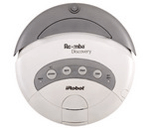
Chris Anderson, the editor-in-chief of Wired magazine, has a Roomba Discovery — the latest generation of the massively popular robot vacuum cleaner. He also has kids, and he recently wrote a terrific blog entry about how his kids and the robot interact. Whenever Chris turns the Roomba loose, the kids play a game with it, desperately dashing around the room to try and pick up their toys before the robot hoovers ‘em up. That’s right: The robot vacuum cleaner not only cleans, but it goads the children into cleaning. As he writes:
The kids scurry around and pick up every last toy (it’s the tiniest Lego pieces that get eaten the fastest), then race around the room jumping over Roomba as it drives from wall to wall, randomly changing direction just often enough to make the game fun. (We’ve told them that if Roomba runs into them it will think that they’re a wall and not clean there, which may or may not be true.) Then, after 15 minutes of this, they’re bored and ready for bed.
I love the thought that our children are growing up used to having domestic robots in the house. Robots for them are slightly dim but friendly vacuum cleaners, not fearsome weapons or fantasy toys. “Robot love me,” declares the two-year-old.
That is, of course, a moment that is simultaneously heartwarming and incredibly freaky. The children are behaving precisely the way Sherry Turklee first described children interacting with Speak ‘N Spells and Merlin computerized games back in the late 70s — when they’d sit around having rather interesting conversations about whether the robots are alive, and if so, to what extent they were alive. Jean Piaget talked about his in his theory, too: He argued that children behave like little scientists, constantly developing theories about how the world works. They notice that when the wind blows, the trees move — so they decide that the movement of trees is what causes the wind to blow. They hold this hypothesis to be true until they get new data that contradicts it (like noticing the presence of wind when there are no trees around) and then they decide on a new theory.
The same thing happens with robots. A young enough child theorizes that one property of “life” is when something seems to move with an intelligence and a purpose — so a robot vacuum cleaner seems indubitably “alive.” Silly, sure — except how many times have you yelled at a car or a computer when it acts up?
Robots are, at heart, philosophical objects. When we regard them, with their weird mix of humanlike and alien behavior, we meditate on the nature of ourselves.
(Thanks to Debbie for this one!)
I'm Clive Thompson, the author of Smarter Than You Think: How Technology is Changing Our Minds for the Better (Penguin Press). You can order the book now at Amazon, Barnes and Noble, Powells, Indiebound, or through your local bookstore! I'm also a contributing writer for the New York Times Magazine and a columnist for Wired magazine. Email is here or ping me via the antiquated form of AOL IM (pomeranian99).
ECHO
Erik Weissengruber
Vespaboy
Terri Senft
Tom Igoe
El Rey Del Art
Morgan Noel
Maura Johnston
Cori Eckert
Heather Gold
Andrew Hearst
Chris Allbritton
Bret Dawson
Michele Tepper
Sharyn November
Gail Jaitin
Barnaby Marshall
Frankly, I'd Rather Not
The Shifted Librarian
Ryan Bigge
Nick Denton
Howard Sherman's Nuggets
Serial Deviant
Ellen McDermott
Jeff Liu
Marc Kelsey
Chris Shieh
Iron Monkey
Diversions
Rob Toole
Donut Rock City
Ross Judson
Idle Words
J-Walk Blog
The Antic Muse
Tribblescape
Little Things
Jeff Heer
Abstract Dynamics
Snark Market
Plastic Bag
Sensory Impact
Incoming Signals
MemeFirst
MemoryCard
Majikthise
Ludonauts
Boing Boing
Slashdot
Atrios
Smart Mobs
Plastic
Ludology.org
The Feature
Gizmodo
game girl
Mindjack
Techdirt Wireless News
Corante Gaming blog
Corante Social Software blog
ECHO
SciTech Daily
Arts and Letters Daily
Textually.org
BlogPulse
Robots.net
Alan Reiter's Wireless Data Weblog
Brad DeLong
Viral Marketing Blog
Gameblogs
Slashdot Games

