
« PREVIOUS ENTRY
“Tag” — the simplest video game in the world
NEXT ENTRY »
Robotic child-herding
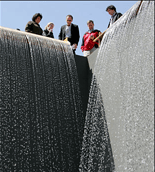
When New York chose the design for its Ground Zero memorial — an installation called “Reflecting Absence” — many people criticized it for being too abstract, and not reflecting the full horror of the 9/11 attack. “Reflecting Absence” is composed of two square wells, into which water flows in thin sheets off the rim. I, too, didn’t think much of the design — to say nothing of the stupidly poncy name.
But today the New York Times ran a fascinating story that has made me change my mind. It’s a piece about how one of the consultants on the project has built an enormous model of the wells in his Ontario backyard.
Why do this? Because tweaking the water is damn hard. The designers need to make sure that it flows at precisely the right intensity: If it runs too gently, it’ll become clogged by fall leaves, or get so buffeted by winds that it’ll splash all over viewers and corrode the surrounding concrete walls. Conversely, if it runs too rapidly, it’ll create a horrible din inside the echoey well. And here’s the thing: You cannot “scale” water. If you built an overly tiny model of the wells, you’d learn nothing about their full-size behavior, because the physics of water are completely different in each case. Hollywood producers have long been bedeviled by this problem; if you’re shooting a war flick and try to put little three-foot-long models of Navy ships a tank of water, the ships might look fine but the waves will look completely unreal — because gravity at that scale can’t produce deep swells.
What’s more, unless you built the model to nearly-full scale, you’ll never understand the weirdly chaotic ways that water can behave in real life. It’s incredibly strange stuff: “Water behaves in its own way,” as one designer of the designers told the Times. “You can tweak its environment but at the end of the day, you can’t change its behavior.” As the reporter went on to note:
Perhaps the most striking thing when the mock-up came into view, nestled incongruously in a suburban setting, was that the water walls were not the “thin sheets” described by the design jury that chose “Reflecting Absence” last year.
Rather, they were more like beaded curtains, with a striation that called to mind the vertical bands of the twin tower facades, dissolving in a cascade of tears.
The effect is achieved by pumping the water over small dams known as weirs. These have serrated edges that act like fingers, spaced one and a half inches apart, separating the flow into discrete channels.
Now I think the design sounds quite beautiful.
I'm Clive Thompson, the author of Smarter Than You Think: How Technology is Changing Our Minds for the Better (Penguin Press). You can order the book now at Amazon, Barnes and Noble, Powells, Indiebound, or through your local bookstore! I'm also a contributing writer for the New York Times Magazine and a columnist for Wired magazine. Email is here or ping me via the antiquated form of AOL IM (pomeranian99).

ECHO
Erik Weissengruber
Vespaboy
Terri Senft
Tom Igoe
El Rey Del Art
Morgan Noel
Maura Johnston
Cori Eckert
Heather Gold
Andrew Hearst
Chris Allbritton
Bret Dawson
Michele Tepper
Sharyn November
Gail Jaitin
Barnaby Marshall
Frankly, I'd Rather Not
The Shifted Librarian
Ryan Bigge
Nick Denton
Howard Sherman's Nuggets
Serial Deviant
Ellen McDermott
Jeff Liu
Marc Kelsey
Chris Shieh
Iron Monkey
Diversions
Rob Toole
Donut Rock City
Ross Judson
Idle Words
J-Walk Blog
The Antic Muse
Tribblescape
Little Things
Jeff Heer
Abstract Dynamics
Snark Market
Plastic Bag
Sensory Impact
Incoming Signals
MemeFirst
MemoryCard
Majikthise
Ludonauts
Boing Boing
Slashdot
Atrios
Smart Mobs
Plastic
Ludology.org
The Feature
Gizmodo
game girl
Mindjack
Techdirt Wireless News
Corante Gaming blog
Corante Social Software blog
ECHO
SciTech Daily
Arts and Letters Daily
Textually.org
BlogPulse
Robots.net
Alan Reiter's Wireless Data Weblog
Brad DeLong
Viral Marketing Blog
Gameblogs
Slashdot Games

