
« PREVIOUS ENTRY
Who you gonna believe? Me, or your lying eyes?
NEXT ENTRY »
A virtual author
Last week, I blogged about Don Watson’s crusade to stamp out business-speak jargon. In the comment area to that post, longtime Collision Detection poster Laura pointed out Bullfighter — a piece of software that scans any document and identifies “bullshit” words, to help people reduce their jargon quotient. It’s pretty funny and works quite well; the creators also write a witty blog devoted to exposing managementese.
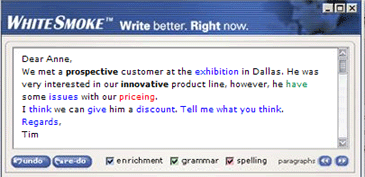
That’s where I first heard about White Smoke, a piece of software that has the opposite goal: It takes a normal document and adds management doublespeak. This is not some Orwellian parody, either. This is a real, serious $49.95 tool intended for a business audience. Check out the Flash demo here, or read the the White Smoke press release, which notes:
By successfully “understanding” context, WHITESMOKE ENRICHMENT can optimize any sentence or text without changing its meaning. For example, the sentence “I am happy with your work” may be upgraded to “I am completely thrilled with your outstanding achievement,” or any other agreeable combination. The program also offers a unique “Suggested Phrase” feature. For example, the word “risk” may be replaced by the phrase “walking on thin ice.”
My jaw lies on the ground. I knew, of course, that various forms of managment-project software exist; PowerPoint includes a “project wizard” to help you take even the simplest 30-second-long pitch and transform it into a bloated, Soviet five-year-plan that requires an entire morning to click through. But White Smoke — “White Smoke”?? — is in a class by itself.
The guys at the Bullfighter blog came up with an ingenious test to find out just how badly White Smoke will mangle a document. They took the following paragraph …
Our customer service could be better. We have four customer complaints for every 100 items we sell — slightly worse than our competitors. But what’s worse is that it takes two phone calls and 20 minutes to straighten things out. In the meantime, our customers have software that isn’t working right. If you believe the research, they’re spreading bad news about our software until we resolve the installation problem. Even then, we probably haven’t converted them into real fans.
Then they ran it through White Smoke. The result?
Our quality customer service could be better. We have four customer complaints for every 100 individual articles we sell — slightly worse than our weak adversaries. But what’s worse is that it eventually extracts two business calls and 20 minutes to straighten entities out. In the meantime, our enthusiastic clients have computer software that isn’t effectively performing right. If you seemingly accept the scientific scrutiny, they’re disseminating bad news about our computer software until we suitably settle the innovative installation problem. Even then, we probably haven’t transformed them into real fans.
Fascinating. Not only does White Smoke insert blithering nonsense — it transforms “straighten things out” to “straighten entities out,” for example — but actually changes the meaning of the sentences, by injecting a constant stream of self-deluded preening. “Clients” become “enthusiastic clients”; “competitors” become “weak adversaries”. White Smoke literally transforms a normal document into propaganda: Every single sentence is purged of any possible thoughtcrime, any suggestion that one’s corporate goal is not striding confidently forward on its shining path.
Indeed, in this respect, White Smoke neatly blurs the mendacities of the corporate world with those of the political one. It’s like the Bush aide who last year infamously told the New York Times Magazine that top administration officials are not members of the “reality-based community”. Much like White Smoke, they can generate good news merely by claiming it’s true. In politics, it seems — as in business — sometimes reality needs a little faith healing.
I'm Clive Thompson, the author of Smarter Than You Think: How Technology is Changing Our Minds for the Better (Penguin Press). You can order the book now at Amazon, Barnes and Noble, Powells, Indiebound, or through your local bookstore! I'm also a contributing writer for the New York Times Magazine and a columnist for Wired magazine. Email is here or ping me via the antiquated form of AOL IM (pomeranian99).

ECHO
Erik Weissengruber
Vespaboy
Terri Senft
Tom Igoe
El Rey Del Art
Morgan Noel
Maura Johnston
Cori Eckert
Heather Gold
Andrew Hearst
Chris Allbritton
Bret Dawson
Michele Tepper
Sharyn November
Gail Jaitin
Barnaby Marshall
Frankly, I'd Rather Not
The Shifted Librarian
Ryan Bigge
Nick Denton
Howard Sherman's Nuggets
Serial Deviant
Ellen McDermott
Jeff Liu
Marc Kelsey
Chris Shieh
Iron Monkey
Diversions
Rob Toole
Donut Rock City
Ross Judson
Idle Words
J-Walk Blog
The Antic Muse
Tribblescape
Little Things
Jeff Heer
Abstract Dynamics
Snark Market
Plastic Bag
Sensory Impact
Incoming Signals
MemeFirst
MemoryCard
Majikthise
Ludonauts
Boing Boing
Slashdot
Atrios
Smart Mobs
Plastic
Ludology.org
The Feature
Gizmodo
game girl
Mindjack
Techdirt Wireless News
Corante Gaming blog
Corante Social Software blog
ECHO
SciTech Daily
Arts and Letters Daily
Textually.org
BlogPulse
Robots.net
Alan Reiter's Wireless Data Weblog
Brad DeLong
Viral Marketing Blog
Gameblogs
Slashdot Games

