
« PREVIOUS ENTRY
Turns out you actually will go blind
NEXT ENTRY »
Cap-and-trade your Hummer
Recently, New York Times columnist Thomas Friedman wrote about how radical Islamic fundamentalists were creating video games to whip up their young into righteous fury. “Video games matter”, as Friedman wrote, which is a bang-on point. Video-game companies — and gaming advocates — like to defend violent games by saying that “games don’t affect behavior”, but this is obviously false. They’re media, and that’s one of the things media does: Influence our behavior.
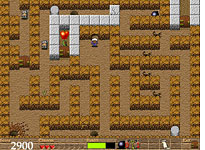
But what precisely are the Islamic games actually like? What do they teach? The only way to know is to play ‘em, and of course none of the pundits who inveighed against them actually did so. So the very cool writer Chris Suellentrop dutifully ordered three games recently discussed in the Washington Post, played them, and described the experience in Slate. It’s a hilarious and valuable piece, not least because he discovers that, far from being evidence of al-Qaeda’s growing digital sophistication, the games seem to prove that “radical Islam dreams not only of restoring the borders of the Caliphate, but also of freezing gaming technology at the level of the old Nintendo Entertainment System.” Heh. (That’s a screenshot from Maze of Destiny, one of the Islamic games, above.) Chris’ best observation, though, comes here:
The fact that these games are derivative, look primitive, and aren’t very fun to play doesn’t mean they’re not important. But they’re also ideologically untroubling. In the Ummah Defense games, the “disbelievers” that must be destroyed are robots, not human soldiers. There’s an outside chance that the robots are a metaphor for the Predator drones used by the United States military, but I doubt these games are going for that level of subtlety. It’s more likely that the robots are a metaphor for Space Invaders.
If you ignore the titles of the Ummah Defense games and the occasional in-game messages — “Alhamdulillah, You Destroyed the Command Ship!” — it’s impossible to tell that you’re playing an “Islamic game.” When I destroyed the third of the four command ships controlling the “Flying Evil Robot Armada” in the first Ummah Defense, I didn’t ruminate on whether my real-life allegiance should be with the robots. I just thought, only one more ship to go!
This is, more precisely, the real point about why point-and-shoot action games suck as tools of indoctrination: Their narratives rarely matter. In an action-shooter game, the real narrative — the one that matters — isn’t the type of uniforms or country you’re fighting; it’s the the physics. The emotional and cognitive content of the game is just about being physically graceful enough to achieve your goals in fast-moving, fast-changing environment — a statement that defines everything Half-Life 2 to football.
The problem with Friedman — and other pundits who don’t play games — is that all they see is what’s happening on the screen. And sure, on the screen, you might be fighting Nazis, or contras, or green-blooded aliens, or the Civil War South. But in the gamer’s mind, it’s all just vectors and motion: After a few hours of playing the game, the external reference points boil away. Talk to chess grandmasters and it’s the same thing. They don’t look down at the board and think, oh, this is a war-like situation in which a powerful queen is defending a hapless, old, past-his-prime king. They just see abstract forces, the platonic interactions of the game’s rule-set. Some masters have told me that they do not even visualize the pieces any more — just the interactions between then.
Action video-games are actually quite similar. A while ago for Slate, I wrote about how Japanese gamers were big fans of the WWII title Medal of Honor: Rising Sun, in which they player takes the role of American forces invading Japan. At first, this struck me as weird, because after all, the kids playing the game were, in essence, joyfully and repeatedly killing virtual representations of their fathers and grandfathers. But that’s not how they saw it at all. It was just “a good war game”, or even more generically, a good game: A bucket of well-designed rules and goals, artfully arranged so as to make success teasingly difficult but not impossible. Like all gamers, they interact with action games on their ludological level — not their narrative and symbolic level.
And that’s why action games don’t work very well as tools of nationalistic indoctrination. They teach excellent eye-hand co-ordination and strategic movement, and they can sometimes be good at desensitizing you so you’ll shoot to kill as a lizard-brain instinct — a nontrivial proposition, which is precisely why the police and military use them with recruits. And you could say that action games have a strong ideological content, insofar as they suggest that killing lots of people is totally okay and wickedly fun.
But when it comes to promoting specific national ideologies? Action video-games are useless. Their narratives simply do not matter; they are not the reason people play them or enjoy them.
(Thanks to Paul Boutin for this one!)
I'm Clive Thompson, the author of Smarter Than You Think: How Technology is Changing Our Minds for the Better (Penguin Press). You can order the book now at Amazon, Barnes and Noble, Powells, Indiebound, or through your local bookstore! I'm also a contributing writer for the New York Times Magazine and a columnist for Wired magazine. Email is here or ping me via the antiquated form of AOL IM (pomeranian99).

ECHO
Erik Weissengruber
Vespaboy
Terri Senft
Tom Igoe
El Rey Del Art
Morgan Noel
Maura Johnston
Cori Eckert
Heather Gold
Andrew Hearst
Chris Allbritton
Bret Dawson
Michele Tepper
Sharyn November
Gail Jaitin
Barnaby Marshall
Frankly, I'd Rather Not
The Shifted Librarian
Ryan Bigge
Nick Denton
Howard Sherman's Nuggets
Serial Deviant
Ellen McDermott
Jeff Liu
Marc Kelsey
Chris Shieh
Iron Monkey
Diversions
Rob Toole
Donut Rock City
Ross Judson
Idle Words
J-Walk Blog
The Antic Muse
Tribblescape
Little Things
Jeff Heer
Abstract Dynamics
Snark Market
Plastic Bag
Sensory Impact
Incoming Signals
MemeFirst
MemoryCard
Majikthise
Ludonauts
Boing Boing
Slashdot
Atrios
Smart Mobs
Plastic
Ludology.org
The Feature
Gizmodo
game girl
Mindjack
Techdirt Wireless News
Corante Gaming blog
Corante Social Software blog
ECHO
SciTech Daily
Arts and Letters Daily
Textually.org
BlogPulse
Robots.net
Alan Reiter's Wireless Data Weblog
Brad DeLong
Viral Marketing Blog
Gameblogs
Slashdot Games

