
« PREVIOUS ENTRY
The ultimate balloon-o-gram
My dad forced me to learn how to golf when I was kid — partly, I think, because he thought it would endow me with a crucial business skill. He worked in the stainless-steel industry, and I suspect more than one deal was consummated over martinis at the 19th hole. Anyway, I spent years trudging around golf courses and gradually learning a respect for this lovely, elegant, and quintessentially insane game. I also discovered that golfers are enormous gearheads, continually obsessed with improving their game via nanoengineered golf-club materials and pseudorandom ball-dimpling reverse-engineered from declassified US military spy-plane technology. This, ultimately, was the final lesson in life that I learned from golf: Everyone loves to work hard at improving their game — but what they love even more is finding a quick cheat that improves their game without requiring any, y’know, work.
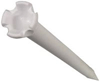
All of which brings me to the subject of this blog post: The epoch-3 — the first bold new re-engineering of the humble golf tee. The inventors explain their innovation on their web site, in prose that wouldn’t be out of place in The Onion …
You’re standing on the first tee. You unsheathe your new $400 driver, engineered with the finest aerospace and structural technology. Then you carefully place the most expensive and technologically sophisticated golf ball ever designed atop its launch pad … a crude wooden spike.
Truth is, there has been no significant performance improvement to the wood golf tee since its commercial introduction in the 1920’s. Its surface imperfections and grain irregularities result in deflection and structural failure at impact, making it an inferior launch platform for modern golf equipment. Environmentally it’s equally archaic, damaging expensive mowing equipment and introducing harmful fungal diseases into the delicate tee box ecosystem. And still there are those who would ask, “Why change the golf tee?” At Evolve Golf we realized it was time someone stopped asking, “Why?” and started asking, “Why not?”
Dare to dream; dare to dream. Anyway, the upshot is that these dudes did some interesting analysis of the physics of how tees interact with golf balls. They concluded that the traditional tee — which touches the ball in a full circle — produces undesirable deflections. The epoch-3, in contrast, touches the ball only in four places, for a smaller contact area. The result, they claim, is that the epoch-3 improves carrying distance by 1.81 yards, increases launch speed by 0.59 mph, and reduces side spin by 51.67 rpm.
It almost makes me want to grab my clubs, pack my briefcase bar, and hit the links.
(Thanks to The Book of Joe for this one!)
I'm Clive Thompson, the author of Smarter Than You Think: How Technology is Changing Our Minds for the Better (Penguin Press). You can order the book now at Amazon, Barnes and Noble, Powells, Indiebound, or through your local bookstore! I'm also a contributing writer for the New York Times Magazine and a columnist for Wired magazine. Email is here or ping me via the antiquated form of AOL IM (pomeranian99).

ECHO
Erik Weissengruber
Vespaboy
Terri Senft
Tom Igoe
El Rey Del Art
Morgan Noel
Maura Johnston
Cori Eckert
Heather Gold
Andrew Hearst
Chris Allbritton
Bret Dawson
Michele Tepper
Sharyn November
Gail Jaitin
Barnaby Marshall
Frankly, I'd Rather Not
The Shifted Librarian
Ryan Bigge
Nick Denton
Howard Sherman's Nuggets
Serial Deviant
Ellen McDermott
Jeff Liu
Marc Kelsey
Chris Shieh
Iron Monkey
Diversions
Rob Toole
Donut Rock City
Ross Judson
Idle Words
J-Walk Blog
The Antic Muse
Tribblescape
Little Things
Jeff Heer
Abstract Dynamics
Snark Market
Plastic Bag
Sensory Impact
Incoming Signals
MemeFirst
MemoryCard
Majikthise
Ludonauts
Boing Boing
Slashdot
Atrios
Smart Mobs
Plastic
Ludology.org
The Feature
Gizmodo
game girl
Mindjack
Techdirt Wireless News
Corante Gaming blog
Corante Social Software blog
ECHO
SciTech Daily
Arts and Letters Daily
Textually.org
BlogPulse
Robots.net
Alan Reiter's Wireless Data Weblog
Brad DeLong
Viral Marketing Blog
Gameblogs
Slashdot Games

