
« PREVIOUS ENTRY
Yeah, but the view is spectacular
NEXT ENTRY »
I’ve now got full-text RSS feeds
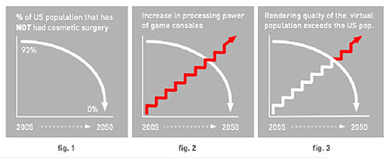
I’ve written in the past about the “Uncanny Valley” — the phenomenon that as computer graphics become more and more lifelike, the characters they create look more and more ghoulish. The problem, as I wrote in Slate last year, is that we humans are good at anthropomorphizing very crudely-drawn figures, such as Charlie Brown or Calvin and Hobbes. We fill in the details and find them cute and cuddly. But when a graphical representation of a human becomes so close to reality that it’s 99% perfect, our attention shifts — and we suddenly start noticing the 1% that isn’t right. Usually it’s something wrong with the face: The eyes look dead, the skin doesn’t move correctly. The characters start looking, quite inadvertantly, like zombies. I sometimes wonder whether computer games and animators will ever get past this hump; maybe we’ll always find nearly-realistic human animations freaky-looking.
Ah, but maybe there’s a much, much weirder solution waiting in the wings. What if people — real people, in real life — stop looking fully realistic, and start looking almost-not-quite-real?
This is the incredibly interesting idea put forward in a new essay by Robert Fabricant, a creative director at Frog Design. He points out that the rise of plastic surgery is producing a new wave of people who look just as surreal as our computerized avatars. As he writes:
It is ironic that, as we perfect the algorithms for simulating facial expressions in 3D software, we are embracing cosmetic treatments that reduce the fidelity and individuality of our own facial expressions. Over the last few years there has been a 20-50% annual increase in the number of minimally-invasive cosmetic procedures (depending on the procedure). And there has been an utter acceptance and celebration of cosmetic surgery in the media with shows like Fox’s “The Swan” and ABC’s “Extreme Makeover.” It is easy to imagine a point in the future when these two trends converge and we all look like Angelina Jolie — errr, Lara Croft.
That chart above is from Fabricant’s essay, and wittily illustrates the merging of these two trends. He also points out lots of other weird mergings of digital and real-life aesthetics, including the Xbox game Yourself!Fitness, in which a hot virtual chick enjoins you to develop a body as perfectly sculpted as hers.
(Thanks to Michele Tepper for this one!)
I'm Clive Thompson, the author of Smarter Than You Think: How Technology is Changing Our Minds for the Better (Penguin Press). You can order the book now at Amazon, Barnes and Noble, Powells, Indiebound, or through your local bookstore! I'm also a contributing writer for the New York Times Magazine and a columnist for Wired magazine. Email is here or ping me via the antiquated form of AOL IM (pomeranian99).
ECHO
Erik Weissengruber
Vespaboy
Terri Senft
Tom Igoe
El Rey Del Art
Morgan Noel
Maura Johnston
Cori Eckert
Heather Gold
Andrew Hearst
Chris Allbritton
Bret Dawson
Michele Tepper
Sharyn November
Gail Jaitin
Barnaby Marshall
Frankly, I'd Rather Not
The Shifted Librarian
Ryan Bigge
Nick Denton
Howard Sherman's Nuggets
Serial Deviant
Ellen McDermott
Jeff Liu
Marc Kelsey
Chris Shieh
Iron Monkey
Diversions
Rob Toole
Donut Rock City
Ross Judson
Idle Words
J-Walk Blog
The Antic Muse
Tribblescape
Little Things
Jeff Heer
Abstract Dynamics
Snark Market
Plastic Bag
Sensory Impact
Incoming Signals
MemeFirst
MemoryCard
Majikthise
Ludonauts
Boing Boing
Slashdot
Atrios
Smart Mobs
Plastic
Ludology.org
The Feature
Gizmodo
game girl
Mindjack
Techdirt Wireless News
Corante Gaming blog
Corante Social Software blog
ECHO
SciTech Daily
Arts and Letters Daily
Textually.org
BlogPulse
Robots.net
Alan Reiter's Wireless Data Weblog
Brad DeLong
Viral Marketing Blog
Gameblogs
Slashdot Games

