
« PREVIOUS ENTRY
The anarchy of airplane boarding
NEXT ENTRY »
Poom!
For years, I’ve been waiting for the advent of location-based applications — apps that use your location as a key data point in delivering services. Up until now, the main appeal of the Internet is that it erases geography; it allowed the model-train freaks and Linux freaks and libertarian freaks and first-edition-of-Spiderman to find one another, no matter where they were located. I remember back in 1996, looking at Yahoo’s original “subject tree” for cyberspace, and realizing that the Internet was organized like the Dewey decimal system. It was a library, not a map.
But now the Internet is penetrating our mobile world — via phones, wifi-hoppin’ laptops, and handhelds. And when you’re on the road, your location is one of the most relevant things about you. Suddenly, it makes a lot of sense to have apps that treat the world not as a Dewey-decimal library, but a map. Mobile-service providers have been babbling for years about how one day you’ll pull out your phone and it’ll tell you where the nearest Italian restaurant or Kinko’s is, but really … who cares. The most genuinely explosive Internet apps have been social: Email, instant messaging, P2P. So I always figured the first truly cool location-based apps would similarly be social.
Sure enough, the first actually popular location-aware tool is Dodgeball, which lets you keep track of your posse while you’re out club-hopping. But though Dodgeball’s great, you have to manually enter your location into the phone. The really wild stuff will happen with phones that are automatically location-aware — as with cell-tower triangulation and GPS.
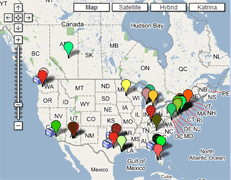
Thus I was really intrigued to hear about Mologogo — a free new app that runs on any GPS-enabled Nextel phone, tracks where you are in real-time, and displays it on a teensy mobile-phone version of Google Maps. For Xtra social fun, you can authorize your friends to track your location, and you theirs. That picture above is a snapshot of random Mologogo users who publicly display their everyday locations.
Unfortunately, it only works on Nextel GPS-and-java-enabled phones. But as more and more phones include GPS, appls like this could create some neato social revolutions. One example? Mologogo was developed by the indomitable Jason Uechi, whose superb mobile-phone apps I’ve blogged about before. He collaborated with another coder he met online, Lemonhead. When they finally got the locationing code running, they pumped in their own co-ordinates, and then, as they recount on their website …
… only then did they realized that they lived in the same town, .0056 longitude and .018 latitude apart. Some would call it fate.
Heh.
I'm Clive Thompson, the author of Smarter Than You Think: How Technology is Changing Our Minds for the Better (Penguin Press). You can order the book now at Amazon, Barnes and Noble, Powells, Indiebound, or through your local bookstore! I'm also a contributing writer for the New York Times Magazine and a columnist for Wired magazine. Email is here or ping me via the antiquated form of AOL IM (pomeranian99).

ECHO
Erik Weissengruber
Vespaboy
Terri Senft
Tom Igoe
El Rey Del Art
Morgan Noel
Maura Johnston
Cori Eckert
Heather Gold
Andrew Hearst
Chris Allbritton
Bret Dawson
Michele Tepper
Sharyn November
Gail Jaitin
Barnaby Marshall
Frankly, I'd Rather Not
The Shifted Librarian
Ryan Bigge
Nick Denton
Howard Sherman's Nuggets
Serial Deviant
Ellen McDermott
Jeff Liu
Marc Kelsey
Chris Shieh
Iron Monkey
Diversions
Rob Toole
Donut Rock City
Ross Judson
Idle Words
J-Walk Blog
The Antic Muse
Tribblescape
Little Things
Jeff Heer
Abstract Dynamics
Snark Market
Plastic Bag
Sensory Impact
Incoming Signals
MemeFirst
MemoryCard
Majikthise
Ludonauts
Boing Boing
Slashdot
Atrios
Smart Mobs
Plastic
Ludology.org
The Feature
Gizmodo
game girl
Mindjack
Techdirt Wireless News
Corante Gaming blog
Corante Social Software blog
ECHO
SciTech Daily
Arts and Letters Daily
Textually.org
BlogPulse
Robots.net
Alan Reiter's Wireless Data Weblog
Brad DeLong
Viral Marketing Blog
Gameblogs
Slashdot Games

