
« PREVIOUS ENTRY
Phonecamming killed the viiiiiiiii-deo star
What’s the fastest way to load people onto an airplane? Certainly not the way that it’s normally done, as any business traveller will attest. They’re all too familiar with the weird inefficiencies of boarding: You dutifully line up on time, but then get backed up by some family that blocks the entire aisle while sitting down; then as soon as you’re finally secure in your aisle seat, your window seat-mate arrives and you have stand up again.
This is why United Airlines has recently announced it will try a new boarding method. As the New York Times reports:
It recently announced a logistics ploy it calls Wilma — shorthand for window-middle-aisle — that it claims will cut boarding times by four to five minutes, an eternity in the industry’s on-time takeoff sweepstakes. The idea is to fill the window seats in economy class first, then the middle seats, then the aisle seats, thereby eliminating the free-for-all chaos that clogs the cabin when passengers are sent in by row numbers.
Judged as a sheer matter of physics, this is an elegant idea. If you think of people as marbles flowing into an empty vessel with gravity on both sides, they’d sort in precisely this fashion.
But no sooner had United announced Wilma than detractors pointed out that this technique has been tried before, by Shuttle by United — and it failed. Why? Because people inevitably behave in erratic ways that thwart your expectations. Under a Wilma system, the people who ought to arrive first are the window-seaters. But all too often they stagger up to the gate late, and wind up having to clamber over their seatmates, and the whole system falls to pieces. Marbles are rational; we’re not.
But what humans are good at is self-sorting anarchy. In a finding that would warm the heart of any libertarian, airplane analysts report that the airline with the single-fastest boarding time is Southwest Airlines — which does not have any seat assignments at all. With Southwest, if someone wants to sit in a window seat (as I invariably do), they have to show up early and get first in line … precisely the result that Wilma is intended to legislate.
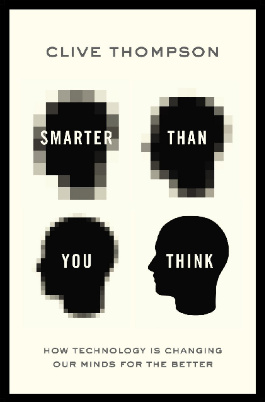
I'm Clive Thompson, the author of Smarter Than You Think: How Technology is Changing Our Minds for the Better (Penguin Press). You can order the book now at Amazon, Barnes and Noble, Powells, Indiebound, or through your local bookstore! I'm also a contributing writer for the New York Times Magazine and a columnist for Wired magazine. Email is here or ping me via the antiquated form of AOL IM (pomeranian99).
ECHO
Erik Weissengruber
Vespaboy
Terri Senft
Tom Igoe
El Rey Del Art
Morgan Noel
Maura Johnston
Cori Eckert
Heather Gold
Andrew Hearst
Chris Allbritton
Bret Dawson
Michele Tepper
Sharyn November
Gail Jaitin
Barnaby Marshall
Frankly, I'd Rather Not
The Shifted Librarian
Ryan Bigge
Nick Denton
Howard Sherman's Nuggets
Serial Deviant
Ellen McDermott
Jeff Liu
Marc Kelsey
Chris Shieh
Iron Monkey
Diversions
Rob Toole
Donut Rock City
Ross Judson
Idle Words
J-Walk Blog
The Antic Muse
Tribblescape
Little Things
Jeff Heer
Abstract Dynamics
Snark Market
Plastic Bag
Sensory Impact
Incoming Signals
MemeFirst
MemoryCard
Majikthise
Ludonauts
Boing Boing
Slashdot
Atrios
Smart Mobs
Plastic
Ludology.org
The Feature
Gizmodo
game girl
Mindjack
Techdirt Wireless News
Corante Gaming blog
Corante Social Software blog
ECHO
SciTech Daily
Arts and Letters Daily
Textually.org
BlogPulse
Robots.net
Alan Reiter's Wireless Data Weblog
Brad DeLong
Viral Marketing Blog
Gameblogs
Slashdot Games

