
« PREVIOUS ENTRY
The glory of the first-person shooter: My latest Wired column
NEXT ENTRY »
Firefly squid!
Everyone knows how college students will try to make themselves sound smarter by reaching for the thesaurus and using big, ponderous words they barely understand. But now a new study shows that readers can see through this. Daniel Oppenheimer, a psychologist at Princeton, took a handful of writing samples and used a thesaurus to replace the simple words with needlessly flowery ones. As the Bad Language blog notes:
He created a “highly complex” version of each original text by replacing each noun, verb and adjective in it with the longest synomym. This is the kind of writing by thesaurus that many business people and techies employ when they want to sound knowledgeable and important or because they think writing like they speak will make them sound lightweight.
Then Oppenheimer gave all the writing samples — the original, simple ones and the modified, flowery ones — to 71 students to evaluate. The result? As the grandiosity and complexity of the language increased, the judges’ estimation of the intelligence of the authors decreased. Oppenheimer wrote up his results in a paper with the gorgeously ironic title “Consequences of Erudite Vernacular Utilized Irrespective of Necessity: Problems with Using Long Words Needlessly.”
His findings make perfect sense when you think about the nature of language. Every sentence and paragraph of writing is an organic whole; a writer’s style is, too. Taking a sentence and swapping in synonyms plucked from a thesaurus is bound to warp the meaning and clarity of a sentence, because synonyms are not mathematical equals: They all have slightly different shadings. Describe someone as “angry” and it means one thing; describe them as “choleric” or “furious” or “splenetic” — all synonyms offered up by Thesaurus.com — and you’re saying something slightly different. When an essay is filled with these sort of swapped-in synonyms, it winds up having Frankensteinian seams: You can feel its cognitive artificiality, its constipated straining to convey a higher meaning. No wonder the judges thought these essays seemed dumber.
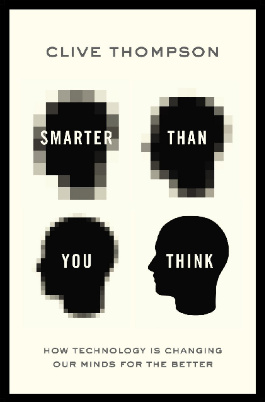
I'm Clive Thompson, the author of Smarter Than You Think: How Technology is Changing Our Minds for the Better (Penguin Press). You can order the book now at Amazon, Barnes and Noble, Powells, Indiebound, or through your local bookstore! I'm also a contributing writer for the New York Times Magazine and a columnist for Wired magazine. Email is here or ping me via the antiquated form of AOL IM (pomeranian99).
ECHO
Erik Weissengruber
Vespaboy
Terri Senft
Tom Igoe
El Rey Del Art
Morgan Noel
Maura Johnston
Cori Eckert
Heather Gold
Andrew Hearst
Chris Allbritton
Bret Dawson
Michele Tepper
Sharyn November
Gail Jaitin
Barnaby Marshall
Frankly, I'd Rather Not
The Shifted Librarian
Ryan Bigge
Nick Denton
Howard Sherman's Nuggets
Serial Deviant
Ellen McDermott
Jeff Liu
Marc Kelsey
Chris Shieh
Iron Monkey
Diversions
Rob Toole
Donut Rock City
Ross Judson
Idle Words
J-Walk Blog
The Antic Muse
Tribblescape
Little Things
Jeff Heer
Abstract Dynamics
Snark Market
Plastic Bag
Sensory Impact
Incoming Signals
MemeFirst
MemoryCard
Majikthise
Ludonauts
Boing Boing
Slashdot
Atrios
Smart Mobs
Plastic
Ludology.org
The Feature
Gizmodo
game girl
Mindjack
Techdirt Wireless News
Corante Gaming blog
Corante Social Software blog
ECHO
SciTech Daily
Arts and Letters Daily
Textually.org
BlogPulse
Robots.net
Alan Reiter's Wireless Data Weblog
Brad DeLong
Viral Marketing Blog
Gameblogs
Slashdot Games

