
« PREVIOUS ENTRY
Microsoft-Excel-generated art!
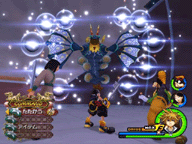
Wired News just published my latest video-game column — and this one is about why we so love “boss battles”. You can read it online at the Wired site, or via the archived copy below!
Who’s the Boss?
On the peculiar allure of the “boss battle”
Clive ThompsonI was barely one hour into playing Kingdom Hearts II, gaming’s latest bona-fide hit, when I encountered the first “boss battle.” It was a three-story tall gray monstrosity — I barely came up to his knee. We lunged about, frantically trading blows, until I finally located his weak spot and plunged my “keyblade” in. Boom: He dissolved into black dust, leaving me with a sore thumb and a system full of adrenaline.
And the curious sense of satisfaction that comes from a boss battle. They’re among the most cherished tropes in gaming: Get a bunch of gamers together to talk about adventure games or action titles, and sure — everyone will praise the wonderful characters, the superb graphics, the intriguing narrative. But it’s the boss battles that leave scars on their souls. They wind up sounding like grizzled war veterans, reminiscing wild-eyed about facing The Flood in Halo, four-armed Goro in Mortal Kombat or even Bowser in Super Mario Bros. Bosses dominate the psychic landscape of games.
It’s partly because a boss battle is the most mythopoeic part of gaming. An adventure game, after all, typically puts you on some dread quest in which the foes get bigger and nastier until you face one final, hellish climactic baddie. This is a pure apocalyptic narrative — the same story line that has obsessed the West for millennia, from the Bible to Das Kapital to the Epic of Gilgamesh. Boss battles make games seem cosmic.
But personally, I think the allure is much more straightforward than that, and also, in its own way, more complex. We love boss battles because they represent game design at its purest and trickiest.
Every game has to strike a careful balance: It has to be teasingly difficult, but not overly frustrating. But when the boss battle comes along, the game is supposed to become suddenly more difficult. That makes the balance all the harder to strike.
“The really good bosses seem impossible at first — but they provide incremental clues to weaken them,” said Ian Bogost, a game-design theorist at the Georgia Institute of Technology, when I called him about the subject. “That’s where the sense of mastery comes from. A good boss has to kill you a few times first. It has to be arduous, physically and mentally.” His favorite villians were the overlords in Legend of Zelda: The Wind Waker, partly because their gargantuan size came as a thrilling shock after the hobbit-like proportions of everyone else in the rest of the game.
The danger, of course, is a game that goes too far: Nothing grinds a game to a halt more than a boss that is hair-pulling impossible to kill. Such was the case when Luke Smith — a friend of mine who works at 1UP — took a band of high-level World of Warcraft characters to battle with C’Thun, a squid-like creature that spawns endless “flay eyes” and “claw tentacles”. “For months it was improperly tuned, literally unkillable,” Smith ranted. “You simply could not put out the damage required to kill everything before the fight spiraled out of control. It kept spawning, and you never caught up.”
With an overly-fierce boss, nothing you’ve learned in the game seems to work — which makes you think, I slogged through weeks of this game only to be repaid with this?
The well-tuned boss vibrates in perfect harmony with the skill level of the game. Tom Byron, the editor in chief of the Official US PlayStation Magazine, told me his favorite boss was the vizier at the end of Prince of Persia: The Two Thrones. “He’s flying up in the air, and whipping these stones down at you — so you need to use literally all of the prince’s acrobatics that you’ve learned. You’re doing all these wall-runs, and there are fireballs, like, everywhere,” Bryon gushed. “It’s just awesome!”
That’s the key: A good boss demands you to call upon every technique you’ve painstakingly learned over hours of play — each special jump and magic combos. In Kingdom Hearts II, for example, I’d played around a bit with the different settings for Donald Duck’s magic-healing ability (boy, that’s a weird sentence) — but I’d never understood how important it was to tweak it until I faced down the Hydra, and was getting flayed alive by its seven heads.
It’s like bosses are the SATs of the game world: “It’s a culmination,” Byron notes. “It’s not asking you to suddenly learn new skills. It’s asking you to remember everything you’ve learned.” You’re aiming for that “aha” moment when, desperate for some way to topple the boss, you suddenly hit upon a clever new way to apply your powers — and the insurmountable becomes manageable.
That’s one of the best feelings ever — and it’s also one we rarely get in everyday life. The enemies we face in our contemporary world are so much more ambiguous and internal, and half the time it’s ourselves. We try to find a meaningful job, to hack through a bad relationship, to blunder through the red tape of money and taxes. Even our modern literature of struggle has been blunted. The Greeks and Romans imagined their lives through metaphors of heroes facing down arcane monsters; we read The Corrections or Indecision or A Heartbreaking Work of Staggering Genius, tales of neurotics struggling just to get out of bed.
Our enemies are nowhere, and everywhere. Targets of resistance melt away in all directions. Terrorists seem frightening only so long as they elude the authorities. Death creeps slowly in hospital wards. And so, perhaps, it’s a comfort to see our fears rear up in an honest-to-god monstrosity. Bring it on.
I'm Clive Thompson, the author of Smarter Than You Think: How Technology is Changing Our Minds for the Better (Penguin Press). You can order the book now at Amazon, Barnes and Noble, Powells, Indiebound, or through your local bookstore! I'm also a contributing writer for the New York Times Magazine and a columnist for Wired magazine. Email is here or ping me via the antiquated form of AOL IM (pomeranian99).
ECHO
Erik Weissengruber
Vespaboy
Terri Senft
Tom Igoe
El Rey Del Art
Morgan Noel
Maura Johnston
Cori Eckert
Heather Gold
Andrew Hearst
Chris Allbritton
Bret Dawson
Michele Tepper
Sharyn November
Gail Jaitin
Barnaby Marshall
Frankly, I'd Rather Not
The Shifted Librarian
Ryan Bigge
Nick Denton
Howard Sherman's Nuggets
Serial Deviant
Ellen McDermott
Jeff Liu
Marc Kelsey
Chris Shieh
Iron Monkey
Diversions
Rob Toole
Donut Rock City
Ross Judson
Idle Words
J-Walk Blog
The Antic Muse
Tribblescape
Little Things
Jeff Heer
Abstract Dynamics
Snark Market
Plastic Bag
Sensory Impact
Incoming Signals
MemeFirst
MemoryCard
Majikthise
Ludonauts
Boing Boing
Slashdot
Atrios
Smart Mobs
Plastic
Ludology.org
The Feature
Gizmodo
game girl
Mindjack
Techdirt Wireless News
Corante Gaming blog
Corante Social Software blog
ECHO
SciTech Daily
Arts and Letters Daily
Textually.org
BlogPulse
Robots.net
Alan Reiter's Wireless Data Weblog
Brad DeLong
Viral Marketing Blog
Gameblogs
Slashdot Games

