
« PREVIOUS ENTRY
The allure of the “boss battle”: My latest Wired News gaming column
NEXT ENTRY »
Plasma Pong: A game of pong played in a plasma field
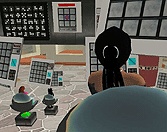
Many neophyte game-designers cut their teeth by doing a simple reskinning of Tetris — the same gameplay, but with differently shaped objects falling. Kermitt Quirk did something much cooler: He created a Tetris knockoff called Tringo, and released it inside the video-game-world Second Life. It became such an enormous hit there that Quirk is now bringing the game to the real world: This week, it’ll be released as a Game Boy Advance cartridge. That’s right — a game was prototyped inside virtual reality before making it out to “real” reality.
Man, there are so many weird and wonderful layers to this. First off, it makes sense a that virtual online world would be a terrific place for a game designer to create new, simple “casual” games — because the very fabric of reality can be reshaped to create experiences. It’s super-quick and cheap to knock out a new game, and you have a population of thousands who can beta-test it. Indeed, Tringo was such a hit in Second Life that Quirk made $4,000 in real-world money by selling copies of the game to Second Life citizens so they could run it in the privacy of their own virtual Second Life homes. As Wagner James Au — the journalist “embedded” in Second Life — reported last year:
An indication of its success is not just found in the number of Tringo-related events (which on some days make up more than 25% of total events), but in the vertiable subculture of Tringo groups Residents have started up. There are at least 21 of them now, with names like Tringo Busters, Tringo Sluts, and Tringo Zombies. In essence, they’re analagous to gamer clans and informal leagues, started up by enthusiasts of the game. [snip]
… Tringo [even] has its share of Resident detractors, who believe the game has come to overwhelm their society.
In a testament to its influence, Jinny Fonzarelli, a British Philosophy/Theology student and Resident who runs Thinkers, a group devoted to discussing political and metaphysical topics, now plans to dedicate an upcoming debate to “The Tringoization of Society”. Which would be, if you like, a cultural debate held within a game about the mini-game that’s beginning to impact the community of the larger game.
Wheels within wheels! Above, that’s a picture of people playing Tringo inside Second Life.
Anyway, the point is — Tringo’s really good. If you’ve ever found yourself bored with Tetris, it’s genuinely new form of play. Instead trying to slot falling bricks in place, you simply place the bricks downwards on a chess-board-like grid. The goal is still the same: You have to clear the screen by fitting clumps of bricks together in perfectly intersecting ways. But whereas Tetris has six bricks, Tringo has 15. This greatly increases the complexity of the game — but interestingly, not so much that the average person cannot quickly figure it out. This is the essence of truly superb game design: To create set of rules and goals that are easy to learn, but virtually impossible to master. (You can go to the publisher’s web site and play it for free yourself.)
Another lovely detail: While Quirk sold the real-world rights to Crave Entertainment, he retained the in-game rights for Tringo as it’s played in Second Life.
(Thanks to Gamasutra for this one!)
I'm Clive Thompson, the author of Smarter Than You Think: How Technology is Changing Our Minds for the Better (Penguin Press). You can order the book now at Amazon, Barnes and Noble, Powells, Indiebound, or through your local bookstore! I'm also a contributing writer for the New York Times Magazine and a columnist for Wired magazine. Email is here or ping me via the antiquated form of AOL IM (pomeranian99).

ECHO
Erik Weissengruber
Vespaboy
Terri Senft
Tom Igoe
El Rey Del Art
Morgan Noel
Maura Johnston
Cori Eckert
Heather Gold
Andrew Hearst
Chris Allbritton
Bret Dawson
Michele Tepper
Sharyn November
Gail Jaitin
Barnaby Marshall
Frankly, I'd Rather Not
The Shifted Librarian
Ryan Bigge
Nick Denton
Howard Sherman's Nuggets
Serial Deviant
Ellen McDermott
Jeff Liu
Marc Kelsey
Chris Shieh
Iron Monkey
Diversions
Rob Toole
Donut Rock City
Ross Judson
Idle Words
J-Walk Blog
The Antic Muse
Tribblescape
Little Things
Jeff Heer
Abstract Dynamics
Snark Market
Plastic Bag
Sensory Impact
Incoming Signals
MemeFirst
MemoryCard
Majikthise
Ludonauts
Boing Boing
Slashdot
Atrios
Smart Mobs
Plastic
Ludology.org
The Feature
Gizmodo
game girl
Mindjack
Techdirt Wireless News
Corante Gaming blog
Corante Social Software blog
ECHO
SciTech Daily
Arts and Letters Daily
Textually.org
BlogPulse
Robots.net
Alan Reiter's Wireless Data Weblog
Brad DeLong
Viral Marketing Blog
Gameblogs
Slashdot Games

