Why interactive websites can create false memories
Can an interactive web site produce false memories?
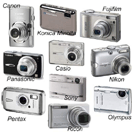
Possibly so, according to a fascinating paper to be published this month in the Journal of Consumer Research by Ann Schlosser, a business professor at the University of Washington. Schlosser performed an intriguing experiment: She took two groups of people and had them check out two different web sites devoted to the same digital camera. One site included static pictures; the other was interactive, allowing users to play around with a virtual version of the product.
Later, she tested them on their ability to recall details about the camera. She intentionally included details that were false, but sufficiently plausible that they might have been true. The result? The people who viewed the interactive demo of the camera were much more likely than the folks who'd only viewed static images to "remember" the false details as being present. Or another way of putting it: The interactive demo was more likely to produce false memories of the product -- potential buyers who thought the camera could do things it can't.
Why? Schlosser theorizees that it's partly because interactivity encourages more "certainty" in our memories, and thus increases the likelihood that we'll believe suggestively false details to be true. And, as she concludes:
These findings suggest that marketing managers should test their campaigns for both true and false memories. Although it may seem advantageous for consumers to believe that a product has features that it actually does not have (e.g., by increasing store visits and purchases), it may ultimately lead to customer dissatisfaction. Because false memories reflect source-monitoring errors—or believing that absent attributes were actually presented in the marketing campaign—consumers who discover that the product does not have these attributes will likely feel misled by the company.
One interesting thing Schlosser points out is that market-research folks almost never study the false-memory effects of advertising. Sure, they test to see whether consumers who've looked at promotional material can recall true information about a product. But they rarely check to see whether the consumers also remember false information. An interesting -- if telling -- elision, eh?
This also makes me wonder about whether other virtual-reality environments, such as simulation video games, can create false pools of knowledge. This is a potentially a big deal for the "serious games" folks, because many of them create brilliant little simulations as a way of educating people about complex situations. Cool enough! But what if they these sims also unintentionally impart bogus knowledge -- making the gamers feel so artificially sure of the complex system that they attribute properties to it that don't exist?
Interesting stuff to think about, either way.
Posted by Clive Thompson at December 05, 2006 10:43 PM
Trackback Pings
TrackBack URL for this entry: http://www.collisiondetection.net/mt3/mt-tb.cgi/1595
Of course games impart bogus information! That's the whole point, really. If the scripted actions and reaction programming are really good, the aliens/zombies/nazis you're shooting at seem to have a tactical awareness of their environment: they appear to be smart enough to use teamwork or take cover, thus making the game more realistic and immersive. Another way is the animated interactions of Sims or Spores or whatnot… there's an astounding amount of [bogus] information that programmers/animators intend a player to receive by way of observing the anthropomorphized "behaviors" of the "creatures."
Really, this goes back to Eliza ("I really was talking to a real therapist!") and Disney's illusion of life.
Posted by: Enrique at December 6, 2006 8:29 AM
Sure, totally, I understand that regular video games impart tons of bogus information. They have aliens with green blood in them, after all, heh.
What I'm wondering about are the "serious games", which try to use sims to impart real, accurate information about complex real systems -- political, historic, whatever. In those situations, a mechanic that imparts false memories -- or inadvertant false knowledge -- would be really problematic.
Posted by: Clive at December 6, 2006 9:49 AM
Perhaps I'm misreading, but weren't the false memories suggested by the recall test rather than the interactive demo? If they did a free recall (i.e., asked to recall all the features they could with no prompting, rather then ticking yes or no on a list of possible features) and still exhibited more false memories, that would make the conclusion more clear. As it stands, it seems that the interactive demo makes them more open to the later implantation of false memories.
(And isn't it possible that the people who did the interactive demo were just more overwhelmed with sensory input that they are more apt to say, yeah, maybe that sounds familiar, maybe that feature was a part of that massive torrent I was trying to assimilate? What if they compared a data-sparse site with a data-rich site, where both are either interactive or not?)
There's plenty of interest here; I'm just not sure the conclusions follow from the findings, and it's a big step from being more susceptible to probes that create false memories to actually creating false memories during the interactive task.
Posted by: Jake at December 6, 2006 11:41 AM
Also, you're essentially "playing" when you use an interactive website. Whereas w/ static shots, you have no chocie but to learn about the product.
the one advantage, i'd guess, with the interactive site, is that -- and this is just a guess -- but i'd bet that the people, on average, spent longer studying the camera than did the people staring at static shots.
Thus, the lesson that should probably be learned here is that the interactive sites have a higher ceiling for knowledge but for BS as well.
Posted by: JohnBarleycorn at December 8, 2006 11:00 PM
Posted by: Dan Lockton at December 10, 2006 8:51 AM
Of course the models in the serious games will be incomplete, if not erroneous or outright tendentious; models are. Is your worry that players will give too much credence to the results of models experienced as games, or that players will 'remember' things that didn't even happen in the model?
The former is a fair problem, but not related to the advertising experiment. The latter is interesting... my narrativium tells me that players will invent things that satisfy *their* narrativium.
Posted by: clew at January 5, 2007 4:27 PM
Really interesting experiment. The human mind is really simple to manipulate if you know how to do it. Marketing companies could really easily mislead people in such a way using interactive websites.
Posted by: Alex Collins at March 18, 2007 4:51 PM
Post a comment
Of course games impart bogus information! That's the whole point, really. If the scripted actions and reaction programming are really good, the aliens/zombies/nazis you're shooting at seem to have a tactical awareness of their environment: they appear to be smart enough to use teamwork or take cover, thus making the game more realistic and immersive. Another way is the animated interactions of Sims or Spores or whatnot… there's an astounding amount of [bogus] information that programmers/animators intend a player to receive by way of observing the anthropomorphized "behaviors" of the "creatures."
Really, this goes back to Eliza ("I really was talking to a real therapist!") and Disney's illusion of life.
Posted by: Enrique
at December 6, 2006 8:29 AM
Sure, totally, I understand that regular video games impart tons of bogus information. They have aliens with green blood in them, after all, heh.
What I'm wondering about are the "serious games", which try to use sims to impart real, accurate information about complex real systems -- political, historic, whatever. In those situations, a mechanic that imparts false memories -- or inadvertant false knowledge -- would be really problematic.
Posted by: Clive
at December 6, 2006 9:49 AM
Perhaps I'm misreading, but weren't the false memories suggested by the recall test rather than the interactive demo? If they did a free recall (i.e., asked to recall all the features they could with no prompting, rather then ticking yes or no on a list of possible features) and still exhibited more false memories, that would make the conclusion more clear. As it stands, it seems that the interactive demo makes them more open to the later implantation of false memories.
(And isn't it possible that the people who did the interactive demo were just more overwhelmed with sensory input that they are more apt to say, yeah, maybe that sounds familiar, maybe that feature was a part of that massive torrent I was trying to assimilate? What if they compared a data-sparse site with a data-rich site, where both are either interactive or not?)
There's plenty of interest here; I'm just not sure the conclusions follow from the findings, and it's a big step from being more susceptible to probes that create false memories to actually creating false memories during the interactive task.
Posted by: Jake
at December 6, 2006 11:41 AM
Also, you're essentially "playing" when you use an interactive website. Whereas w/ static shots, you have no chocie but to learn about the product.
the one advantage, i'd guess, with the interactive site, is that -- and this is just a guess -- but i'd bet that the people, on average, spent longer studying the camera than did the people staring at static shots.
Thus, the lesson that should probably be learned here is that the interactive sites have a higher ceiling for knowledge but for BS as well.
Posted by: JohnBarleycorn
at December 8, 2006 11:00 PM
Manual trackback - http://architectures.danlockton.co.uk/2006/12/08/creating-false-memories/
Posted by: Dan Lockton
at December 10, 2006 8:51 AM
Of course the models in the serious games will be incomplete, if not erroneous or outright tendentious; models are. Is your worry that players will give too much credence to the results of models experienced as games, or that players will 'remember' things that didn't even happen in the model?
The former is a fair problem, but not related to the advertising experiment. The latter is interesting... my narrativium tells me that players will invent things that satisfy *their* narrativium.
Posted by: clew
at January 5, 2007 4:27 PM
Really interesting experiment. The human mind is really simple to manipulate if you know how to do it. Marketing companies could really easily mislead people in such a way using interactive websites.
Posted by: Alex Collins
at March 18, 2007 4:51 PM